Vizsla

- Origin
- Hungary
- Type
- Gundog
- Size
- Medium
- Height
- 53–64 cm (21–25 in)
- Weight
- 18–30 kg (40–66 lb)
- Coat
- Short, smooth and dense, with no undercoat
- Colors
- Golden russet
- Life span
- About 13.5 years
- Status
- Recognised by the FCI, AKC and The Kennel Club
The Vizsla is a short-coated pointing dog from Hungary. It was bred, and is still used, to hunt, point and retrieve game on land and in water, and it has long doubled as a household companion.
History
The first written reference to the Vizsla is in the Illustrated Vienna Chronicle, prepared in 1357 on the order of King Louis I of Hungary.
The breed has come close to extinction more than once. In the 1800s it was nearly swamped by English Pointers and German Shorthaired Pointers. After World War II a search of Hungary and a poll of its sportsmen turned up only about a dozen Vizslas of the true type, and the breed was rebuilt from that small stock.
Vizslas began to reach the United States at the end of World War II. Owners formed the Vizsla Club of America, and on 25 November 1960 the Vizsla became the 115th breed recognized by the American Kennel Club. In Britain it is among the 50 most popular breeds, with about 4,520 puppies registered with The Kennel Club each year, and a Vizsla won Best in Show at Crufts in 2010.
Appearance
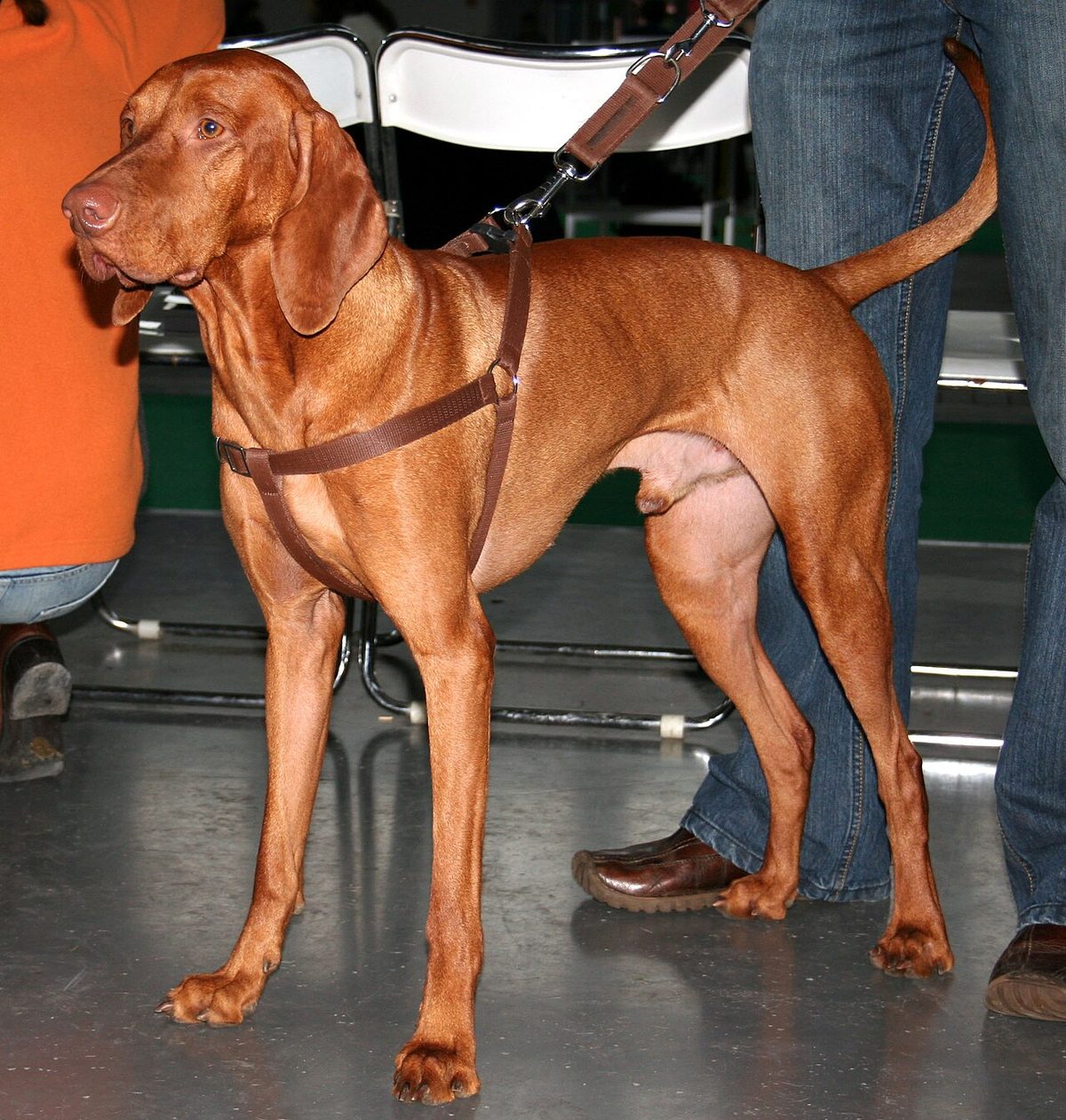
The Vizsla is a medium-sized dog, robust but lightly built, lean and clearly muscled.
The coat is short, smooth, dense and close-lying, with no woolly undercoat. Its color is described as russet gold, copper or dark sandy gold. Dark mahogany red and pale yellow are faults, and small white marks on the chest, neck or tail are allowed but not wanted. The nose is reddish and blends with the coat, as do the eyes and nails.
Males weigh 20–30 kg (45–66 lb) and females 18–25 kg (40–55 lb). The American standard calls for the tail to be docked to two thirds of its length; The Kennel Club’s standard accepts docked or natural tails.
Temperament
Vizslas are lively, gentle, affectionate and sensitive, and also fearless, with a well-developed protective instinct. They are trainable but can be spoiled by harsh handling. They want attention, exercise and company, and they need plenty to occupy their minds when young. Left alone for long hours, they can become bored and destructive. With socialization and training they can be very good with children. They like to stay close to their owners, to the point of sleeping under the bedcovers.
Care and health
The short coat is easy to keep. Dirt brushes off once dry, the dog has little odor and rarely needs a bath. It does shed all year, so regular brushing helps. With no undercoat, the Vizsla is not suited to living outdoors.
A 2024 UK study found a life expectancy of 13.5 years. The breed is considered robust, but inherited problems have appeared in some lines: epilepsy, cancers (mast cell tumors, hemangiosarcoma and lymphoma), sebaceous adenitis and, very rarely, hip dysplasia. Vizslas can also suffer from hypothyroidism, dwarfism, heart defects, progressive retinal atrophy, skin and food allergies, and bleeding disorders such as hemophilia A and von Willebrand’s disease.
Facts on this page were checked against Wikipedia and may have changed since.