Magyar Agár
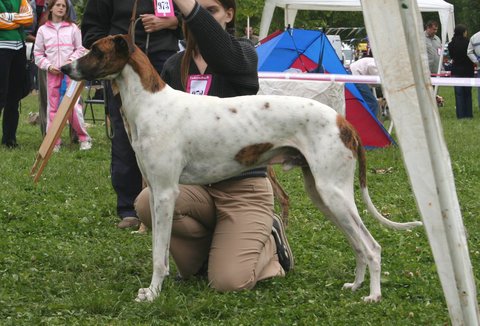

- Origin
- Hungary
- Type
- Sighthound
- Size
- Large
- Height
- 62–70 cm (24–28 in)
- Weight
- 22–31 kg (49–68 lb)
- Coat
- Short, dense and smooth
- Colors
- Any color except black and tan, blue and tricolor
- Life span
- 12–14 years
- Status
- Recognised by the FCI
The Magyar Agár is a sighthound from Hungary and from lands that once belonged to the Austro-Hungarian Empire, such as Transylvania. It is used for hunting and coursing and is also kept as a companion. It is often called the Hungarian Greyhound, though it is a distinct breed and not a Greyhound.
History
These dogs probably came with the Magyars to the Carpathian Basin and Transylvania in the 10th century. Tradition places their arrival in northeastern Hungary and the Great Hungarian Plain a little over a thousand years ago. The oldest archeological evidence comes from the Carpathian Mountains along Hungary’s northern and eastern border. It is not known whether the dogs were there before the Magyars.
The breed has a strong hunting history in the counties of Szabolcs-Szatmár-Bereg, Hajdú-Bihar and Somogy. It was bred to run long distances and to catch hare or deer shot by mounted hunters in open country. Hungarians say it was expected to keep up with the riders for 30 to 50 km a day. Ownership was not limited to the nobility, although the nobles’ dogs were much bigger. The smaller dogs kept by peasants, known as Farm Agárs or Hare Catchers, are now extinct.
The breed’s build stayed the same from the Middle Ages until Greyhounds were crossed in during the 19th and early 20th centuries. How much Greyhound influence is desirable is still argued among European breeders: some prefer the older, robust type and others a lighter, faster dog.
Appearance
The Magyar Agár is elegant but rugged. It is longer than it is tall and heavier in bone than a Greyhound. The head is more wedge-shaped, with strong jaw muscles and a shorter muzzle. The ears are rose-shaped and half raised, and the eyes are oval with a bright, gentle expression.
Males stand 65–70 cm and females 62–67 cm, and the dogs weigh 22 to 31 kg. The skin is thick, and the short, dense, smooth coat grows a little longer in winter, so the breed copes with cold better than some other short-coated sighthounds. It comes in many colors.
It is slower than a Greyhound over a short sprint but has more endurance over long distances.
Temperament
This is an affectionate, docile dog. It is unlikely to snap at people, yet has a stronger guarding instinct than some other sighthounds. It is usually good with children and other dogs, somewhat reserved without being shy, and intelligent, faithful and easy to train. It can live with cats and small animals if introduced and supervised properly, but it will tend to chase anything that looks like prey.
Care and health
Magyar Agárs adapt to apartments or outdoor kennels as long as they get exercise and company, and they are easy to housebreak. They sleep much of the day but need daily exercise. Long walks, free running and trotting beside a bicycle suit them best, as they are seldom keen on chasing a ball. The average lifespan is 12 to 14 years.
Facts on this page were checked against Wikipedia and may have changed since.