English Springer Spaniel
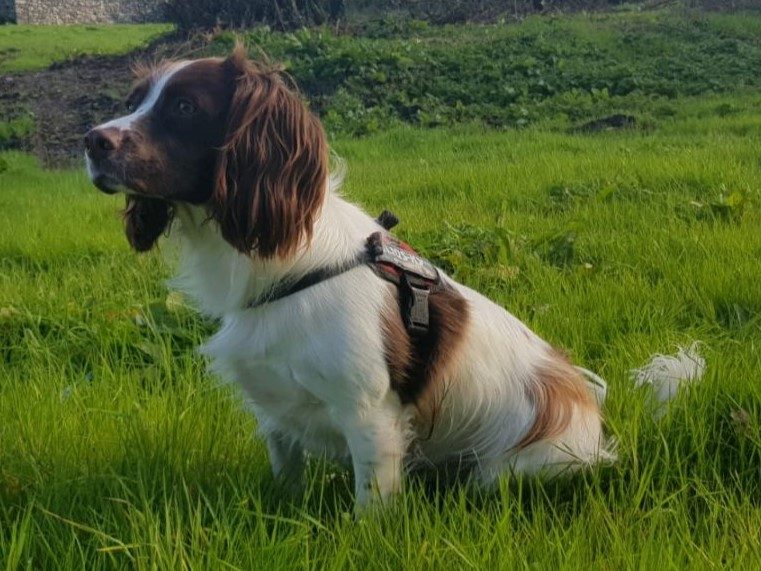

- Origin
- England
- Type
- Gundog
- Size
- Medium
- Height
- 46–53 cm (18–21 in)
- Weight
- 16–27 kg (35–60 lb)
- Coat
- Moderately long, with feathering on the legs and tail
- Colors
- Black or liver with white, blue or liver roan, or tricolor
- Life span
- 12–13 years
- Status
- Recognised by the FCI, AKC and The Kennel Club
The English Springer Spaniel is a medium-sized gundog traditionally used to flush game from cover and retrieve it. It descends from the Norfolk and Shropshire spaniels of the mid-19th century and is closely related to the Welsh Springer Spaniel and, more closely still, to the English Cocker Spaniel.
History
Spaniels were described in England as early as 1576, in John Caius’s Treatise of Englishe Dogs. By 1801 Sydenham Edwards proposed dividing the land spaniel into two kinds: the springing or hawking spaniel, and the cocking spaniel. For a long time both came from the same litters. The smaller pups were used on woodcock, while their bigger littermates “sprang” game birds into the air for a trained hawk or falcon.
During the 19th century two strains of larger land spaniel, the Norfolk and the Shropshire, were seen as the true springer type, and by the 1850s they were shown as Norfolk spaniels. In 1902 The Kennel Club recognised the English Springer Spaniel as a breed, and the American Kennel Club followed in 1910.
Appearance
The Springer is compact and well balanced, with a gentle expression. Show-line males stand about 48 to 53 cm (19 to 21 in) and weigh 18 to 27 kg (40 to 60 lb); females stand 46 to 51 cm (18 to 20 in) and usually weigh 16 to 25 kg (35 to 55 lb).
Few breeds are as sharply divided between working and show lines. The two have been bred apart for at least 70 years and can look like different breeds, though they share a registry. Field-bred dogs are wiry and lighter, with shorter, coarser coats and less pendulous ears. Show dogs are heavier-boned with longer coats, longer ears, dewlaps and hanging flews.
The coat is black or liver with white, mainly white with black or liver markings, blue or liver roan, or tricolor with tan on the eyebrows, cheeks, inside the ears and under the tail. White areas may be flecked with ticking. Compared with the English Cocker, the Springer is bigger, with shorter, higher-set ears, a longer muzzle and a less abundant coat.
Temperament
Field-bred Springers are chosen for their nose, hunting ability and response to training. The same qualities have made the breed a widely used detection dog, searching for explosives, drugs and much else, from bumblebee nests to the hospital superbug C. difficile. Springers also work with mountain and lowland rescue teams, where their willingness and ability to cover rough ground are valued.
Care and health
Springers shed mainly in spring and summer. UK studies have found a life expectancy of 11.9 to 13.5 years. Cancer was the most common cause of death in a UK breed club survey. The breed is predisposed to hip dysplasia, to a severe form of chronic hepatitis that tends to strike younger dogs and females, and to skin and ear conditions including otitis externa, Malassezia dermatitis, primary seborrhea, intertrigo and acral mutilation syndrome.
Facts on this page were checked against Wikipedia and may have changed since.