English Cocker Spaniel
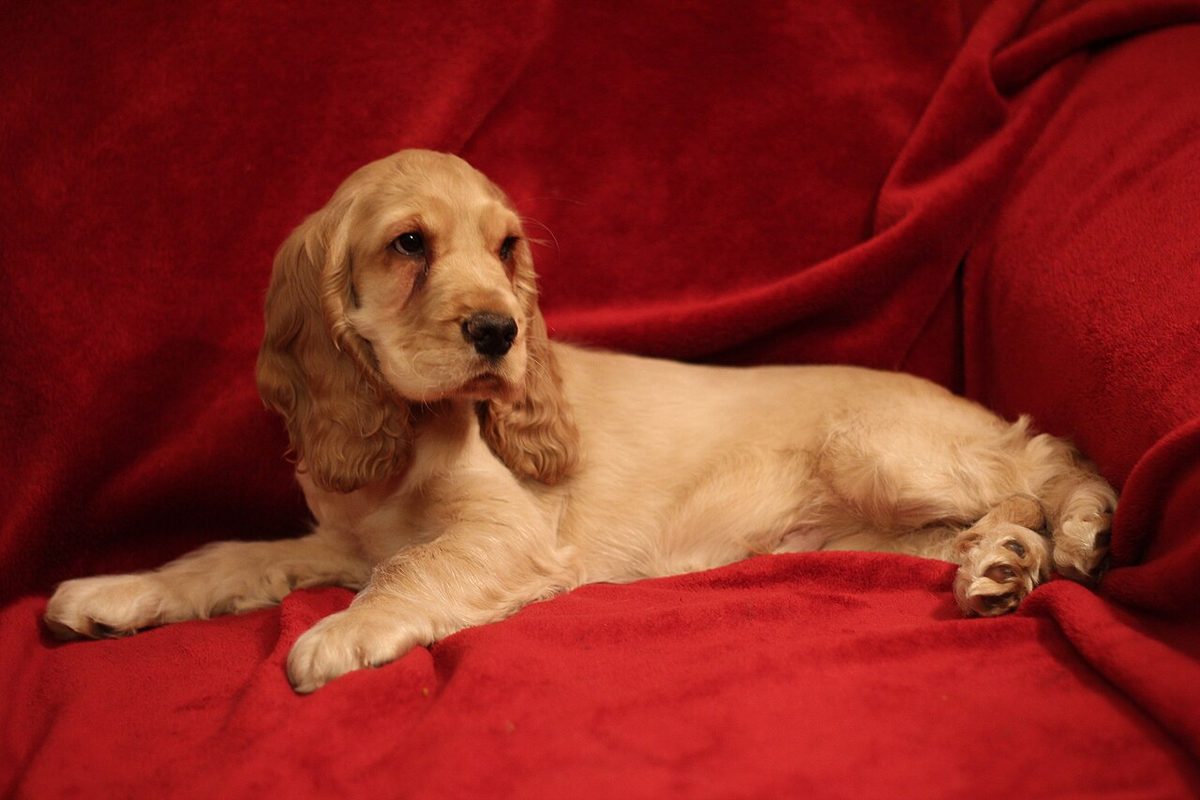

- Origin
- England
- Type
- Gundog
- Size
- Medium
- Height
- 38–41 cm (15–16 in)
- Weight
- 13–14.5 kg (29–32 lb)
- Colors
- Solid black, liver or red/golden; roans, ticked and parti-colors with white
- Life span
- 11–13 years
- Status
- Recognised by the FCI, AKC and The Kennel Club
The English Cocker Spaniel is a compact, active and good-natured gundog from England. The word “cocker” comes from the woodcock the dogs were used to flush. Outside the United States the breed is usually just called the Cocker Spaniel, and its ever-wagging tail has earned it the nickname “Merry Spaniel”. It is the foundation of the smaller American Cocker Spaniel.
History
Spaniel-type dogs have appeared in art and writing for nearly 500 years. In England they were first divided simply into land spaniels and water spaniels, and the separate breeds known today only began to emerge in the mid-19th century, when land spaniels were sorted by weight. An 1840 source gives Cockers as 5.5 to 9 kg (12 to 20 lb). Cockers and Springers could then come from the same litter. The early spaniels were used to drive game toward the guns, not to retrieve it.
When the Kennel Club published its first stud books in 1874, any spaniel under 11 kg (25 lb) went into the Cocker breeding pool. The Spaniel Club, formed in 1885, wrote separate standards for the Springer and the Cocker, and the Kennel Club divided the two eight years later. Since then they have been bred apart and now differ in much more than weight.
In the United States the English and American types were shown together until 1936, and the American Kennel Club gave the English Cocker its own breed designation in 1946.
The breed has won Best in Show at Crufts seven times, more than any other, most recently in 1996.
Appearance
The English Cocker is sturdy, compact and well balanced, with an alert, intelligent expression. The eyes are dark, and the long, lobe-shaped ears reach a little past the tip of the nose when drawn forward. Males stand 39 to 41 cm (15.5 to 16 in) at the withers and females 38 to 39 cm (15 to 15.5 in); both weigh about 13 to 14.5 kg (29 to 32 lb). Compared with the English Springer Spaniel, the Cocker is smaller, with longer, lower-set ears, a shorter muzzle and a fuller coat.
Solid colors are black, liver and red or golden; in these the Kennel Club standard allows only a little white on the chest. Parti-colors include blue, liver, orange and lemon roan, ticked coats, and black, liver, orange or lemon with white. Sable is rare and debated, and plain white dogs are seldom born and not encouraged.
Dogs from working lines look noticeably different from show-bred dogs. Tails are customarily docked in North America; docking is illegal in Australia and South Africa, and in England and Wales it is allowed only for proven working dogs.
Temperament
This is a friendly breed that wants to be with people and is not suited to being left alone in a yard. With early socialization it gets along well with children, other dogs and other pets. Cockers can be upset by loud noise and rough handling, and respond best to kind, reward-based training, which brings out a happy, obedient and affectionate companion. The breed ranks 18th in Stanley Coren’s The Intelligence of Dogs.
Some studies have reported more aggression in English Cockers than in other dogs, including a 2009 Spanish study of dogs referred to a behavior clinic. The idea of a “cocker rage”, however, has been dismissed as a myth.
Care and health
Studies in the United Kingdom have put life expectancy at 11.3 years (2022) and 13.3 years (2024), and an Italian study in 2024 found 13 years.
In a review of 2,318 English Cockers seen by vets, the most common problems were periodontal disease (about 21%), outer ear infection (10%), obesity (10%) and anal sac impaction (8%). The breed is predisposed to chronic hepatitis, and is among those more often affected by progressive rod-cone degeneration, an inherited eye disease caused by a recessive mutation in the PRCD gene.
Facts on this page were checked against Wikipedia and may have changed since.