Kuvasz

- Origin
- Hungary
- Type
- Livestock guardian
- Size
- Large
- Height
- 66–76 cm (26–30 in)
- Weight
- 37–62 kg (82–137 lb)
- Coat
- Thick, coarse and wavy, with a soft undercoat
- Colors
- White or ivory-white
- Life span
- 12–14 years
- Status
- Recognised by the FCI and AKC
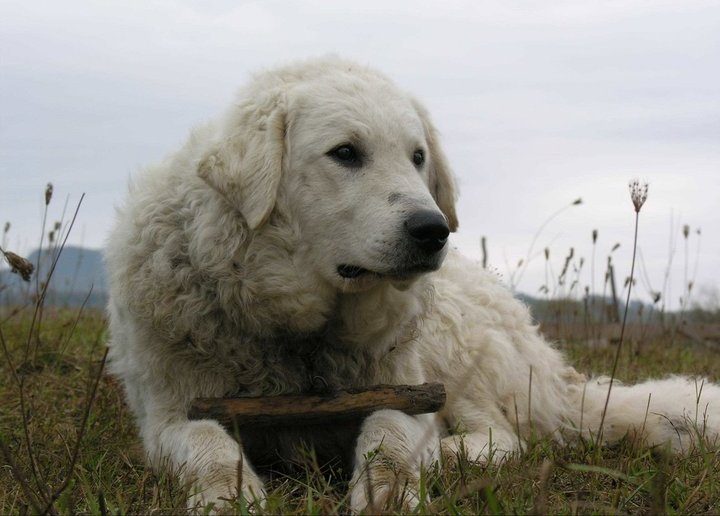
The Kuvasz is a large white flock guardian dog from Hungary, mentioned in old Hungarian texts. It has guarded livestock and served as a royal guard dog, and over the last seventy years it has increasingly been kept as a pet.
History
The Kuvasz originated in the Carpathian Basin. Its name probably comes from an Old Turkish word, and the breed may have been brought to Hungary during the Migration Period; some link it with the Cuman-Kipchaks. It is related to the Akbash of western Anatolia.
In the 15th century King Matthias Corvinus is believed to have kept large numbers of Kuvasz at his court as guard dogs, hunting dogs and sometimes war dogs. Selective breeding began in the later 19th century, when a standard was drawn up. The FCI accepted the breed in 1934 and gives 1954 as the date of full acceptance. The American Kennel Club places it in the working group.
By the end of World War II nearly every Kuvasz in Hungary had been killed. The dogs were known for defending their families, and German and Soviet soldiers sought them out and shot them, though some German officers took dogs home. Fewer than thirty were left in the country after the war, and by some accounts as few as twelve. Breeders have since rebuilt the population. Because the remaining gene pool was so small, it is thought that some may have used other breeds, such as the Great Pyrenees, to carry on.
In Romania the law requires a Kuvasz to be muzzled in public places.
Appearance
The Kuvasz is a large, powerful dog. Males stand 71–76 cm at the withers and weigh 48–62 kg; females stand 66–70 cm and weigh 37–50 kg. The coat is white or ivory-white, thick and coarse, with a soft undercoat. The skin is slate-gray. The nose, lips and eye rims are black, and the paw pads black or slate-gray. The head is wedge-shaped, with a slight stop and a muzzle a little under half the length of the head. The eyes are almond-shaped, dark brown and slightly slanted.
Care and health
The Kuvasz is generally healthy and robust and can be expected to live about 12–14 years. It is prone to developmental bone problems.
Facts on this page were checked against Wikipedia and may have changed since.