English Pointer
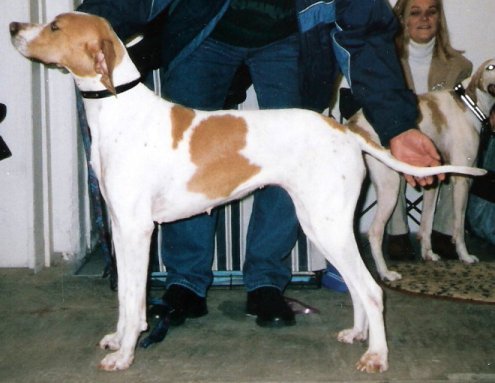

- Origin
- England
- Type
- Gundog
- Size
- Large
- Height
- 61–69 cm (24–27 in)
- Weight
- 20–34 kg (45–75 lb)
- Coat
- Short, fine, hard and smooth
- Colors
- White with lemon, orange, liver or black patches; tricolor and solid colors are rare
- Life span
- 13–14 years
- Status
- Recognised by the FCI and The Kennel Club
The English Pointer, known in its home country simply as the Pointer, is an athletic gundog developed in England to find game for hunters. Its name comes from the stance it takes when it scents hidden game: it stops dead with its nose aimed at the spot. Unlike most hunting breeds, its job is to point, not to retrieve.
History
The breed’s ancestry has long been argued over. The most common view is that it descends from Old Spanish Pointers brought to England, by popular account in 1713 with soldiers returning from Spain. Other early sources point to Portuguese, Italian or French pointing dogs, and a less widely held idea is that a pointing dog had been used in England since medieval times to find hares for greyhounds or hawks.
Early Pointers were heavy, slow dogs that would hold a point while the hunter readied his gun. They were crossed with setters, bloodhounds and foxhounds. As firearms improved through the 18th and 19th centuries, hunters wanted faster dogs, and Greyhound blood was added more and more. This produced the finer modern dog with its tucked-up loin, tight lips and low-set tail. The breed standard was formally adopted in 1936 and has changed little since.
Appearance
The Pointer is built for both speed and endurance. The Kennel Club standard asks for males of 64 to 69 cm (25 to 27 in) and females of 61 to 66 cm (24 to 26 in). Males weigh 25 to 34 kg (55 to 75 lb) and females 20 to 29 kg (45 to 65 lb).
The head is distinctive, with a slightly dished face, a raised nose, wide nostrils and a pronounced brow. The ears are set high, hang close to the face and come to a slight point.
The coat is short, fine, hard and smooth. Most Pointers are white with patches of lemon, orange, liver or black; tricolored and solid-colored dogs are rare. Show-bred dogs have come to differ from working lines, with narrower chests, more exaggerated heads and less muscle.
Temperament
The Pointer is adaptable, obedient and even-tempered, and dogs from field lines can be extremely active. Compared with other gundogs it is more aloof and has less need for human company, which may come from the Greyhound in its background.
In the field it ranges back and forth ahead of the hunter with its head high, scenting the air. It is the most popular pointing breed on sporting estates in the United Kingdom and on commercial shooting preserves in the United States.
Care and health
The short, fine coat suits summer work on grouse moors but leaves the dog quick to feel the cold in wet, chilly weather.
The Pointer is considered a generally healthy breed, with a life expectancy of 13 to 14 years. Inherited conditions found in the breed include hip dysplasia, elbow dysplasia, patella luxation, hereditary sensory neuropathy, spinal muscle atrophy, X-linked cerebellar ataxia and deafness. It also has minor predispositions to hypothyroidism, demodicosis, cataracts, retinal dysplasia and corneal dystrophy.
Facts on this page were checked against Wikipedia and may have changed since.