Pumi
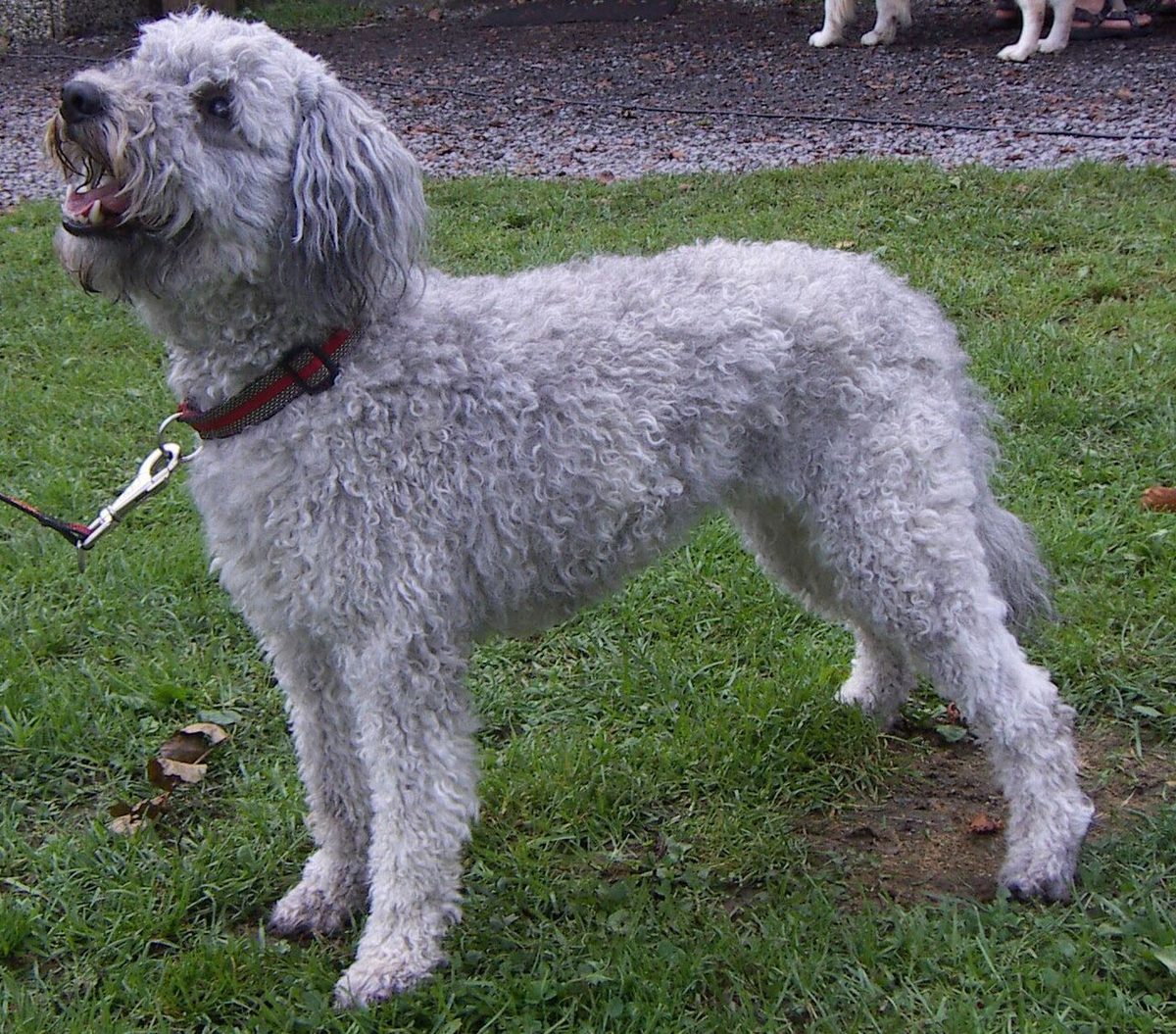

- Origin
- Hungary
- Type
- Herding
- Size
- Medium
- Height
- 38–47 cm (15–19 in)
- Weight
- 8–15 kg (18–33 lb)
- Coat
- Wavy and curly, dense double coat
- Colors
- Gray, black, white or fawn
- Life span
- 12–14 years
- Status
- Recognised by the FCI, AKC and The Kennel Club
The Pumi is a medium-small sheepdog from Hungary. It works close to the stock, especially sheep, gathering and driving them with quick movement, barking and the odd nip. It has a long, tapered muzzle, tufted ears and a tail curled over its back. Because it is quick, alert, lean and square in build, some call it the Hungarian herding terrier.
History
The Pumi arose in the seventeenth and eighteenth centuries, when Hungarian Pulis were crossed with German spitz dogs, French Briards and terriers of some kind. Nobody planned it; the type developed on its own. Small Pyrenean dogs that arrived with imported Merino sheep in the eighteenth century probably added to the mix and gave a shorter, curlier coat.
The name was first used in 1815, the date of the first known drawing of a Pumi. For a long time Pumi and Puli were used almost interchangeably, and many regarded the Pumi as a regional variety of the Puli. A first distinction between them was published in 1902. In 1921 Emil Raitsits wrote a separate standard for the Pumi, calling it a sheepdog terrier, and by 1927 the two breeds were officially separate. The FCI approved the standard in 1935.
Both world wars cut numbers badly. Breeding resumed after 1956, and Pumis were exported to Finland in 1973, Sweden in 1985 and the United States in the early 1990s. The American Kennel Club fully recognized the breed in 2016 as its 190th breed, and The Kennel Club accepted a standard in 2015. In 2016 the Hungarian government named the Pumi one of its eight native breeds. Most working sheepdogs in Hungary today are Pumis.
Appearance
The Pumi is a square, lightly built dog that looks bigger than it is because of its coat. Males stand 41–47 cm (16–19 in) and weigh 10–15 kg (22–33 lb); females stand 38–44 cm (15–17 in) and weigh 8–13 kg (18–29 lb). The head is long and narrow with a barely visible stop, and the eyes are small, dark and slightly slanted. The ears are set high and carried half upright, with longer hair than the body.
The coat is curly, 4–7 cm long, with a harsh topcoat over a soft undercoat. Gray is the most common color. Gray Pumis are born black and start to lighten at six to eight weeks. Black, white and fawn with a darker mask are also accepted.
Temperament
The Pumi is alert, expressive, bold and rather vocal. It is intelligent and easy to train, and it can be protective and stubborn. It stays playful as an adult, which, along with its ears, has earned it the Hungarian nickname the clown. Pumis are good with children and other animals when raised with them, and early socializing matters. Without enough to do they may dig, bark or try to herd people.
Care and health
A Pumi needs plenty of exercise and work for its mind, such as herding, agility or obedience. The coat keeps growing and sheds little or not at all. It is combed every few weeks and trimmed every two to four months, or it will mat.
Pumis typically live 12 to 14 years. Hip dysplasia is probably the most common problem, and patellar luxation also occurs. Breeders test for degenerative myelopathy and primary lens luxation, though neither is common.
Facts on this page were checked against Wikipedia and may have changed since.