English Setter
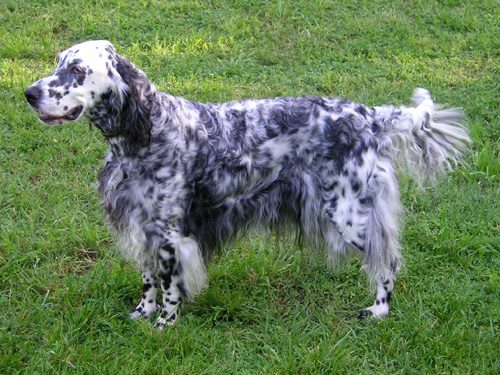

- Origin
- England
- Type
- Gundog
- Size
- Large
- Height
- 61–69 cm (24–27 in)
- Coat
- Flat and silky, with long feathering on the ears, chest, belly, legs and tail
- Colors
- White with black, orange, lemon or liver flecks (belton), or tricolor
- Life span
- 10–13 years
- Status
- Recognised by the FCI, AKC and The Kennel Club
The English Setter is an elegant gundog from England, one of the setter family along with the Irish, Irish Red and White and Gordon Setters. Its mostly white coat is flecked with color, a pattern called belton, and hangs in silky fringes. It was bred to find game birds such as quail, pheasant and grouse and to freeze in front of them rather than chase.
History
Setting dogs have worked in England for more than 400 years, and the type is thought to have come from crosses of the Spanish Pointer, a large water spaniel and the English Springer Spaniel. The dog ranged silently over open country with its head high, caught the scent of birds on the air and stopped in a crouch, or set. Hunters at first followed up with hawks, later with nets, and from the mid-1600s with guns. By the 17th century setters were widespread on British estates.
The modern breed owes its look to Edward Laverack (1800–1877), who built his strain from a pair named Ponto and Old Moll bought around 1826, and to Richard Purcell Llewellin (1840–1925), who crossed Laverack’s best dogs with other bloodlines. Laverack Setter and Llewellin Setter are names for dogs of those strains, not separate breeds. The first Laverack dog reached America in 1874. When the American Kennel Club was founded in 1878, the first dog it registered was an English Setter named Adonis.
In the United Kingdom the breed was most popular from the 1960s to the 1980s. Registrations have since fallen so far that the Kennel Club has placed it on its list of Vulnerable Native Breeds. It remains well represented in Italy as a working gundog.
Appearance
Females stand about 61 cm and males up to 69 cm. The head is slightly domed with a deep muzzle and dark, gentle eyes, and the ears hang in a neat fold. The neck is long and muscular, the chest deep, the hindquarters strong, and the tail is carried level with the back.
The body coat is short to medium in length, flat and silky, with long feathering on the ears, neck, chest, belly, the backs of the legs and the tail. The ground color is white with flecks spread all over the body: black (blue belton), orange, lemon or liver, or tricolor, which adds tan on the face, chest and legs. Laverack coined the word belton, after a village in the far north of England. Dogs from field lines are often smaller and finer, with less feathering and bolder spotting than show dogs.
Temperament
The breed is often called a gentleman by nature. English Setters are friendly, people-loving dogs that enjoy visitors and are especially happy with children, though dogs from working lines can be strong-willed and mischievous. They are energetic outdoors and calm in the house. They are intelligent but not always easy to train, because birds distract them, and they are sensitive, so praise and treats work better than criticism.
Care and health
English Setters need plenty of exercise, up to two hours a day. The long coat of show-type dogs needs regular grooming, while the shorter field coat needs less. A 2024 UK study found a life expectancy of 13.1 years, and an Italian study 10 years.
Conditions known in the breed include congenital deafness, found in 12.4 percent of 701 dogs tested in one study, autoimmune thyroiditis, hypothyroidism, elbow dysplasia, allergies and atopic dermatitis.
Facts on this page were checked against Wikipedia and may have changed since.