Red Wolf

- Origin
- United States
- Type
- Wild canid
- Weight
- 20–39 kg (44–86 lb)
- Coat
- Sparse compared with the gray wolf's
- Colors
- Tawny to grayish, often reddish; sometimes black
- Status
- Critically Endangered (IUCN)
The red wolf (Canis rufus) is a wild canid native to the southeastern United States. In size it falls between the coyote and the gray wolf. Whether it is a species in its own right has been argued over for nearly a century: it has also been treated as a subspecies of the gray wolf and as a wolf and coyote hybrid. The American Society of Mammalogists considered it a separate species in 2021.
Range and habitat
The red wolf once ranged across the southeastern United States to the Atlantic and Gulf coasts, north to the Ohio River Valley and central Pennsylvania, and west to southeastern Missouri and central Texas.
The last natural population lived in coastal prairie marshes, swamps and rice and cotton fields on the Gulf Coast, though there is evidence that the species was once most numerous in the bottomland river forests and swamps of the Southeast. Red wolves appear to be generalists that can live wherever there is enough prey and little persecution.
Appearance
Adults measure 136–165 cm (54–65 in) in length, including a tail of about 37 cm (15 in), and weigh 20–39 kg (44–86 lb). Males average 29 kg (64 lb) and females 25 kg (55 lb).
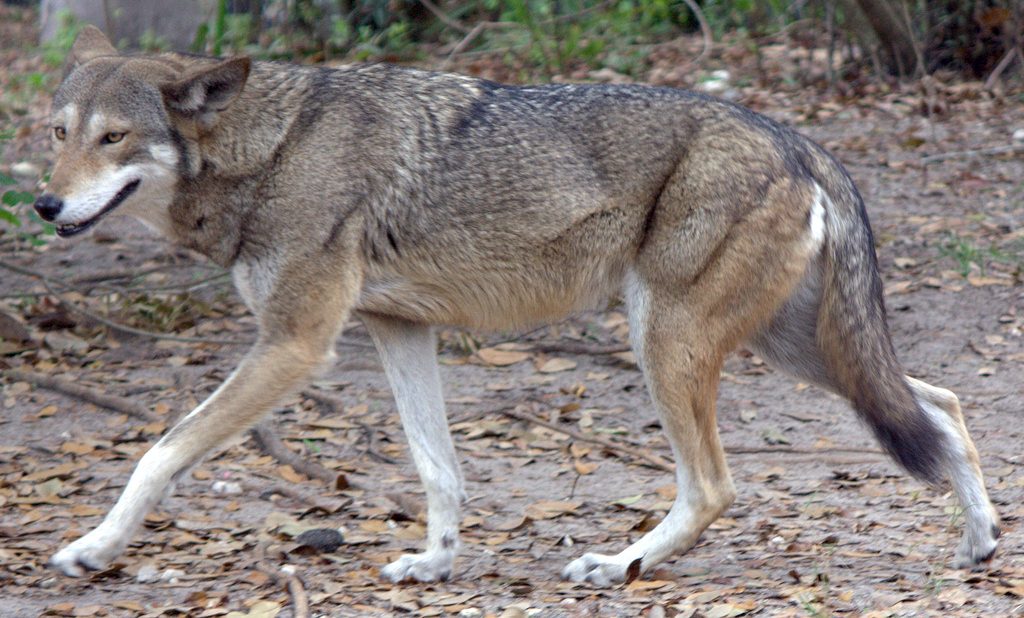
The coat is usually tawny to grayish with light markings around the lips and eyes, and is typically redder and thinner than that of a coyote or gray wolf. Black individuals occur. The legs are long and slender, the ears proportionately larger than a coyote’s or gray wolf’s, and the skull narrow with a long, slim muzzle.
Behavior
The red wolf is more sociable than the coyote but less so than the gray wolf. Pairs are monogamous and both parents raise the young. Mating takes place in January and February, and litters averaging six or seven pups are born from March to May in dens made in hollow trees, stream banks or the abandoned burrows of other animals. Pups reach full size at a year old.
Before the species vanished from the wild its diet was rabbits, rodents and nutria. The restored population also takes white-tailed deer, pigs, raccoons, rice rats, muskrats and carrion.
Conservation
Predator control, habitat loss and widespread interbreeding with coyotes had brought the red wolf close to extinction by the mid-1900s. By the late 1960s only small numbers remained on the Gulf Coast of western Louisiana and eastern Texas. The US Fish and Wildlife Service listed it as endangered in 1973 and captured about 400 wild canids there by 1980. Only 14 proved to be pure red wolves able to breed, and these founded the captive population at Point Defiance Zoo in Tacoma, Washington.
The species was declared extinct in the wild in 1980. In 1987 captive-bred wolves were released in the Alligator River National Wildlife Refuge in northeastern North Carolina. That population grew to as many as 100–120 by 2012, then fell steeply, to about 8 by October 2021, a decline linked to shooting and poisoning and to suspended conservation work.
The IUCN listed the red wolf as critically endangered in 1996. As of August 2026 the wild population was estimated at 22–23 adults and subadults with 14–15 pups, and about 295 wolves were held in the captive breeding program.
Facts on this page were checked against Wikipedia and may have changed since.