Grey Wolf

- Origin
- Eurasia and North America
- Type
- Wild canid
- Size
- Large
- Height
- 80–85 cm (31–33 in)
- Weight
- 12–79 kg (26–175 lb), 40 kg (88 lb) on average
- Coat
- Dense winter fur with a short undercoat and long, coarse guard hairs
- Colors
- Mottled white, brown, gray and black; nearly white in the Arctic
- Status
- Least Concern (IUCN)
The grey wolf (Canis lupus), often simply called the wolf, is a wild canine native to Eurasia and North America and the largest living wild member of the dog family. More than thirty subspecies have been recognized. It is closely related to the domestic dog: genetic studies suggest that dogs and modern wolves descend from a common ancestral wolf population.
Range and habitat
Wolves once lived across Eurasia and North America. Persecution by people, driven by attacks on livestock and fear of attacks on humans, has cut that range to about a third of what it was. The wolf has disappeared from much of Western Europe, the United States and Mexico, and it is extinct in the British Isles and Japan. Today it lives mostly in wilderness and remote areas, from sea level to about 3,000 m (9,800 ft). The wild population is estimated at 300,000.
Appearance
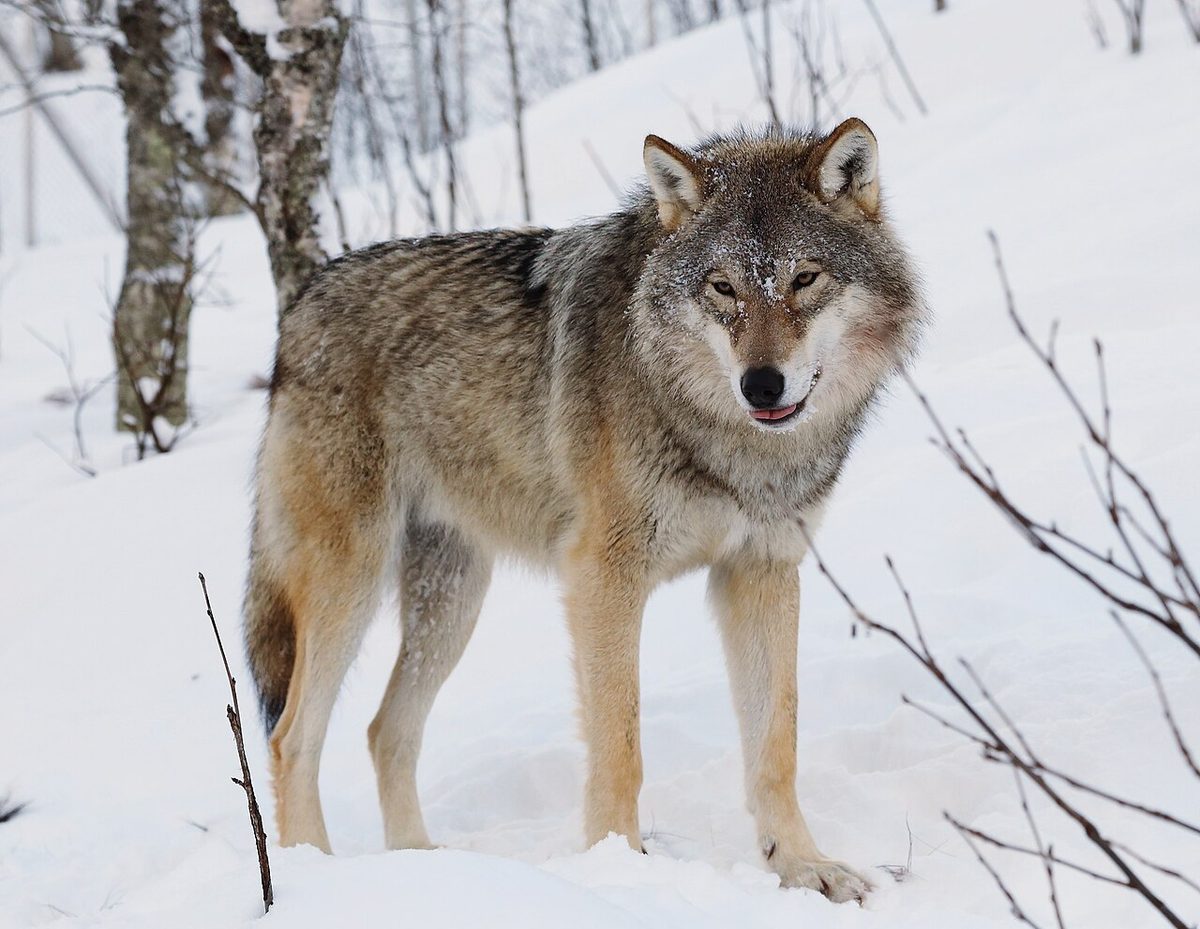
The wolf is slender but powerfully built, with a deep rib cage, a sloping back and a heavily muscled neck. Compared with coyotes and jackals it has a broader snout, shorter ears, a shorter body and a longer tail. Its legs are fairly long, which helps it move quickly and cope with deep snow.
Adults measure 105–160 cm (41–63 in) in length and stand 80–85 cm (31–33 in) at the shoulder. Wolves grow larger the farther north they live. The average weight is 40 kg (88 lb); the smallest wolf on record weighed 12 kg and the largest 79.4 kg. Females are a few kilograms lighter than males.
The winter fur is very dense, with a short undercoat and long, coarse guard hairs, and it keeps out severe cold. Most wolves are a mix of white, brown, gray and black. Wolves of the Canadian Arctic are white, and black wolves are common in parts of the Rocky Mountains; the black coat in North America came from interbreeding with dogs long ago.
Behavior
Of all the members of its genus, the wolf is the one most specialized for hunting large prey together. It lives and travels in family groups made up of a mated pair and their young. The young may leave to found their own packs once they are sexually mature or when food is short. Wolves communicate with a wide range of expressive behavior, including howling alone or as a group. They hold territories, and fights over territory are among the main causes of death.
The wolf is an apex predator that feeds mainly on hoofed mammals. In Eurasia these are mostly moose, red deer, roe deer and wild boar; in North America, elk, moose, caribou, white-tailed deer and mule deer. It picks out vulnerable animals. It also eats rodents, hares, waterfowl and their eggs, some fruit and berries, and carrion when food is scarce. Where wild prey is lacking, as in parts of Eurasia with many people, wolves depend more on livestock and garbage.
Wolves and people
Wolves have been hunted in most herding communities because they take livestock, and respected in some farming and hunter-gatherer societies. Attacks on people are rare, and most recorded attacks have been put down to rabid animals.
Facts on this page were checked against Wikipedia and may have changed since.