Golden Jackal

- Origin
- Eurasia
- Type
- Wild canid
- Size
- Medium
- Height
- 45–50 cm (18–20 in)
- Weight
- 6–14 kg (13–31 lb)
- Coat
- Coarse and fairly short
- Colors
- Golden, from pale creamy yellow in summer to dark tawny in winter
- Status
- Least Concern (IUCN)
The golden jackal (Canis aureus), also called the common jackal, is a wolf-like wild canid native to Eurasia. Despite its name, it is not closely related to the black-backed and side-striped jackals of Africa. It stands closer to wolves and coyotes, and it can produce fertile hybrids with the gray wolf, the African wolf and the domestic dog. There are six subspecies.
Range and habitat
Golden jackals live in Europe and in Southwest, Central, South and Southeast Asia. Genetic studies point to India as the center from which the species spread, around 20,000 years ago, toward the end of the last ice age. Jackals were missing from most of Europe until the 19th century. They then spread slowly, and much faster toward the end of the 20th century. They are now moving from southeastern Europe into central Europe as far as France and the Baltic region, mostly into areas with few or no wolves.
The species is abundant in valleys and along rivers, canals, lakes and seashores, and rare in foothills and low mountains. It can withstand temperatures down to −25 °C (−13 °F), though it is not adapted to snow and has to follow paths made by larger animals or people.
Appearance
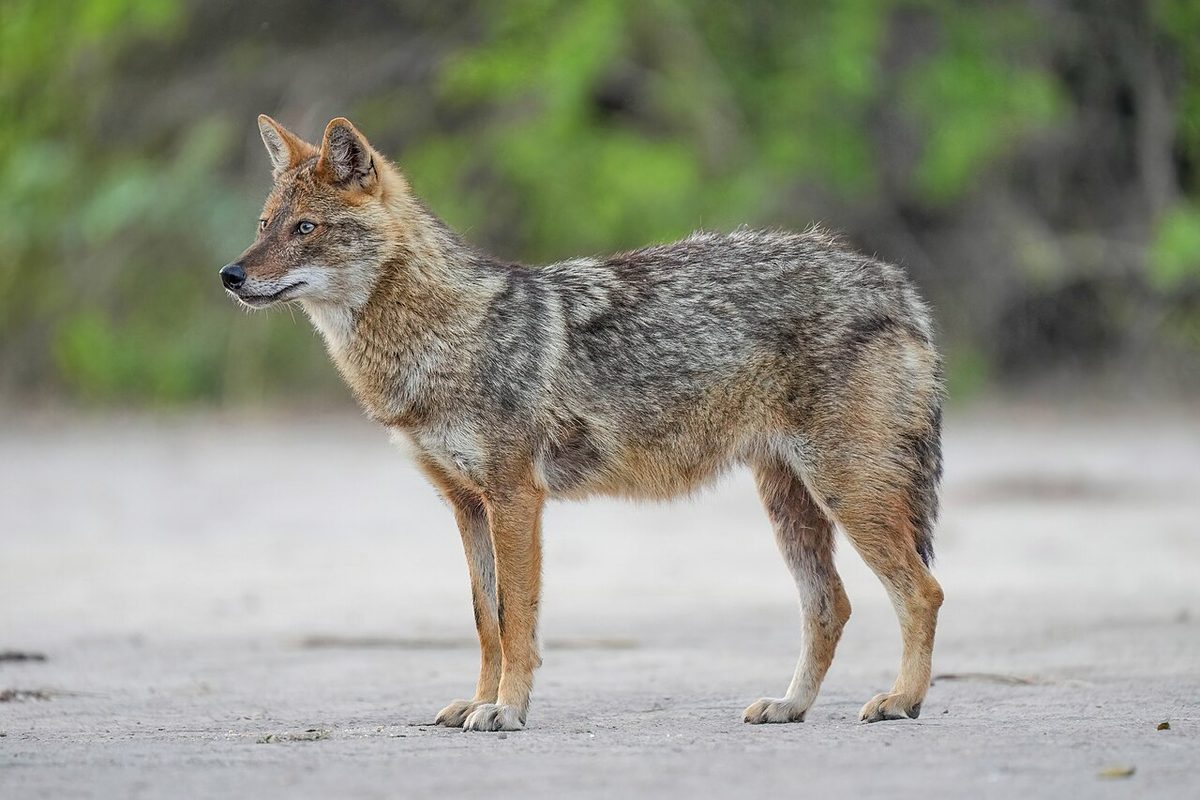
The golden jackal looks like a small gray wolf, but it is lighter, with a longer torso, shorter legs and tail, a less prominent forehead and a narrower, more pointed muzzle. Males measure 71–85 cm (28–33 in) in body length and weigh 6–14 kg (13–31 lb). Females measure 69–73 cm (27–29 in) and weigh 7–11 kg (15–24 lb). Both stand 45–50 cm (18–20 in) at the shoulder.
The fur is coarse and fairly short. Its base color is golden, shifting with the seasons from pale creamy yellow to dark tawny. Black, brown and white hairs are mixed on the back, and the underparts are pale ginger to cream. The bushy tail has a tan to black tip. Jackals molt twice a year, in spring and in fall.
Behavior
The basic social unit is a breeding pair, sometimes with its current litter of pups, and family groups of four or five have been recorded. Social life is flexible and depends on how much food is available. Home ranges vary from 1 to 20 square km, and a jackal may travel 12–15 km (7.5–9.3 miles) in a night. Jackals howl in groups, most often between December and April when pairs form and breed.
The golden jackal is both hunter and scavenger, and fills much the same role in Eurasia as the coyote does in North America. Its diet changes with place and season and includes rodents, hares, birds, reptiles, insects, fruit, carrion and garbage. It also takes poultry and young livestock and can damage grape, melon and nut crops.
Wolves dominate jackals, and jackals leave an area when a wolf pack arrives. Jackals in turn dominate red foxes, which keep to the edges of jackal territory. Some jackals carry diseases and parasites that can affect people and domestic animals, including rabies.
Facts on this page were checked against Wikipedia and may have changed since.