Olde English Bulldogge
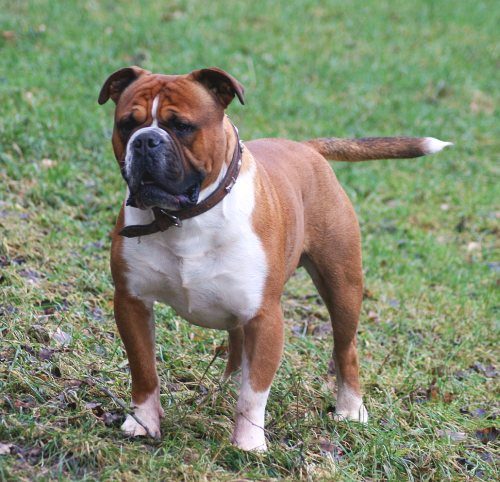

- Origin
- United States
- Type
- Mastiff
- Size
- Medium
- Height
- 41–51 cm (16–20 in)
- Weight
- 23–36 kg (50–80 lb)
- Coat
- Short
- Colors
- Brindle or solid colors, with or without white
- Status
- Recognised by the UKC
The Olde English Bulldogge is an American breed, created in the 1970s as an attempt to bring back the look, health and athleticism of the bulldogs that were used for bull baiting in England until 1835, but with a much gentler character. The United Kennel Club recognises it and places it in its Guardian Dog Group.
History
David Leavitt of Coatesville, Pennsylvania, began the project in 1971. To reach his goal quickly he followed a line breeding scheme designed for cattle by Dr. Nathan Fechimer of Ohio State University. The foundation crosses were one-half Bulldog, one-sixth American Bulldog, one-sixth Bullmastiff and one-sixth other breeds. After many planned matings the dogs began to breed true.
Leavitt set up the Olde English Bulldogge Association to keep the stud book. In the 1980s Ben and Karen Campetti of Massachusetts worked closely with him. He stopped breeding in 1993 and handed over the registry and his dogs. The Olde English Bulldogge Kennel Club was formed in 2001, and the two registries merged in 2005.
In August 2008 the breed was enrolled with the Canine Developmental, Health and Performance Registry so that it could be assessed for United Kennel Club recognition. Full recognition came on 1 January 2014.
In 2004 Leavitt renamed his own line the Leavitt Bulldog, to set it apart from the dogs of other breeders. The UKC registers Leavitt Bulldogs as Olde English Bulldogges.
Appearance
This is a muscular, medium-sized dog of great strength that moves with fluid agility. It should look able to work in heat or cold without any trouble breathing, and excessive wrinkle is a serious fault. Males weigh 27–36 kg (60–80 lb) and stand 43–51 cm (17–20 in) at the withers. Females weigh 23–32 kg (50–70 lb) and stand 41–48 cm (16–19 in).
The skull is large, with a clear furrow between the eyes. The muzzle is square, wide and deep, and the bite undershot. The nose is broad and black with wide nostrils. The eyes are almond-shaped, brown and set wide and low. The ears are small and set high, and the rose ear is preferred. The body is sturdy and slightly rectangular with a wide, deep chest and well-muscled hind legs.
Accepted colors are brindle and solid colors, with or without white.
Temperament
The breed was developed to have a friendly temperament, far less aggressive than the bull-baiting dogs it was modeled on.
Care and health
The Olde English Bulldogge may be healthier than many modern bulldog breeds, though it can suffer from the same disorders as any dog. It was bred for fewer health problems and a lifespan reaching into the teens. Researchers have named it as a possible outcross for restoring genetic diversity to the Bulldog, and Swiss breeders used it with the Bulldog to create the Continental Bulldog.
Facts on this page were checked against Wikipedia and may have changed since.