Grey Fox
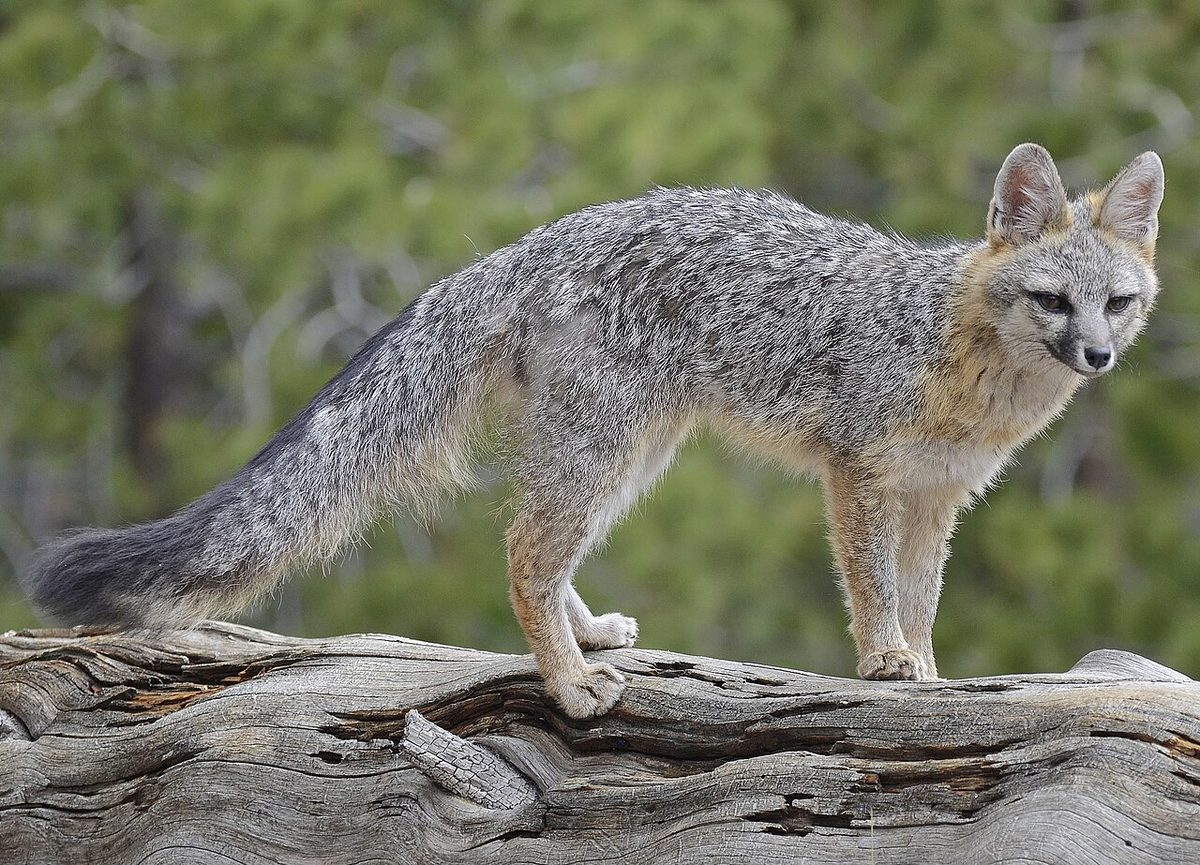

- Origin
- North America
- Type
- Wild canid
- Size
- Small
- Weight
- 3.6–7 kg (8–15 lb)
- Coat
- Grizzled, with banded guard hairs
- Colors
- Gray above with reddish sides and legs, white underparts and a black-striped tail
- Life span
- 6–10 years
- Status
- Least Concern (IUCN)
The gray fox (Urocyon cinereoargenteus), also spelled grey fox, is a wild, omnivorous member of the dog family found across North and Central America. With the small island fox of California’s Channel Islands it makes up the genus Urocyon, which genetic studies place as sister to all other living canids. Its species name means “ashen silver”.
Range and habitat
The gray fox lives in rocky, wooded and brushy country from southern Canada to Venezuela and Colombia, though not in the mountains of the northwestern United States. It is the only canid whose natural range covers both North and South America. It favors deciduous forest in the east, a mix of woods and farmland in the Midwest, and juniper and ponderosa pine in the west.
It was once the most common fox in the eastern United States. Clearing of the forests let the red fox take over there, but the gray fox is still the main fox of the Pacific states and the Great Lakes region, and it does well in towns and suburbs, southern Florida being a good example. Fossils show the species in North America 3.6 million years ago.
Appearance
The gray fox measures 76 to 112.5 cm (30 to 44 in) from nose to tail tip, of which the tail is 27.5 to 44.3 cm (11 to 17 in). It usually weighs 3.6 to 7 kg (8 to 15 lb), and very large animals reach 9 kg (20 lb). Females are slightly smaller than males. It can weigh as much as a red fox but looks smaller, because its fur and legs are shorter.
The upper parts are grizzled, each guard hair banded white, gray and black. A black stripe runs down the tail to a black tip. The legs, sides, chest and the back of the head and neck are reddish, and the throat, chest, belly and ears show white. It has none of the red fox’s black stockings, and its pupils are oval, not slit-shaped. The claws are long and curved.
Behavior
The gray fox is built to climb. Its hooked claws let it scramble up bare, vertical trunks as high as 18 meters (59 ft) to escape dogs and coyotes or to reach food, and it comes down by jumping from branch to branch or backing down like a cat. It is active mainly at night and at dusk and dawn, and spends the day in a hollow tree, a stump or a borrowed burrow.
It hunts alone. Cottontail rabbits are a staple in the east and rodents in California, along with voles, shrews, birds and carrion. It eats more plant food than the red fox: fruit is an important part of its diet, and in places such as Zion National Park it lives largely on insects and plants. It caches surplus food and marks the spot with scent.
Gray foxes travel and hunt along forest edges, and often live near people and roads, which coyotes and bobcats tend to avoid. Both of those predators kill gray foxes.
Gray foxes are thought to be monogamous. Mating falls in late winter, pregnancy lasts about 53 days, and litters number one to seven kits, 3.8 on average. Kits hunt with their parents at three months and the family breaks up in autumn. The animals typically live six to ten years. In the United States they are hunted for their fur, and more than 500,000 are reported killed each year.
Facts on this page were checked against Wikipedia and may have changed since.