Island Fox

- Origin
- Channel Islands of California
- Type
- Wild canid
- Size
- Small
- Height
- 12–15 cm (4.5–6 in)
- Weight
- 1–2.8 kg (2.2–6.2 lb)
- Coat
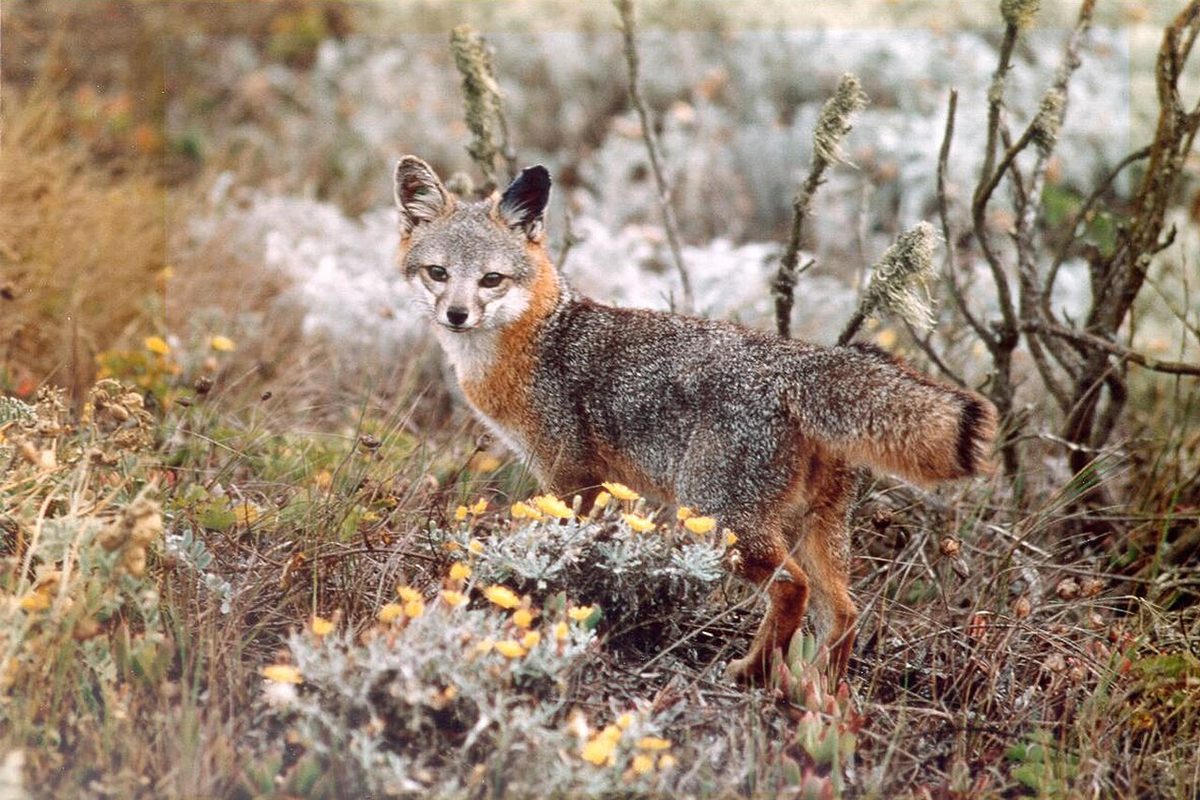
- Gray on the head and back, rusty red sides, white belly and throat
- Life span
- 4–6 years in the wild
- Status
- IUCN: Near Threatened
The island fox (Urocyon littoralis) is a small wild fox found only on six of the eight Channel Islands off California. It descends from the larger gray fox of the mainland and is about a quarter smaller, an example of island dwarfism. Each island has its own subspecies.
Range and habitat
Genetic and archaeological evidence suggests the foxes reached the islands roughly 7,000 years ago, probably with human help; people almost certainly carried them to the southern islands. They live on San Miguel, Santa Rosa, Santa Cruz, San Nicolas, Santa Catalina and San Clemente. Anacapa has no reliable fresh water and Santa Barbara is too small to feed a fox population. The foxes use every habitat on the islands, including forest, grassland and chaparral, and prefer layered vegetation with plenty of fruiting shrubs. No island holds more than about 1,000 foxes.
Appearance
The head and body measure 48 to 50 cm, the shoulder height is 12 to 15 cm and the tail is 11 to 29 cm, shorter than a gray fox’s because it usually has two fewer vertebrae. Weight runs from 1 to 2.8 kg, and males are always larger than females. The fur is gray on the head, rusty red on the sides and white on the belly, throat and lower face, with a black stripe along the top of the tail. The coat is darker and duller than a gray fox’s.
Behavior
Island foxes form monogamous pairs and breed in late February and early March. One to five pups are born in a den in spring. The foxes mostly travel alone and are generally active at night, with peaks at dawn and dusk. They eat fruit, insects, birds, eggs, snails, crabs, lizards and small mammals such as deer mice, and they scavenge on beaches. They show little fear of people and are easily tamed. The native Channel Islanders kept them as pets and used their pelts, and the fox figures in Chumash legend.
Conservation
Fox numbers collapsed in the 1990s. Golden eagles, which had colonized the islands, were the main cause on the northern islands: on San Miguel the population fell from 450 adults to 15, and on Santa Rosa from more than 1,500 to 14. On Santa Catalina an outbreak of canine distemper in 1998 killed about 90 percent of the foxes. Four subspecies were listed as federally endangered in 2004.
Captive breeding, vaccination against distemper and rabies, and restoration of the islands’ ecosystems have brought the foxes back, and populations have since been stable or growing. The IUCN moved the species from critically endangered to near threatened. Drought, wildfire and diseases brought by dogs remain concerns, and pets are not allowed in Channel Islands National Park.
Facts on this page were checked against Wikipedia and may have changed since.