Himalayan Wolf

- Origin
- Himalayas
- Type
- Wild canid
- Size
- Large
- Height
- 68–76 cm (27–30 in)
- Weight
- 30–55 kg (66–121 lb)
- Coat
- Thick and woolly
- Colors
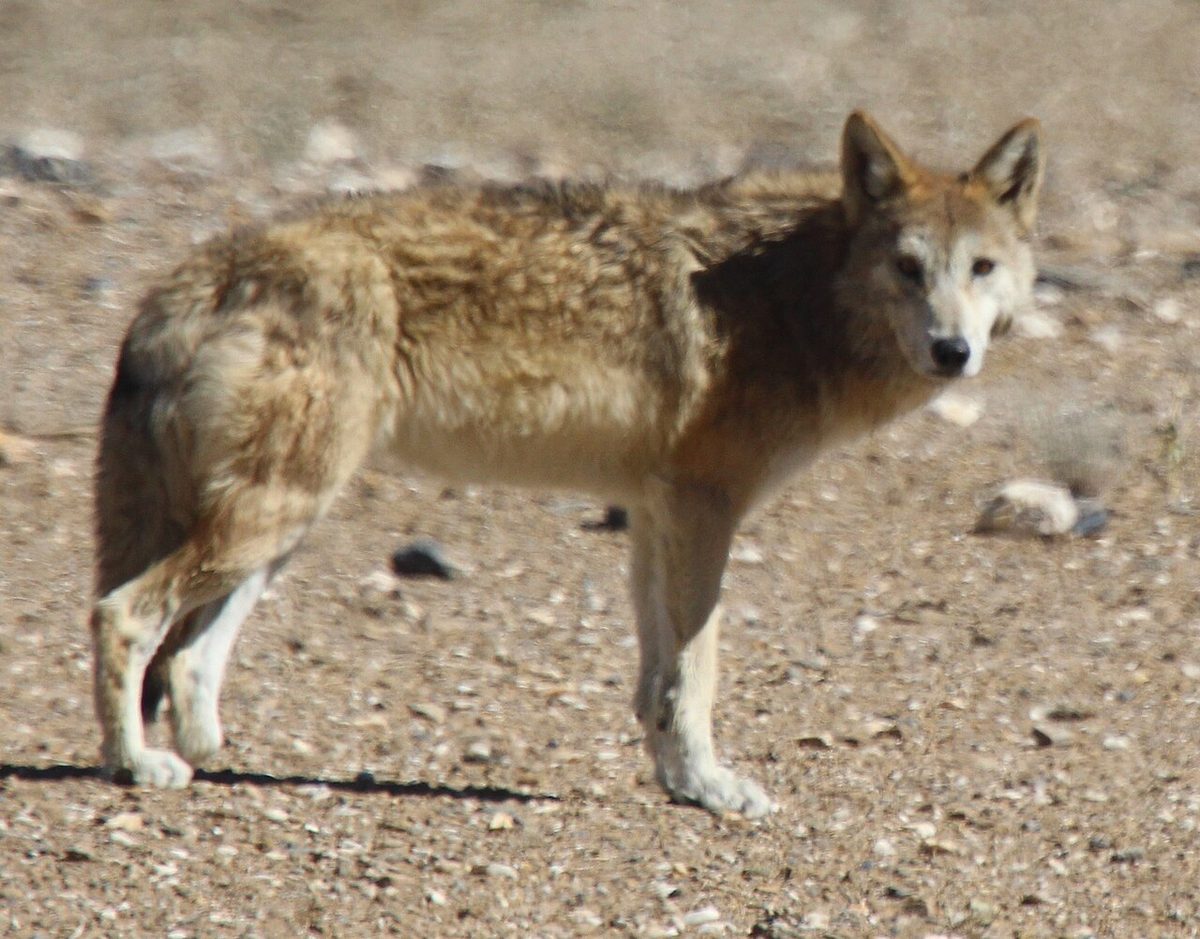
- Dull earthy brown above, yellowish white on the face, underside and limbs
- Status
- Vulnerable (IUCN)
The Himalayan wolf (Canis lupus chanco) is a wild wolf of the Himalayas, the Tibetan Plateau and the mountains of Central Asia. It lives mostly above 4,000 m (13,000 ft), where it has adapted to air that is low in oxygen. Its classification is debated. Its DNA sets it apart from the gray wolves of the rest of the northern hemisphere, and some scientists have proposed treating it as a species of its own.
Range and habitat
In China the Himalayan wolf lives on the Tibetan Plateau, in Gansu, Qinghai, Tibet and western Sichuan. In northern India it is found in Ladakh and in the Lahaul and Spiti region of Himachal Pradesh, and it has been seen in the alpine meadows of Uttarakhand. In 2004 the Indian population was put at about 350 wolves spread over some 70,000 square kilometers. The Nepal Himalayas are an important refuge, with records from Upper Dolpo, Humla, Manaslu, Upper Mustang and the Api Nampa and Kanchenjunga conservation areas.
Appearance
The fur is thick and woolly. It is a dull earthy brown on the back and tail, and yellowish white on the face, underside and limbs. Fine black speckles lie close together on the muzzle, below the eyes and on the upper cheeks and ears.
It is larger than the Indian wolf and the common European wolf. It measures 110 to 180 cm (45 to 70 in) in length, stands 68 to 76 cm (27 to 30 in) at the shoulder and weighs about 30 to 55 kg (66 to 121 lb). Its heart can cope with the low oxygen of high elevations.
Behavior
The howl of the Himalayan wolf is lower, flatter and shorter than those of other wolves, and is one of the most distinct of all wolf howls.
It prefers the small Tibetan gazelle to the larger white-lipped deer, and animals of the plains to cliff-dwellers such as the blue sheep. It also eats Himalayan marmots, pikas and woolly hares.
Where wild prey is available, the wolves leave livestock alone. Where it has been depleted they come into conflict with herders. In a study of three villages in Ladakh, wolves accounted for 60 percent of livestock losses, ahead of the snow leopard and the Eurasian lynx.
Genetics
Mitochondrial DNA shows the Himalayan wolf to be basal to the gray wolves of the northern hemisphere: its line branched off before theirs spread. It shares a maternal lineage with the African wolf. A 2020 study found that a large part of its genome comes from an unknown wolf-like canid, the source of a gene that helps both these wolves and Tibetan dogs live at high altitude.
Conservation
The wolves of Bhutan, India, Nepal and Pakistan are listed on CITES Appendix I. Hunting is prohibited in India and Nepal and banned in China, where the wolf is listed as vulnerable. In India much of the population lives outside protected areas, and little is known about its basic ecology there.
Facts on this page were checked against Wikipedia and may have changed since.