Indian Wolf
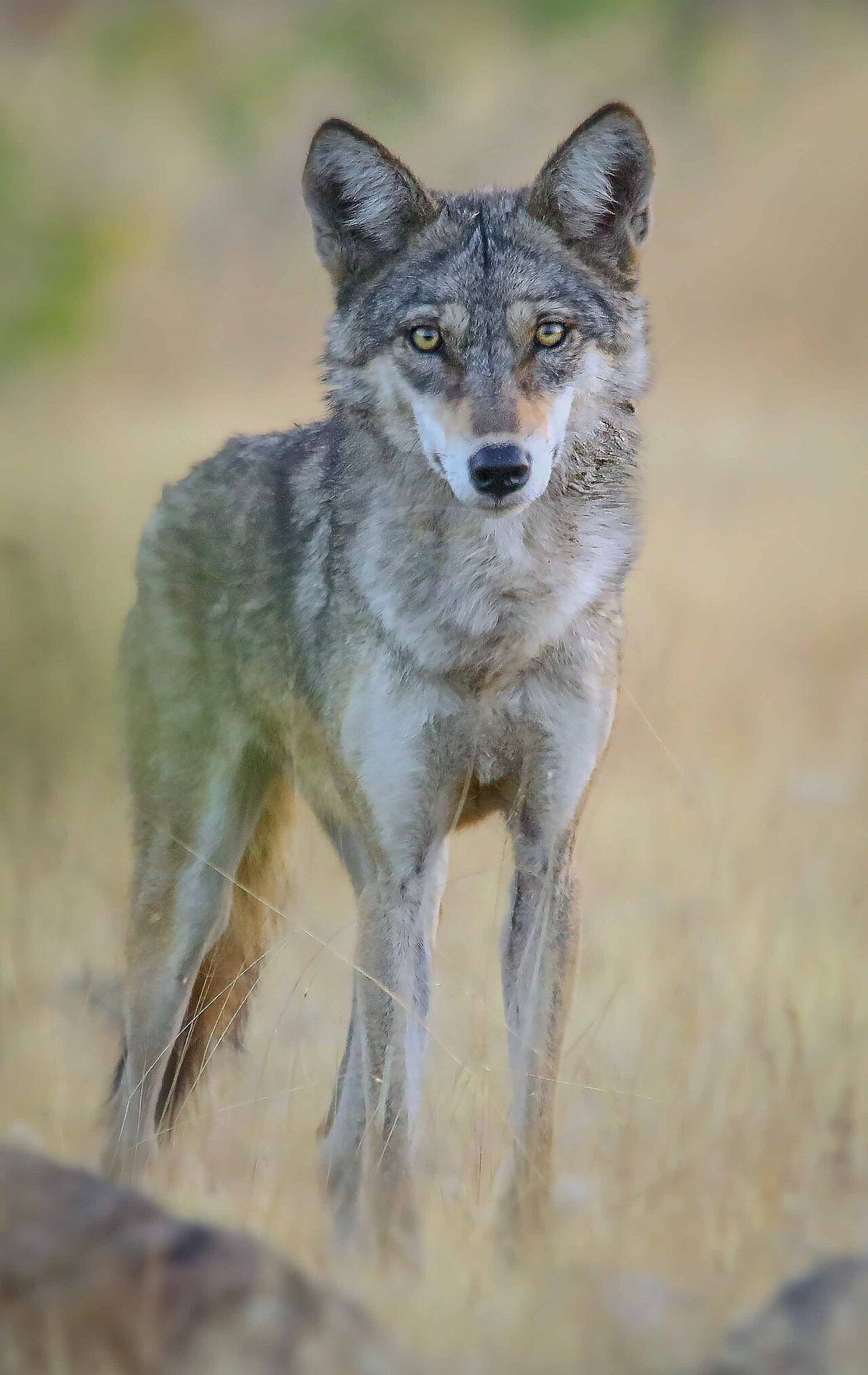

- Origin
- South and Southwest Asia
- Type
- Wild canid
- Size
- Large
- Height
- 57–72 cm (22–28 in)
- Weight
- 17–25 kg (37–55 lb)
- Coat
- Short and thin, with little or no underfur
- Colors
- Grayish-red to reddish-white, grizzled with black; pale limbs and white underparts
- Status
- Vulnerable (IUCN)
The Indian wolf (Canis lupus pallipes) is a subspecies of the gray wolf that ranges from Southwest Asia to the Indian subcontinent. It is a wild animal, smaller and lighter than the wolves of the north and adapted to warm, dry country. It is one of the most endangered gray wolf populations in the world.
Range and habitat
In West Asia the Indian wolf was widespread on both sides of the Jordan River in the 19th century, but numbers fell sharply between 1964 and 1980, mostly through persecution by farmers. Israel now keeps a moderately sized, protected population, with 80 to 100 wolves on the Golan Heights. Turkey may hold about 7,000. In Iran the wolf is found across the country except the central desert, but there is no reliable count, and it suffers from habitat loss, unregulated hunting and the loss of its prey.
Northern Afghanistan and Pakistan are strongholds. In India the wolf occurs in many states, from Jammu and Kashmir to Gujarat, Rajasthan, Maharashtra and Karnataka, mostly outside protected areas. It has been protected in India since 1972, and about 3,100 were estimated to live there in 2022.
Appearance
The Indian wolf resembles the Eurasian wolf but is smaller and more lightly built. It stands about 57 to 72 cm (22 to 28 in) at the shoulder and measures 103 to 145 cm (41 to 57 in) from nose to tail. Males weigh 19 to 25 kg (42 to 55 lb) and females 17 to 22 kg (37 to 49 lb).
The fur is short and thin with little or no underfur, though the hair along the back stays long even in summer, which is thought to shield the animal from the sun. The coat is grayish-red to reddish-white, grizzled with black, with a dark V-shaped patch around the shoulders, paler legs and almost white underparts.
Behavior
Indian wolves live much as other gray wolves do, but in smaller packs that rarely number more than six to eight, and they are less vocal; they are seldom heard to howl. They are active at night and hunt from dusk to dawn. Their natural prey is antelope, rodents and hares. When hunting antelope they usually work in pairs, with one wolf acting as a decoy while the other attacks from behind. Outside protected areas they feed largely on livestock such as goats and sheep. They breed from mid-October to late December and raise their pups in holes or ravines.
Classification
The wolf was first described in 1831 by William Henry Sykes. Genetic studies have found that the wolves of the Indian lowlands form an old lineage, distinct from the wolves of the Himalayas and from all other gray wolves, including wolves from Syria and Iran that are classed in the same subspecies. Some researchers have proposed treating the Indian plains wolf as a separate species, Canis indica, but this has not been generally accepted.
Facts on this page were checked against Wikipedia and may have changed since.