Maned Wolf
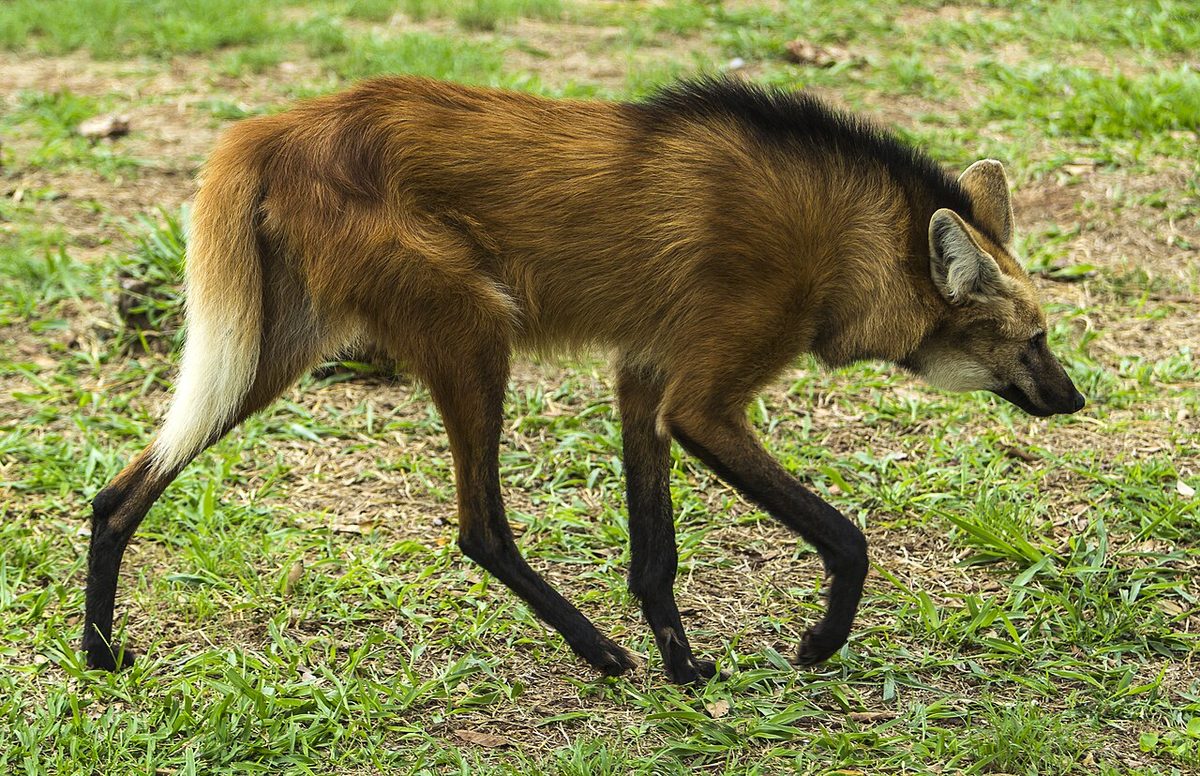

- Origin
- South America
- Type
- Wild canid
- Size
- Large
- Height
- Up to 110 cm (43 in)
- Weight
- 20–30 kg (44–66 lb)
- Coat
- Dense, with an erectile mane on the nape
- Colors
- Reddish brown to golden orange with black legs and mane, a white throat and a white tail tip
- Life span
- 12–15 years in captivity
- Status
- Near Threatened (IUCN)
The maned wolf (Chrysocyon brachyurus) is the largest canid in South America and the tallest of all wild canids. Its red coat and markings recall a red fox, but it is neither a fox nor a wolf. It is the only species in its genus, and its closest living relative is the bush dog. The name refers to the black mane on the nape of its neck.
Range and habitat
Maned wolves live in open and semi-open country, especially grassland with scattered bushes and trees. They are found in the Cerrado of Brazil, in Paraguay, northern Argentina, Bolivia east and north of the Andes, and the far southeast of Peru. In Uruguay the species is very rare and may have been lost. Although they prefer grassland, scrub and forest edges, they can survive in disturbed places, including burned ground and areas heavily used by people.
Appearance
An average adult weighs about 23 kg and, according to the source, stands up to 110 cm at the shoulder, with a head and body about 100 cm long and a 45 cm tail. The very long legs are probably an adaptation to tall grass. The ears are large, about 18 cm long. The fur is reddish brown to golden orange on the sides, with long black legs, a black mane, a white tuft at the tip of the tail and a white bib under the throat. The mane can be raised to make the animal look bigger when it is threatened. Black individuals exist but are rare. Pups are born black and turn red after about ten weeks.
Behavior
Unlike most large canids, the maned wolf is solitary and does not form packs. It is most active at twilight. It hunts alone, turning its big ears to listen for prey in the grass, tapping the ground with a forefoot to flush it out and then pouncing. A monogamous pair may share a territory of around 30 square kilometers, though outside the mating season the two seldom meet. They communicate mainly by scent marking, and their urine has a strong smell that people compare to hops or cannabis, hence the nickname skunk wolf. They also give a loud call known as a roar-bark.
The maned wolf is an omnivore. It eats rodents, rabbits, birds, eggs, reptiles, armadillos and insects, but most of its diet is plant matter. The wolf apple, a tomato-like fruit, usually makes up 40 to 90 percent of what it eats, and the animal spreads the plant’s seeds in its droppings.
Mating takes place from November to April. After 60 to 65 days the female bears two to six pups, which are fully grown at one year.
Conservation
The maned wolf is listed as Near Threatened by the IUCN and as vulnerable in Brazil. Its numbers are falling because of habitat loss, road deaths and urban growth. Domestic dogs pass on diseases such as rabies, parvovirus and distemper, and sometimes attack. It is shy and little threat to people, though it has a reputation as a chicken thief. Hunting it is forbidden in Brazil, Argentina and Uruguay. In 2012, 3,288 maned wolves were kept in more than 300 institutions worldwide.
Facts on this page were checked against Wikipedia and may have changed since.