Culpeo

- Origin
- South America
- Type
- Wild canid
- Size
- Medium
- Weight
- 5–13.5 kg (11–30 lb)
- Coat
- Grizzled fur with a bushy tail
- Colors
- Gray and reddish, with a white chin and black-tipped tail
- Status
- Least Concern (IUCN)
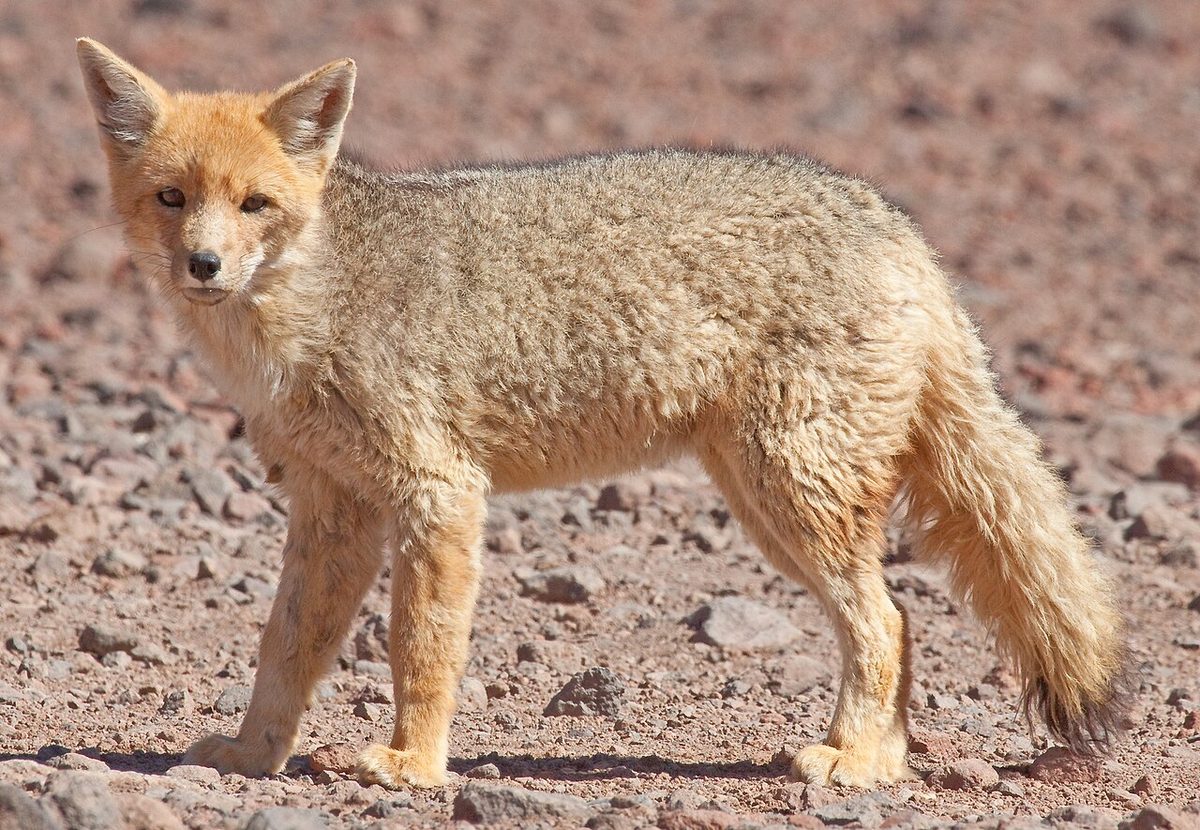
The culpeo (Lycalopex culpaeus) is a wild canid of western South America. It is often called the Andean fox, but it is not a true fox of the genus Vulpes: it is more closely related to wolves and jackals, and its fox-like looks are the result of convergent evolution.
Range and habitat
The culpeo is found from Patagonia and Tierra del Fuego in the south to Ecuador and Peru in the north, with some populations reaching southern Colombia. It is most common on the western slopes of the Andes, in open country and deciduous forest.
It uses a wide range of habitats: southern beech rainforest, dry scrubland, desert, chaparral and high plateaus such as the Altiplano, up to the tree line at about 4,800 m (15,700 ft).
Appearance
In size the culpeo falls between a red fox and a coyote, and it is the second-largest native canid in South America after the maned wolf. Males average 11.4 kg (25 lb) and the smaller females 8.4 kg (19 lb), within a reported range of 5 to 13.5 kg. Total length runs from 94 to 133 cm (37 to 52 in), of which 32 to 44 cm is tail.
It looks much like a red fox. The fur is gray and reddish with a grizzled look, the chin is white and the legs are reddish. The neck and shoulders are often tawny to rufous and the upper back dark, sometimes with a faint stripe. The bushy tail ends in a black tip.
Behavior
The culpeo is an opportunistic predator. Its main prey is rodents and rabbits and hares, especially the European rabbit and European hare introduced to South America. It also eats birds, lizards, insects, fruit and carrion, and it has been seen taking introduced beavers in Tierra del Fuego. Because it preys heavily on introduced rabbits it is considered useful, and those rabbits are thought to have helped it spread from the Andean foothills across the Patagonian plain.
It sometimes kills young lambs, goats and poultry, and for that reason it is hunted in rural Chile and Argentina. It has become rare in some regions, but the species as a whole is not threatened.
Where their ranges meet, the larger culpeo appears to dominate competitors such as the South American gray fox, pushing it out of the areas richest in prey.
Mating usually takes place between August and October. After a pregnancy of 55 to 60 days the female gives birth, usually to two to five pups.
History
The classification of the culpeo has long been debated, and it has been placed at different times in the genera Dusicyon, Canis, Pseudalopex and Lycalopex; Lycalopex is the name preferred today.
The Selk’nam people of Tierra del Fuego domesticated the culpeo, producing the Fuegian dog, which they used for hunting and fishing and as a source of warmth in their shelters. The Fuegian dog died out in the late 19th or early 20th century.
Facts on this page were checked against Wikipedia and may have changed since.