Darwin’s Fox
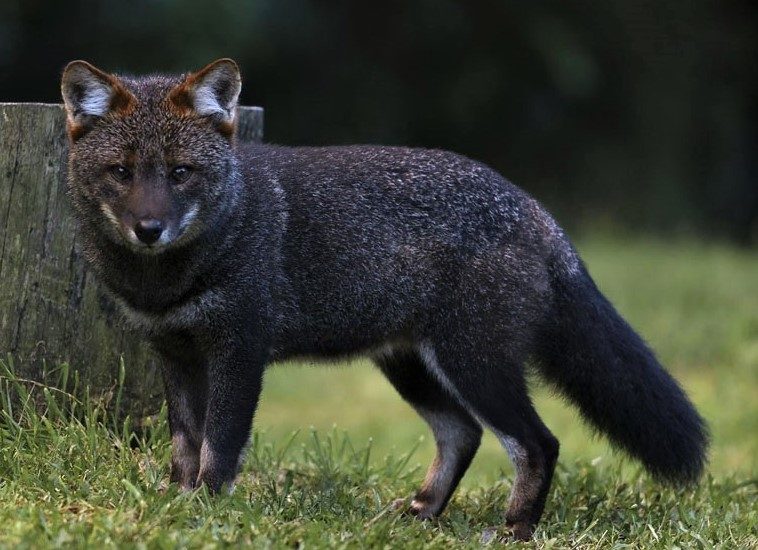

- Origin
- Chile
- Type
- Wild canid
- Size
- Small
- Weight
- 1.8–3.95 kg (4.0–8.7 lb)
- Coat
- Mottled black and gray fur
- Colors
- Dark gray and black, with reddish ears and lower legs and white underparts
- Status
- Endangered (IUCN)
Darwin’s fox (Lycalopex fulvipes) is a small, dark wild canid found only in Chile. Despite the name it is not a true fox: it belongs to the South American genus Lycalopex, which is distantly related to wolves. It is named after Charles Darwin, who collected the first specimen on San Pedro Island, off Chiloé, in December 1834.
Range and habitat
The species lives in the temperate rainforests of southern Chile: on Chiloé Island, in Nahuelbuta National Park, and in the Cordillera de Oncol and Cordillera Pelada on the mainland. It was thought to live only on Chiloé until a small mainland population was found in Nahuelbuta in 1990. Chiloé was joined to the mainland by a land bridge until about 15,000 years ago, and the DNA of the two populations differs by only 2 percent.
It uses old and second-growth forest and shrubland, and now and then coastal dunes. It is found more often where native forest cover is high and less often where there are many roads or dogs.
For a long time Darwin’s fox was treated as a subspecies of the South American gray fox. Genetic work in the 1990s showed it to be a species of its own.
Fewer than 1,000 mature animals are thought to survive, most of them on Chiloé; a 2016 IUCN assessment estimated at least 639. The species was once listed as Critically Endangered and was moved to Endangered in 2016. Domestic and feral dogs are the main threat, both through attacks and through diseases such as canine distemper. Habitat loss to farming and forestry and human disturbance add to the pressure. Conservation work centers on vaccination against disease and on protected areas.
Appearance
Darwin’s fox weighs 1.8 to 3.95 kg. Its head and body measure 48 to 59 cm, and the tail adds 17.5 to 25.5 cm. Males and females look alike, apart from the male’s broader muzzle.
It is smaller and darker than the other Lycalopex species, with shorter legs and a broader, shorter head. The fur is a mottled black and gray, with reddish tones on the ears and lower legs and white under the chin, along the lower jaw, on the belly and inside the legs. The short, bushy, dark gray tail helps tell it apart from related species.
Behavior
Darwin’s fox is most active at twilight and before sunrise. Home ranges run from about 103 to 488 hectares and overlap a good deal; males are not territorial and show no aggression to other males passing through. Local people report that the foxes have little fear of humans.
It is an opportunistic omnivore. Insects are believed to make up much of its diet, along with small mammals, birds, reptiles, fruits and seeds. Droppings from Nahuelbuta contained mostly mammal remains, while on Chiloé invertebrates, rodents and fruit were most common, with more rodents eaten in winter. It does not interbreed with other Lycalopex species.
Facts on this page were checked against Wikipedia and may have changed since.