Crab-eating Fox
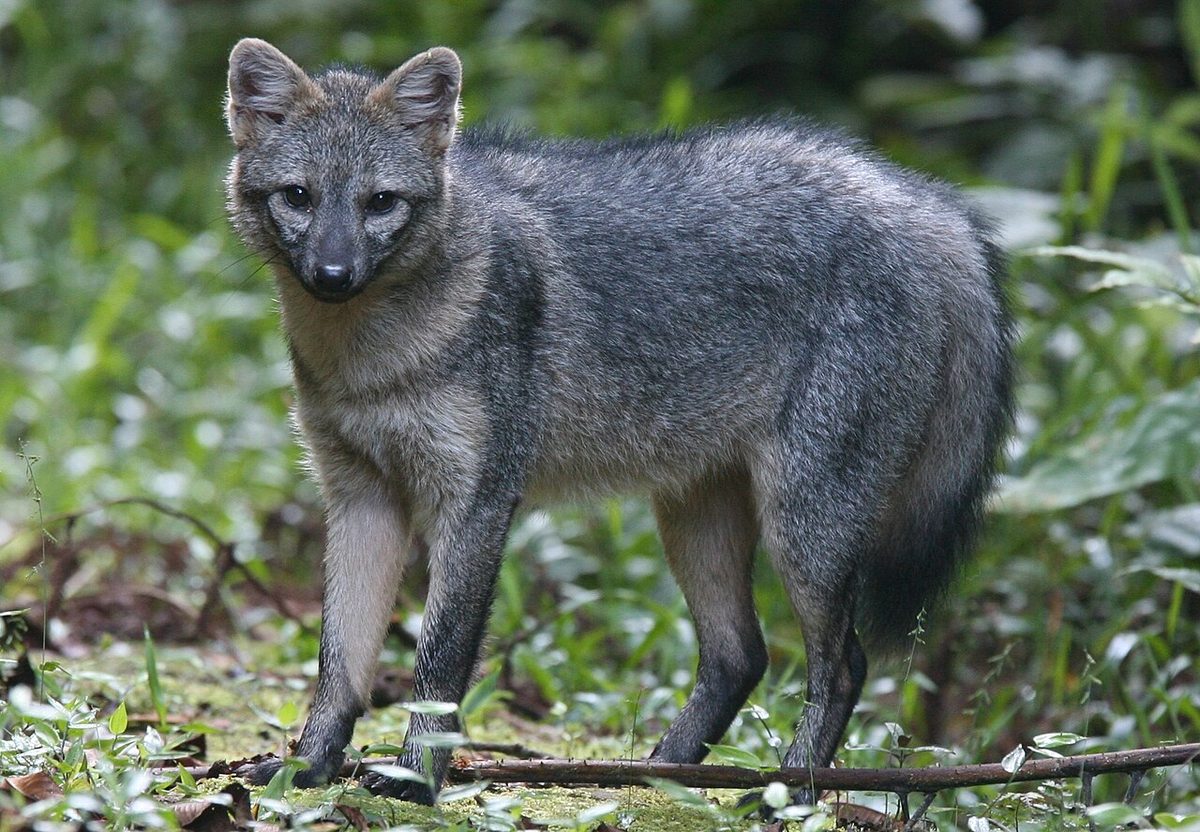

- Origin
- South America
- Type
- Wild canid
- Size
- Small
- Weight
- 4.5–7.7 kg (10–17 lb)
- Coat
- Short and thick
- Colors
- Grayish brown with reddish face and legs and black-tipped ears and tail
- Status
- Least Concern (IUCN)
The crab-eating fox (Cerdocyon thous) is a medium-sized wild canid of central South America, where it has lived since at least the Pleistocene. Despite the name it is not closely related to the true foxes. Its genus name joins the Greek words for fox and dog, a nod to its mix of features. It is the only living member of its genus; its nearest living relative is thought to be the short-eared dog.
Range and habitat
The species ranges from Colombia and southern Venezuela in the north to Paraguay, Uruguay and northern Argentina in the south, and it has been sighted in Panama since the 1990s. It lives in savannas, woodlands, subtropical forests, thorny thickets and wooded riverbanks. It avoids rainforest, high mountains and open grassy savanna. In the rainy season the animals move uphill, and in drier times they return to lower ground.
Five subspecies are recognised, differing in size and in the color of the fur.
Appearance
The crab-eating fox is mostly grayish brown, with reddish fur on the muzzle, ears and paws and black on the tail, legs and ear tips. A black stripe runs along the spine. Color varies widely between populations, from very dark to a light gray-yellow. The coat is short and thick.
The body is rather narrow, on short, strong legs, and the ears are wide and round. The tail is long and bushy and is held upright when the animal is excited. Head and body average 64.3 cm (25.3 in) long, with a tail of 28.5 cm (11.2 in). Adults weigh between 4.5 and 7.7 kg.
Behavior
Crab-eating foxes are nocturnal, most active in the middle of the night and the early morning. They live and hunt as monogamous pairs, and several pairs may gather in the breeding season. They defend territory in the dry season and care less about it in the rains, when food is plentiful. Dens are found in bushes and thick grass, usually with several entrances. The foxes can dig but prefer to take over another animal’s burrow. They bark, whirr and howl, often when a pair has lost touch with each other.
The name comes from their habit of searching muddy floodplains for crabs in the wet season. They are opportunistic omnivores, eating insects, rodents, birds, other crustaceans, tortoises, eggs, lizards, fruit and carrion. Crustaceans dominate in the wet season and insects in the dry.
Young foxes mature at nine to ten months. Females bear one or two litters a year after a pregnancy of about 56 days. Both parents raise the pups, which are weaned at around three months and independent at five to eight months.
Conservation
The IUCN lists the species as Least Concern. No precise count exists, but it is common across its range and its numbers are stable, though it faces local extinction in some areas. Farmers regard it as a threat to livestock, which leads to illegal hunting in some countries. The main threat is disease caught from unvaccinated dogs.
Facts on this page were checked against Wikipedia and may have changed since.