Bush Dog

- Origin
- South America
- Type
- Wild canid
- Size
- Small
- Height
- 20–30 cm (8–12 in)
- Weight
- 5–8 kg (11–18 lb)
- Coat
- Long and soft
- Colors
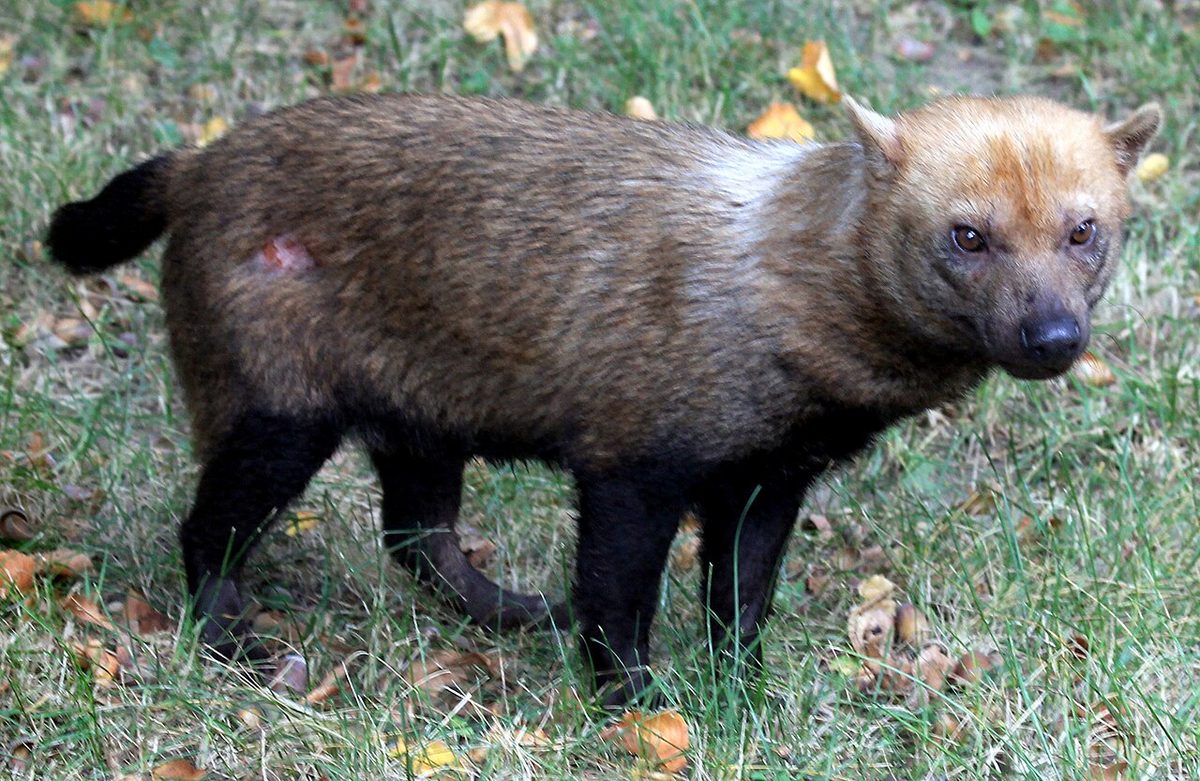
- Brownish tan with a reddish head, neck and back and a dark underside
- Life span
- Up to 10 years in captivity
- Status
- Near Threatened (IUCN)
The bush dog (Speothos venaticus) is a small, short-legged wild canid of Central and South America. It was first described from fossils found in Brazilian caves by Peter Wilhelm Lund, who believed it extinct until living animals turned up. It is the only living species in its genus, and genetic evidence points to the maned wolf or the African wild dog as its closest living relative. In Brazil and Spanish-speaking countries it is often called the vinegar dog.
Range and habitat
Bush dogs live from Costa Rica through much of South America east of the Andes, as far south as central Bolivia, Paraguay, southern Brazil and the far northeast of Argentina. Despite this wide range they are very rare almost everywhere except Suriname, Guyana and Peru. They mainly live in lowland forest, wet savanna and other country near rivers, up to about 1,900 meters, but also turn up in drier cerrado and open pasture. Three subspecies are recognized: the South American, the Panamanian and the southern bush dog.
Appearance
Adults have long, soft brownish-tan fur with a redder tinge on the head, neck and back, a dark underside, sometimes a paler throat patch, and a bushy tail. Young animals are black all over. The head and body measure 57 to 75 cm, with a short tail of 12.5 to 15 cm, and the animal stands 20 to 30 cm at the shoulder and weighs 5 to 8 kg. The legs and snout are short and the ears small. The toes are partly webbed, which helps in swimming. The bush dog has 38 teeth, an arrangement unique among American canids, and its lower carnassial has a single cutting cusp, a feature shared only with the dhole and the African wild dog.
Behavior
Bush dogs are carnivores that hunt by day, mostly large rodents such as pacas, agoutis, acouchis and capybaras. They can hunt alone but usually live in small packs made up of a mated pair and their relatives, with a home range of 3.8 to 10 square kilometers. When chasing a paca, some of the pack pursue on land while others wait in the water where it tends to flee. Packs can also bring down peccaries and rheas, and six bush dogs were once reported hunting a tapir. They shelter in hollow logs and old armadillo burrows and keep in touch with frequent whines.
Only the adult pair breeds, and the rest of the pack helps rear and guard the pups. Mating happens year-round. After 65 to 83 days a litter of three to six pups is usually born, blind and helpless. They are weaned at about four weeks and mature at one year.
Conservation
The species is listed as Near Threatened after a decline of roughly 20 to 25 percent in 12 years. The main threats are habitat loss from deforestation, loss of prey to human hunters and diseases caught from domestic dogs. Hunting bush dogs is illegal in most of their range. They are shy, thinly scattered and among the least studied canids, so researchers have begun using scent-detection dogs to find their burrows. Camera traps recorded bush dogs in Costa Rica’s Talamanca Mountains in 2020.
Facts on this page were checked against Wikipedia and may have changed since.