Dhole
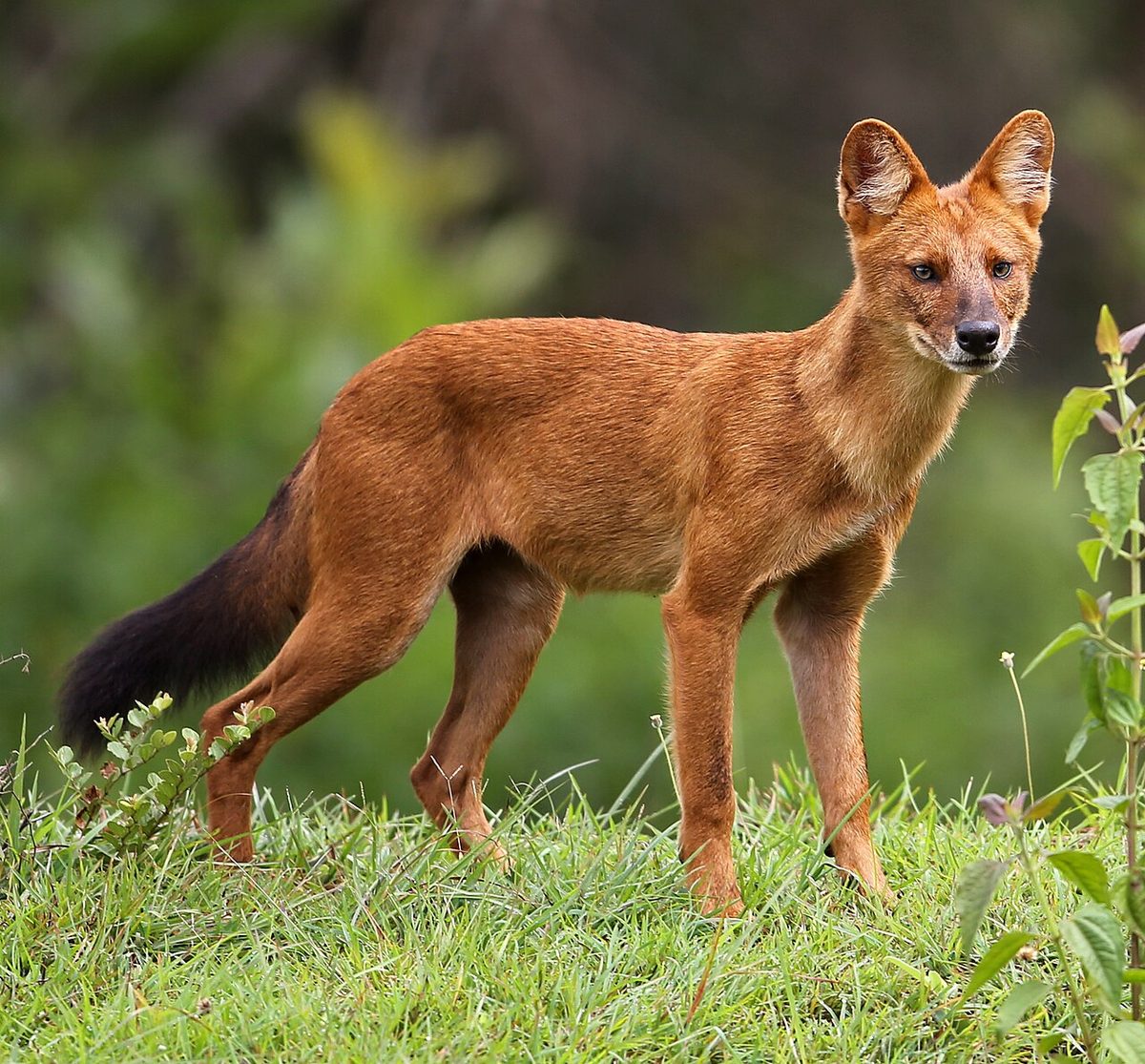

- Origin
- South, East and Southeast Asia
- Type
- Wild canid
- Size
- Medium
- Height
- 42–50 cm (17–20 in)
- Weight
- 10–21 kg (22–46 lb)
- Coat
- Short and coarse in summer, thicker and brighter in winter
- Colors
- Rusty red with paler underparts and a dark-tipped tail
- Life span
- Up to 15–16 years in captivity
- Status
- Endangered (IUCN)
The dhole (Cuon alpinus) is a wild canid native to South, East and Southeast Asia, and the only member of its genus. It differs from wolves and dogs in its skull, which bulges outward in profile, and in its teeth: it has one molar fewer in the lower jaw. It is a highly social hunter that lives in clans and preys on medium-sized and large hoofed animals.
Range and habitat
In the Ice Age the dhole lived across Asia and into Europe. Today it is gone from Central Asia, Singapore, South Korea and parts of Southeast Asia, and is considered extinct in Russia, though unconfirmed reports continue from Siberia and the Russian Far East.
India is a stronghold. Dholes live across most of the country south of the Ganges, especially in the Central Indian Highlands and the Western and Eastern Ghats, as well as in the northeast and the Terai. They are also found in Nepal, Bhutan, Bangladesh and Myanmar, and camera traps have recorded them in several western and southern provinces of China. In Thailand, Laos, the Malay Peninsula, Sumatra and Java the range is broken into fragments, and the Vietnamese population may be gone.
Dholes prefer forest, including mountain forest, and are only occasionally seen on plains.
Appearance
A dhole is 88–113 cm (35–44 in) long, with a tail of 41–50 cm (16–20 in), and stands 42–50 cm (17–20 in) at the shoulder. Females weigh 10–17 kg (22–37 lb) and males 15–21 kg (33–46 lb).
The coat is reddish and brightest in winter, when the back is a deep rusty red. The throat, chest, belly and upper legs are more yellowish and the lower legs whitish. The tail is full and fluffy with a dark brown tip. The summer coat is shorter, coarser and darker.
The skull is broad and heavy with strong jaw muscles, giving the face an almost hyena-like look, and the muzzle is shorter than in most canids.
Behavior
Dholes are more sociable than gray wolves and have a looser hierarchy. A clan usually has 5 to 12 members, though groups of 40 have been reported, and it often splits into hunting parties of three to five. Fighting within a clan is rare, and more than one female may breed. Dholes do not howl or bark. They whistle, apparently to keep in touch in thick cover, and also whine, growl, scream and chatter.
They hunt mainly in the early morning and rely on sight. Most chases are short, around 500 m, though dholes can run at 50 km/h (30 mph) and may drive prey into water. Prey ranges from chital, sambar, muntjac and wild boar to gaur and, in the mountains, ibex and musk deer. They also eat insects, lizards and more fruit and plant matter than most canids. They are not known to hunt people.
Dens are dug under thick scrub or in dry riverbanks. Pregnancy lasts 60–63 days and litters average four to six pups. Clan members feed the mother at the den and later regurgitate food for the pups, which join hunts at about six months.
Fewer than 2,500 adult dholes are thought to remain, and numbers are falling. The causes are loss of habitat and prey, competition, killing over livestock, snaring, and diseases caught from domestic dogs, including rabies, distemper, mange and parvovirus. The species is legally protected in India, Russia, China and Cambodia.
Facts on this page were checked against Wikipedia and may have changed since.