Ethiopian Wolf

- Origin
- Ethiopia
- Type
- Wild canid
- Size
- Medium
- Height
- 53–62 cm (21–24 in)
- Weight
- 11–19 kg (25–43 lb)
- Coat
- Short guard hairs over thick underfur
- Colors
- Ochre to rusty red with white underparts and markings
- Status
- Endangered (IUCN)
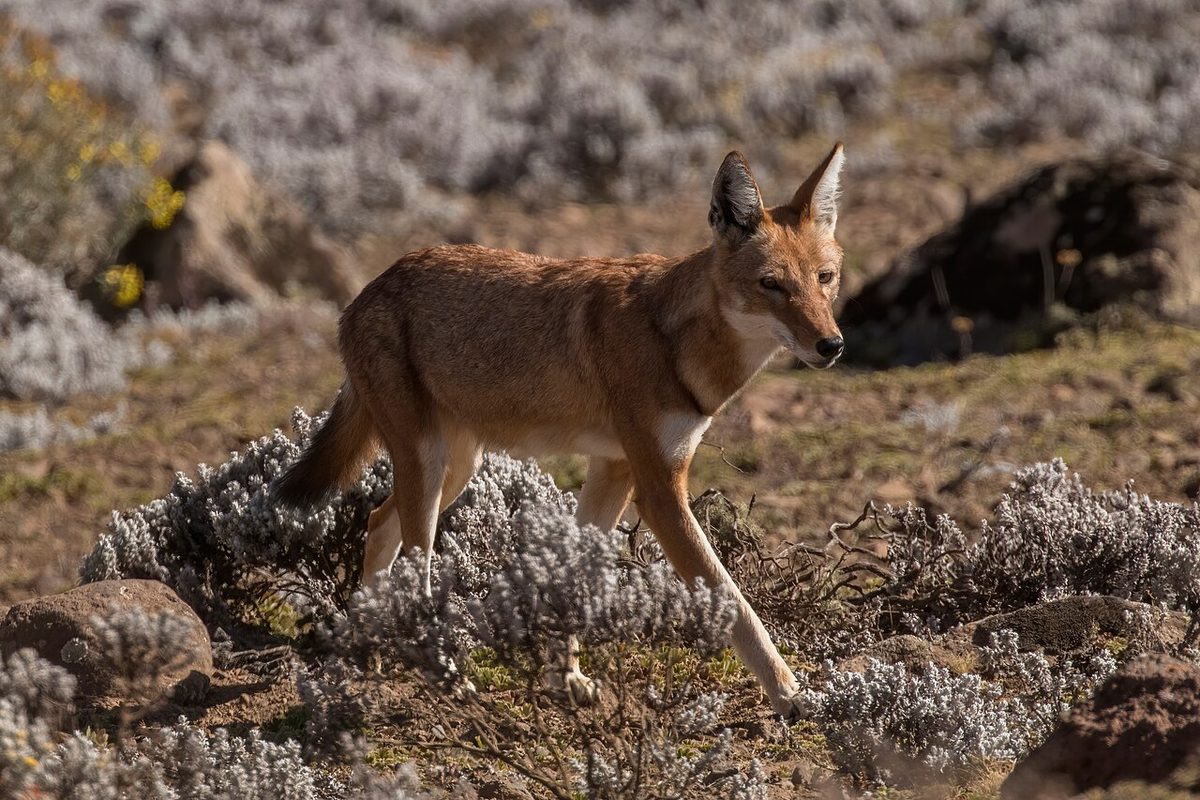
The Ethiopian wolf (Canis simensis) is a wild canid found only in the highlands of Ethiopia. It is about the size and build of a coyote, with a long, narrow skull and a red and white coat. Most large canids range widely and eat many things; this one is a specialist that lives almost entirely on the rodents of the high Afroalpine grasslands. It is one of the rarest canids in the world and the most endangered carnivore in Africa.
Range and habitat
The species survives in a handful of isolated mountain ranges at 3,000 to 4,500 m. North of the Rift Valley it lives in the Simien Mountains, the Wollo highlands and Guassa Menz; to the southeast it lives in the Arsi and Bale Mountains. The adult population was put at 360 to 440 animals in 2011, more than half of them in Bale.
It prefers open ground with short herbs and grasses, where rodents are most plentiful. Farming, which now reaches as high as 3,700 m, has pushed the wolves onto the highest peaks.
Appearance
Adults measure 84 to 101 cm (33 to 40 in) in body length and stand 53 to 62 cm (21 to 24 in) tall. Males weigh 14.2 to 19.3 kg (31 to 43 lb) and females 11.2 to 14.15 kg (25 to 31 lb). The legs are long, the ears broad and pointed, and the skull very flat, with a long muzzle and small, widely spaced teeth suited to catching rodents.
The coat is ochre to rusty red, sharply set off by white on the throat, chest, underparts and around the sides of the neck. The bushy tail is white beneath with a black tip.
Behavior
Ethiopian wolves live in family packs, commonly of about six adults but sometimes as many as 20, which share a territory averaging 6 square kilometers. They sleep in the open and use dens only for raising pups. Usually only the dominant female breeds. She mates between August and November and bears two to six pups about two months later, and the whole pack helps to guard and feed them.
Although they are social, the wolves hunt alone and by day, when rodents are active. Their main prey in Bale is the big-headed African mole-rat, along with grass rats and highland hares; packs occasionally join forces to take a mountain nyala calf. They pose little threat to livestock.
Threats and conservation
Every major threat to the species comes from people: the loss and breaking up of habitat by farming, overgrazing and roads; rabies and canine distemper caught from dogs; persecution and road deaths; and interbreeding with dogs. Rabies outbreaks in Bale in 1991 and 2008–2009 killed or removed about three quarters of the known animals.
The wolf has been legally protected since 1974. The IUCN listed it as critically endangered in 1994 and moved it back to endangered in 2004 after the Bale population recovered. The Ethiopian Wolf Conservation Programme, founded by Oxford University in 1995, works to protect it through vaccination and community outreach.
Facts on this page were checked against Wikipedia and may have changed since.