Swift Fox
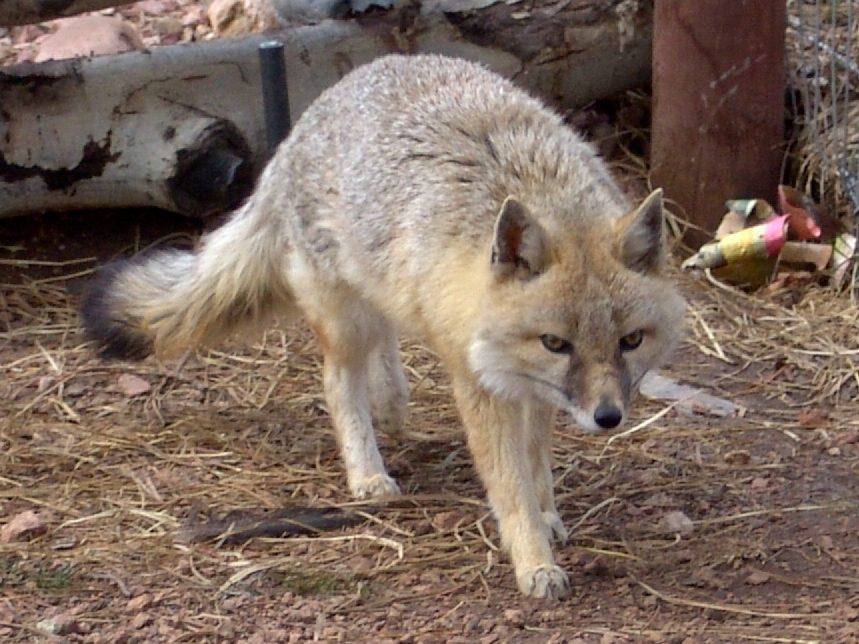

- Origin
- North America
- Type
- Wild canid
- Size
- Small
- Height
- About 30 cm (12 in)
- Weight
- 2.3–3.2 kg (5–7 lb)
- Colors
- Grayish tan above, yellowish tan on the sides and legs, pale below, with a black-tipped tail
- Life span
- 3–6 years in the wild; up to 14 in captivity
- Status
- Least Concern (IUCN)
The swift fox (Vulpes velox) is a small wild fox of the western Great Plains of North America, about the size of a domestic cat. It is closely related to the kit fox, and some mammalogists have treated the two as one species, though genetic work indicates they are distinct. They interbreed only in a limited zone where their ranges meet, in eastern New Mexico and western Texas.
Range and habitat
Swift foxes live on short-grass prairie and western grassland, and in deserts. In the United States they are found in states including Montana, Wyoming, Colorado, Nebraska, Kansas, Oklahoma, New Mexico and Texas. In Canada they live in the south of the prairie provinces. They dig their dens in sandy soil on open prairie, in plowed fields or along fences.
Predator control programs in the 1930s, aimed mainly at gray wolves and coyotes, brought the species close to extinction, and it was gone from Canada by 1938. A reintroduction program that began in 1983 has established small populations in southeast Alberta and southwest Saskatchewan. Canada listed the swift fox as endangered in May 1999.
The species now occupies only about 40% of its historic range. Populations in the central part of its United States range are stable, and the IUCN lists it as Least Concern.
Appearance
The swift fox is dark grayish tan on the back, shading to yellowish tan on the sides and legs. The throat, chest and belly are pale yellow to white. The tail has a black tip, and there are black patches on the muzzle. The ears are noticeably large.
It stands about 30 cm (12 in) tall and measures 79 cm (31 in) from head to tail tip. It weighs roughly five to seven pounds (2.3–3.2 kg). Males and females look alike, with males slightly larger.
Behavior
The swift fox is mainly nocturnal. In summer it spends the day in its den and comes out in the evening and at night, though in winter it may lie above ground in the warm midday hours. It depends on its dens more than most North American canids, using them as shelter from predators. The burrows are two to four meters long, and a fox may use up to thirteen in a year. True to its name, it can run at more than 50 km/h (30 mph).
It is an omnivore. Rabbits, mice, ground squirrels, birds, insects, lizards and eggs are staples, along with grasses, fruit and carrion. In summer the adults eat large numbers of beetles and grasshoppers.
Adults live in pairs. Some mate for life and others change partners from year to year. Breeding runs from December to February in the southern United States and begins in March in Canada. Gestation takes about 51 days, and four or five kits are born in the den. Their eyes and ears stay closed for ten to fifteen days. They are weaned at six or seven weeks and stay with their parents until fall.
The coyote is the swift fox’s main predator.
Facts on this page were checked against Wikipedia and may have changed since.