Argentine Grey Fox

- Origin
- Argentina
- Type
- Wild canid
- Size
- Small
- Weight
- 2.5–5.45 kg (5.5–12 lb)
- Coat
- Brindled, with a short, dense, pale undercoat
- Colors
- Gray with a reddish-brown head, tawny legs and pale gray underparts
- Status
- IUCN: Least Concern
The Argentine grey fox, more often called the South American gray fox, is a small wild canid of the southern parts of Argentina and Chile, above all Patagonia. Its scientific name is Lycalopex griseus, and it belongs to a South American group sometimes called the false or lesser foxes. In Spanish it is the chilla or zorro gris.
Range and habitat
The species lives on both sides of the Andes, from the far north of Chile at about 17 degrees south down to Tierra del Fuego at 54 degrees south. In Chile it is found throughout the country. In Argentina it keeps to the semiarid west, from the foothills of the Andes eastward, and south of the Río Grande its range widens until it reaches the Atlantic coast. It has been reported from Peru, but that has not been confirmed.
People have also moved it to new places. It was taken to the Falkland Islands in the late 1920s or early 1930s and is still numerous on Beaver and Weddell Islands and several smaller ones. In 1951 it was released on Tierra del Fuego to keep down European rabbits.
It lives in many kinds of country: warm, dry scrubland in the Argentine uplands, the cold and arid Patagonian steppe, and the forests of southernmost Chile.
Appearance
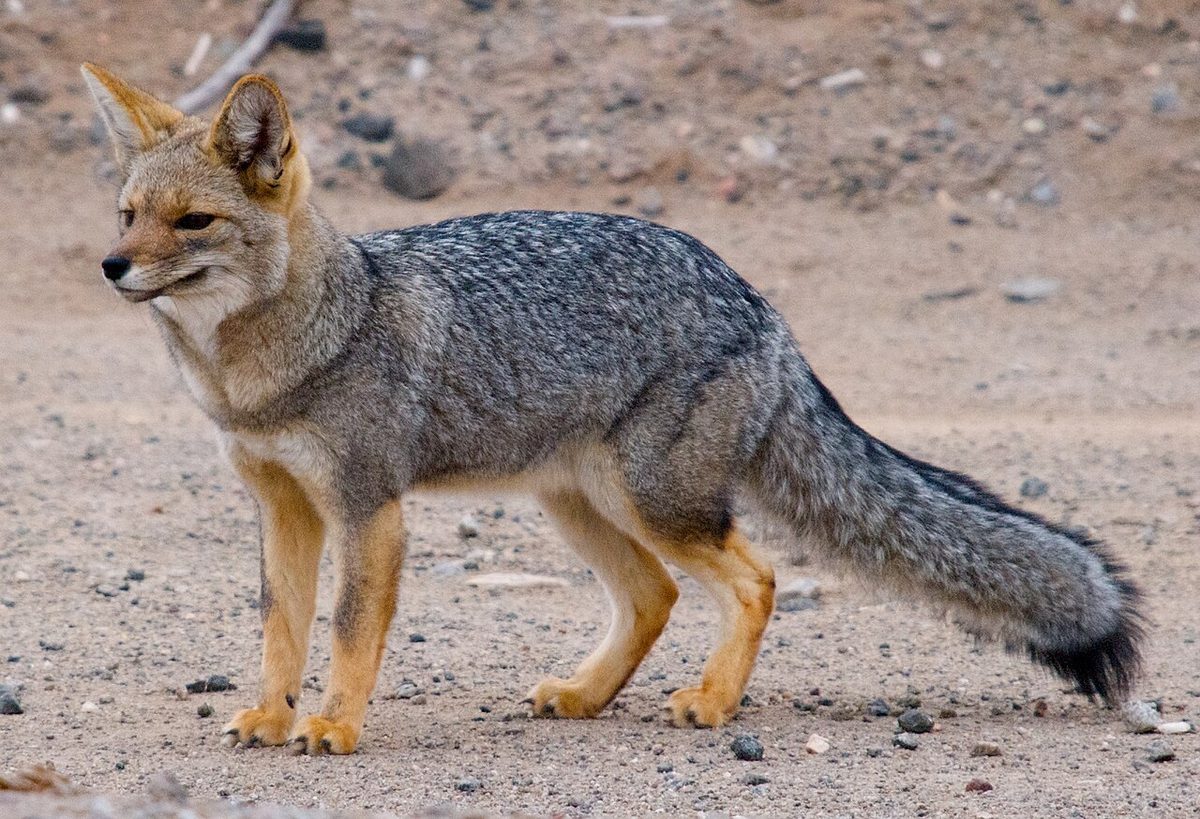
This is a small animal, weighing 2.5 to 5.45 kg (5.5 to 12 lb) and measuring 65 to 110 cm (26 to 43 in) from nose to tail tip, of which the tail makes up 20 to 43 cm (8 to 17 in). The head is reddish brown flecked with white, the ears are large, and there is a clear black spot on the chin. The coat is brindled, with banded guard hairs over a short, dense, pale undercoat. The underparts are pale gray, the legs tawny, and a dark bar crosses each thigh. The long, bushy tail has a dark stripe along the top and a dark tip, with a paler, mottled underside.
Behavior
The South American gray fox lives largely alone. Its diet changes with the place and the season and takes in mammals, birds, arthropods, birds’ eggs, reptiles, fruit and carrion. Small mammals, especially rodents, appear to be the main prey. By eating fruit it spreads seeds, and it also clears away carrion.
Breeding takes place in early southern autumn, around March. After a pregnancy of about two months, two to four kits are born in a den. Little else has been recorded about how it lives.
Where it shares ground with the larger culpeo fox, the two compete. The culpeo takes bigger prey, including introduced European hares, and keeps the gray fox out of the best hunting territories, so the smaller fox relies more on rodents and arthropods.
The species has long been hunted for its pelt. It sometimes comes close to houses looking for food such as chickens and sheep, but tends to stay away from places where there are dogs.
Facts on this page were checked against Wikipedia and may have changed since.