Tibetan Fox
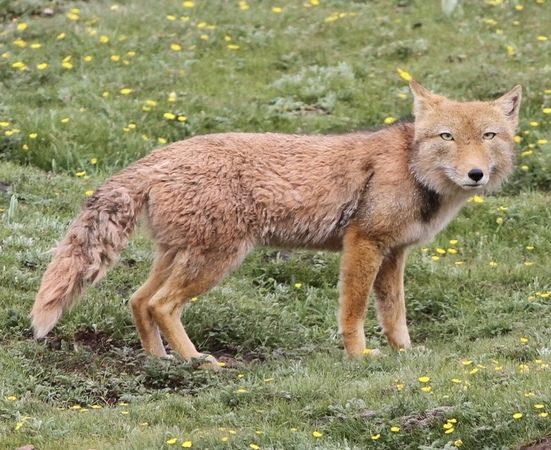

- Origin
- Tibetan Plateau
- Type
- Wild canid
- Size
- Small
- Weight
- 4–5.5 kg (9–12 lb)
- Coat
- Soft and dense
- Colors
- Rufous with gray cheeks, flanks and rump and a white-tipped tail
- Status
- Least Concern (IUCN)
The Tibetan fox (Vulpes ferrilata), also called the Tibetan sand fox, is a true fox found only on the high Tibetan Plateau and in neighboring parts of China, India, Nepal and Bhutan. It lives at heights of up to about 5,300 m (17,400 ft). Because it is widespread across the plateau’s steppes and semi-deserts, it is listed as Least Concern on the IUCN Red List.
Range and habitat
The fox is restricted to the Tibetan Plateau in western China and to the Ladakh plateau and Sikkim in India. It occurs north of the Himalayas along the northern borders of Nepal and India, across Tibet, and in parts of the Chinese provinces of Qinghai, Gansu, Xinjiang, Yunnan and Sichuan.
It keeps mainly to dry and semi-dry grassland, well away from people and from thick vegetation, on upland plains and hills between 3,500 and 5,200 m (11,500 and 17,100 ft). Now and then it has been seen as low as 2,500 m (8,200 ft).
As the plateau warms, the fox’s suitable habitat has moved to higher ground. Its range now overlaps more with that of the red fox, and the two compete more than before.
Appearance
The coat is soft and dense. It is rufous from the crown down the neck and back to the lower legs, while the cheeks, flanks, upper legs and rump are gray. The muzzle is narrow. The bushy tail has a white tip, and the short ears are tan to grayish tan behind and white inside.
Adults measure 60 to 70 cm (24 to 28 in) without the tail, which adds 29 to 40 cm (11 to 16 in). They usually weigh 4 to 5.5 kg (9 to 12 lb).
Of all the true foxes, this one has the skull most specialized for eating meat. It is long, with narrow jaws, a concave forehead and very long canine teeth.
Behavior
The Tibetan fox lives mainly on plateau pikas. It also takes rodents, marmots, woolly hares, small ground birds and lizards, and scavenges the carcasses of Tibetan antelopes, musk deer, blue sheep and livestock. Since pikas are active by day, so is the fox. It hunts mostly alone, though mated pairs stay together and may hunt as a team.
Tibetan foxes sometimes follow brown bears that are digging for pikas, and snatch the ones that get away from the bear.
Dens are dug at the foot of boulders, along old shorelines and on low slopes, and may have four entrances, each 25–35 cm (10–14 in) across. After a pregnancy of about 50 to 60 days, two to four young are born in the den. They stay with their parents until they are eight to ten months old.
Foxes in parts of Sichuan province are heavily infected with Echinococcus tapeworms.
Facts on this page were checked against Wikipedia and may have changed since.