African Wild Dog

- Origin
- Sub-Saharan Africa
- Type
- Wild canid
- Size
- Large
- Height
- 60–75 cm (24–30 in)
- Weight
- 18–36 kg (40–79 lb)
- Coat
- Stiff bristle hairs with no underfur
- Colors
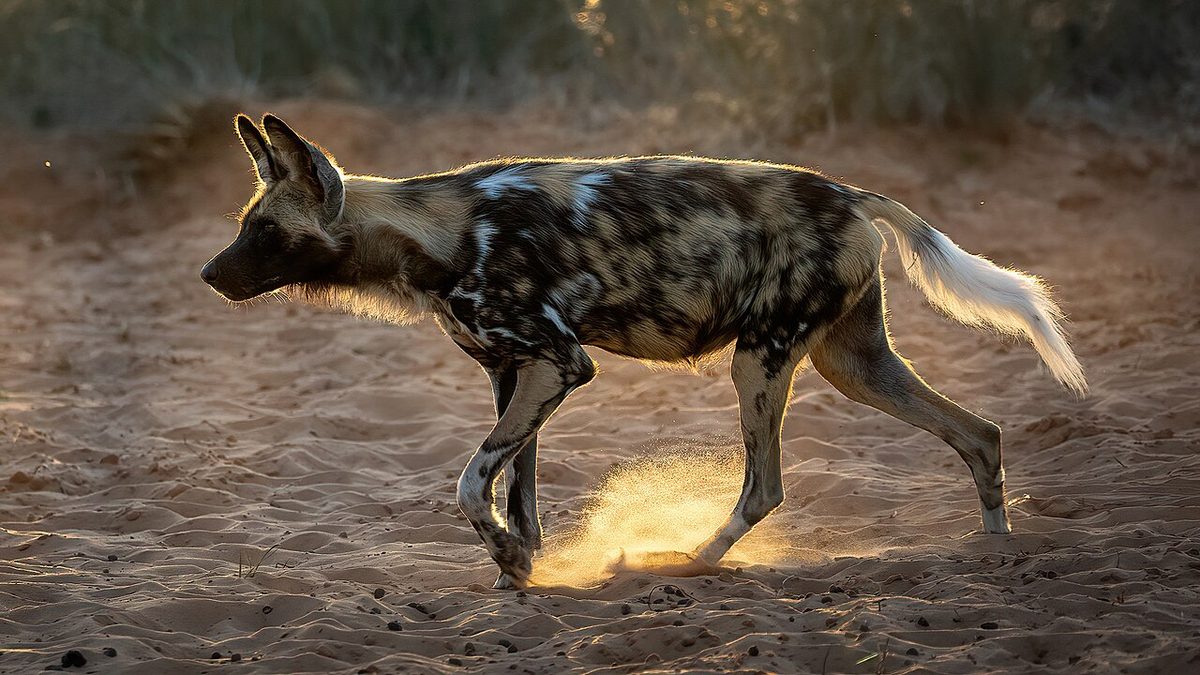
- Patches of black, brown, yellow and white, different on every animal
- Life span
- 10–11 years in the wild
- Status
- Endangered (IUCN)
The African wild dog (Lycaon pictus), also called the painted dog or Cape hunting dog, is a wild canine native to sub-Saharan Africa. It is the largest wild canine on the continent and the only living member of its genus, set apart from wolves and dogs by teeth specialised for an almost all-meat diet and by the absence of dewclaws. Its scientific name means painted and wolf-like.
Range and habitat
The species is found mainly in Southern and East Africa. It is rare in North Africa and mostly absent from West Africa, where the only population that may be viable lives in Senegal’s Niokolo-Koba National Park. It prefers savanna and arid country and generally avoids forest, probably because it hunts by sight and pursuit over open ground. Even so, packs have been recorded in mountain forest in Ethiopia and once on the summit of Kilimanjaro. Kruger National Park holds a stable population of more than 370.
An estimated 6,600 adults survive in 39 separate populations, all threatened by fragmented habitat, persecution by people and outbreaks of disease. The species has been listed as endangered since 1990.
Appearance
This is the bulkiest and most solidly built of Africa’s canids, yet lean and tall beside a wolf or dog, with very large ears. It stands 60 to 75 cm at the shoulder and weighs 18 to 36 kg; females are slightly smaller than males. The middle two toe pads are usually fused.
The coat is made up entirely of stiff bristle hairs with no underfur. Its coloring varies enormously, and no two animals match; even the two sides of one animal differ. Dogs from northeastern Africa tend to be mostly black with small white and yellow patches, and southern ones are brighter mixes of brown, black and white. The muzzle is black, shading to brown on the cheeks and forehead, and the tail usually ends in a white tip.
Behavior
African wild dogs form very strong social bonds and almost never live or hunt alone. Packs hold from two to 27 adults and yearlings. Males and females have separate hierarchies, and the dominant pair usually does all the breeding. Unusually among social carnivores, the males stay in the pack they were born into and the females leave to join others.
Litters are the largest of any canid, averaging ten pups after a pregnancy of 69 to 73 days. The whole pack helps raise them. Adults bring up meat for the pups, and for one another, and the young are allowed to eat first at a kill.
The dogs communicate with a wide range of twittering, whining and hooting calls. In Botswana, packs have been seen to decide whether to set off hunting by sneezing: the more dogs that sneeze, the likelier the pack is to go.
They hunt mostly medium-sized antelope such as impala, Thomson’s gazelle and kudu, usually at dawn and dusk. The pack approaches quietly, then runs its prey down at up to 66 km/h in a chase that averages about 2 km. Lions are their main enemy and kill them where they can, and spotted hyenas often steal their kills.
Facts on this page were checked against Wikipedia and may have changed since.