Side-striped Jackal
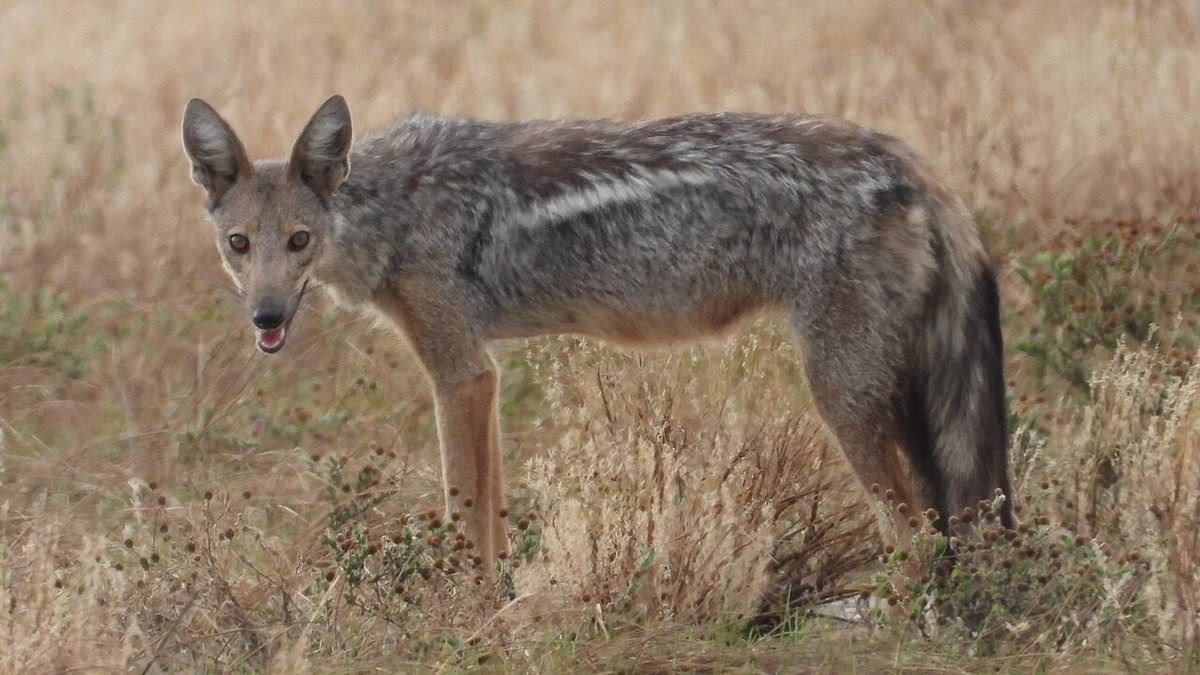

- Origin
- Africa
- Type
- Wild canid
- Size
- Medium
- Height
- 35–50 cm (14–20 in)
- Weight
- 6.5–14 kg (14–31 lb)
- Colors
- Buff-gray with a faint white stripe on each flank and a black tail tipped with silver-gray
- Status
- Least Concern (IUCN)
The side-striped jackal (Lupulella adusta) is a wild canid native to central and southern Africa. It is found over a much wider area than the better-known black-backed jackal, though for large parts of that range nothing is known about its numbers.
The species was first named Canis adustus in 1847. DNA evidence shows that it and the black-backed jackal form a lineage of their own outside the wolves and their relatives, and in 2019 a specialist group recommended placing both in the genus Lupulella. Fossils of the side-striped jackal go back to the Pliocene.
Appearance
This is a slender, medium-sized animal, on average slightly larger than the black-backed jackal. It weighs 6.5 to 14 kg (14 to 31 lb), measures 69 to 81 cm (27 to 32 in) in head and body, and has a tail of 30 to 41 cm (12 to 16 in). It stands 35 to 50 cm (14 to 20 in) at the shoulder.
The coat is buff-gray, darker on the back than underneath. The tail is black with a gray, almost silver tip. Faint white stripes run along the flanks from elbow to hip. They vary from one animal to the next and are clearer in adults than in young ones.
The skull is flatter than the black-backed jackal’s, with a longer, narrower muzzle and smaller shearing teeth, a set of teeth well suited to a mixed diet.
Behavior
The side-striped jackal eats less meat than other jackals. It is a highly adaptable omnivore whose diet shifts with place and season: mostly invertebrates in the wet months and small mammals such as the springhare in the dry ones. It often scavenges at campsites and at the kills of larger predators. In the wild it eats fruit only in season, but near farms and villages fruit can make up 30% of what it eats. It rarely takes anything larger than a newborn antelope. One animal was recorded entering a duck pen to eat the ducks’ feed while ignoring the birds.
It usually forages alone, though family groups of up to 12 have been seen feeding together in western Zimbabwe. The jackals live singly or in family groups of up to seven, led by a breeding pair. Pairs are monogamous and stay together for years.
Breeding time depends on the region; in southern Africa it runs from June to November. Pregnancy lasts 57 to 70 days, and the usual litter is three to six pups. The young are sexually mature at six to eight months and generally begin to leave the family at about 11 months.
Facts on this page were checked against Wikipedia and may have changed since.