Coyote
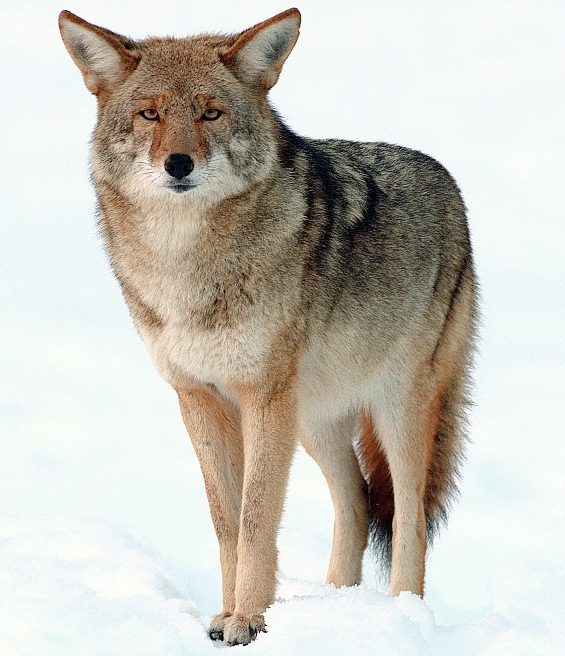

- Origin
- North America
- Type
- Wild canid
- Size
- Medium
- Weight
- 7–20 kg (15–44 lb)
- Coat
- Short, soft underfur with long, coarse guard hairs
- Colors
- Light gray and red or fulvous, mixed with black and white
- Status
- Least Concern (IUCN)
The coyote (Canis latrans) is a wild canine native to North America. It is smaller than its close relative the gray wolf, and it fills much the same place in nature as the golden jackal does in Eurasia. Its scientific name means “barking dog”. Adaptable and widespread, it is listed as Least Concern by the International Union for Conservation of Nature.
Range and habitat
Before Europeans arrived, the coyote lived mainly on the open plains and in the dry country of western North America and of northern and central Mexico.
From the 19th century, as land was cleared and wolves were wiped out, it spread north and east. It now lives across the contiguous United States and Mexico, south through Central America and north through most of Canada and Alaska, from about 8°N in Panama to 70°N. It was first recorded east of the Panama Canal in 2013.
The species does well in landscapes changed by people, and urban coyotes are common in many cities.
Appearance
Males average 8 to 20 kg (18 to 44 lb) and females 7 to 18 kg (15 to 40 lb). Northern coyotes are larger than those of Mexico. Total length averages 1.0 to 1.35 m (3 ft 3 in to 4 ft 5 in), including a tail of about 40 cm (16 in).
The fur is mainly light gray and red or fulvous, mixed with black and white. Northern coats are longer and denser than southern ones.
Compared with the gray wolf, the coyote has a slimmer frame, a narrower face and muzzle, and longer ears. It carries its bushy tail low when it walks or runs, where a wolf holds its tail level. Nineteen subspecies are recognized.
Behavior
Coyotes are flexible in how they live. The basic group is a family built around a breeding female, but unrelated animals also form loose, temporary packs. Pairs are strictly monogamous. They form in midwinter, and the pups, six in an average litter, are born after 63 days in a den that is often the enlarged burrow of a badger, marmot or skunk. Both parents feed and guard the pups.
About 90 percent of the diet is meat: rabbits, hares, rodents, deer, birds, reptiles, amphibians, fish and insects, along with carrion. Coyotes also eat fruit, grass and crops. Small prey is caught alone, often with a pounce; large prey is hunted in pairs or small groups.
They are most active around dusk and early in the night, and tend to become nocturnal near people. They travel 5 to 16 km (3 to 10 mi) a day and swim well. The typical call is a howl that shifts quickly in tone and pitch.
People are the coyote’s greatest threat, followed by cougars and gray wolves. Coyotes interbreed with eastern and red wolves, and occasionally with domestic dogs, producing fertile hybrids known as coydogs. The larger eastern coyote of the northeast is the result of past crossing with wolves.
Facts on this page were checked against Wikipedia and may have changed since.