Blanford’s Fox
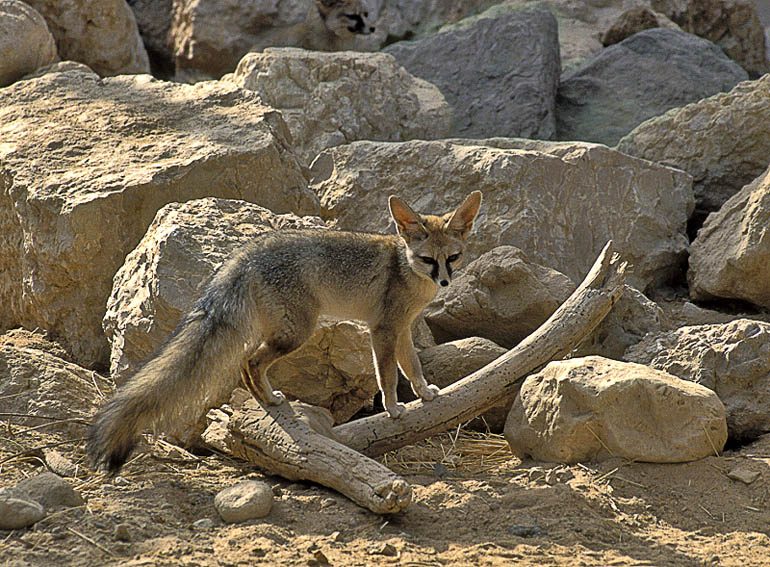

- Origin
- West and Central Asia
- Type
- Wild canid
- Size
- Small
- Weight
- About 0.9 kg (1.9 lb)
- Coat
- Soft and woolly in winter, thinner and paler in summer
- Colors
- Brownish-gray with a black band along the back, fading to light yellow on the belly
- Life span
- 4–5 years in the wild
- Status
- Least Concern (IUCN)
Blanford’s fox (Vulpes cana) is a small wild fox native to West Asia, Central Asia and parts of South Asia. Among living members of the dog family only the fennec fox is smaller. It was described scientifically in 1877 by William Thomas Blanford, from a specimen collected in southern Balochistan.
Range and habitat
The range is broken into separate patches. The fox was first known only from southwest Asia, around the Iranian Plateau, Turkmenistan and Pakistan, with skins also collected in Afghanistan and Tajikistan. It was reported in Israel in 1981 and has since proved to be more widespread on the Arabian Peninsula than anyone had thought, with confirmed records from the Sinai Peninsula, Jordan, Saudi Arabia, Oman, the United Arab Emirates and Yemen. There is a single record from Egypt west of the Suez Canal, an animal caught in 1988 and at first taken for a Rüppell’s fox.
Appearance
This is a small fox with wide ears and a long, bushy tail almost as long as its body. Size varies from region to region. One set of measured specimens averaged 873 g (about 1.9 lb), with a body 42 cm (17 in) long and a tail of 32.5 cm (12.8 in).
The body is brownish-gray, fading to light yellow on the belly. A black band runs down the middle of the back from the nape and continues as a crest along the tail, which usually ends in a black tip, though in some animals the tip is white. The winter coat is soft and woolly, with a dense black undercoat and white flecks on the back; the summer coat is thinner and paler.
The large ears help the fox shed heat, as in other foxes of dry country. Unlike other desert foxes, it has bare footpads. With these and its sharp, curved claws it grips narrow ledges, using the tail as a counterweight. It climbs crumbling cliffs in a series of leaps and can jump to a ledge 3 m (9.8 ft) above it.
Behavior
Blanford’s fox is strictly nocturnal, probably as a defense against birds of prey that hunt by day. It nearly always forages alone, only occasionally in pairs, and seldom stores food.
It eats both animal and plant food, mainly insects and fruit. In Israel the fruit of two caper bushes is the main plant food, along with dates and other plants. In Pakistan the foxes live largely on fruit, including Russian olives, melons and grapes.
The species is thought to be strictly monogamous. Females come into heat once a year, in January or February, and bear one to three kits after about 50 to 60 days. The young begin foraging with a parent at two months and on their own at three, and are sexually mature at 10 to 12 months. In the wild the average lifespan is four to five years, and no more than ten.
Conservation
The IUCN lists Blanford’s fox as Least Concern, a rating lowered as more was learned about how widely it is spread. Even so, little is known about the species or about how vulnerable it is to the diseases of domestic dogs. It competes little with people for habitat. It is protected in Israel and may not be hunted in Oman and Yemen. Some are hunted for fur in Afghanistan, and a few die from poison set out for hyenas and other animals.
Facts on this page were checked against Wikipedia and may have changed since.