Corsac Fox

- Origin
- Central Asia
- Type
- Wild canid
- Size
- Small
- Weight
- 1.6–3.2 kg (3.5–7.1 lb)
- Coat
- Thick and silky in winter
- Colors
- Gray to yellowish with paler underparts; straw-gray in winter
- Life span
- Up to 9 years in the wild
- Status
- Least Concern (IUCN)
The corsac fox (Vulpes corsac), also called the corsac or steppe fox, is a medium-sized wild fox of the steppes, semi-deserts and deserts of Central Asia, Mongolia and northern China. Its name comes from the Russian korsák, which goes back to a Turkic word.
Range and habitat
Corsac foxes are found throughout Kazakhstan, Uzbekistan and Turkmenistan and across all but the far north of Mongolia. To the south their range reaches northern Iran, Tajikistan, Kyrgyzstan, Afghanistan and China, and they also live in nearby parts of Russia. They keep to open grassy steppe and semi-desert. They avoid dense vegetation, mountains, drifting sand, snow deeper than about 15 cm, and places disturbed by people.
The species is listed as least concern, though its numbers swing widely and can fall tenfold in a single year. The main threat is hunting for fur, which has gone on since the Bronze Age. Overgrazing, development and the decline of marmots, whose burrows the foxes use, also affect it. Natural disasters can cut local numbers by 90%, but populations usually recover quickly.
Appearance
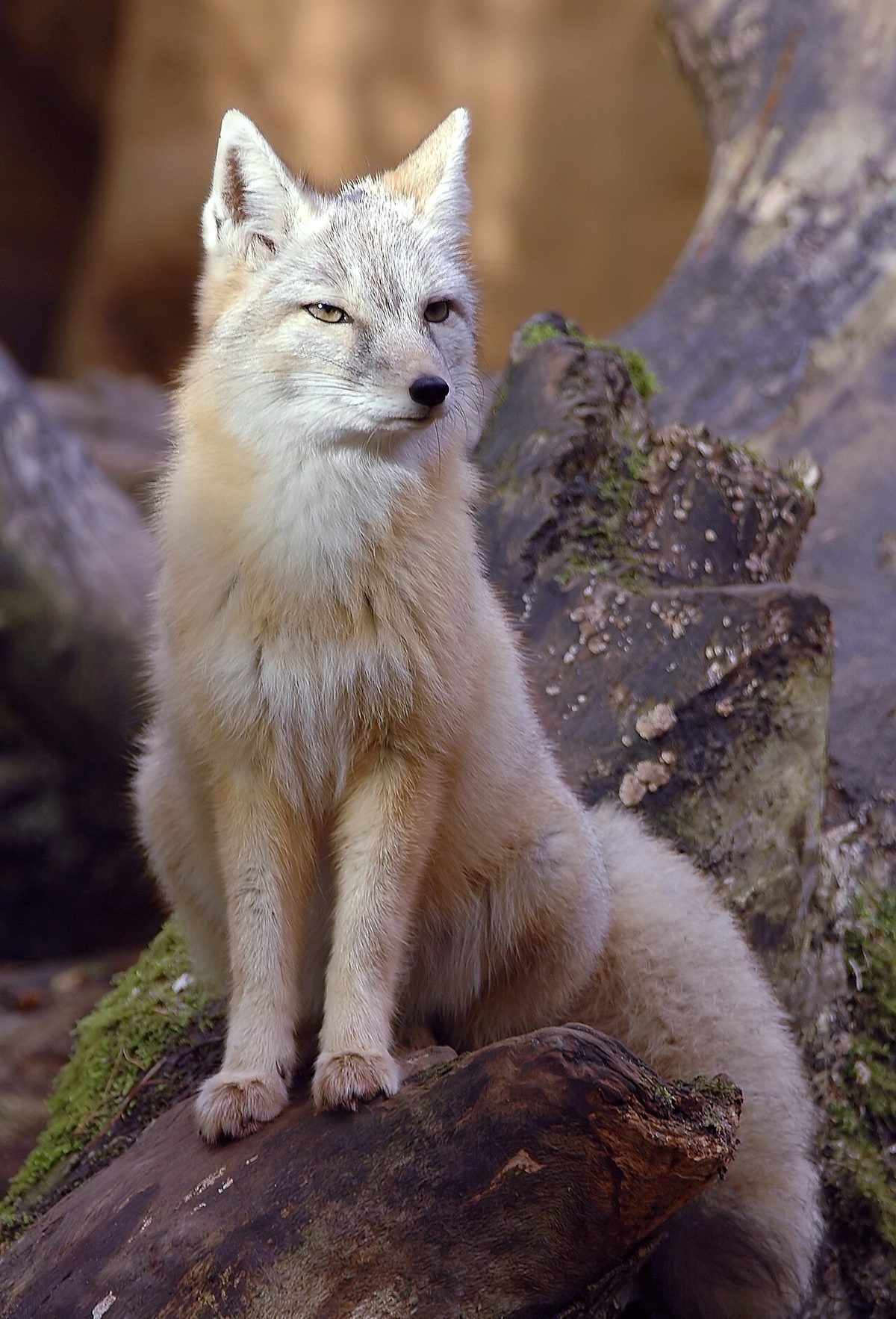
The head and body measure 45–65 cm, with a tail of 19–35 cm, and adults weigh 1.6–3.2 kg. The fur is gray to yellowish over most of the body, paler below, with pale markings on the mouth, chin and throat. In winter the coat grows much thicker and silkier and turns straw-gray, with a darker line down the back. For a fox it has small teeth and a wide skull. Its eyesight, hearing and sense of smell are reported to be keen.
Behavior
The corsac is a nomadic hunter, mostly active at night, with no defended territory. Unlike some foxes it sometimes forms packs. It eats mainly insects and small rodents such as voles, gerbils, jerboas, hamsters and ground squirrels, and will take hares and pikas, scavenge carrion and eat some fruit and plants in winter. It can go without food and water for long periods.
It cannot hunt in deep snow. In hard weather it shelters in a den, and in the north of its range it may move up to 600 km south for the winter. It digs shallow dens of its own and also takes over the burrows of marmots, ground squirrels and badgers. Packs share groups of connected burrows. Corsacs are slow runners and can easily be caught by a dog. They bark when hunting or threatening rivals and use higher yelps or chirps as alarm calls and greetings.
Mating runs from January to March. Pairs are monogamous and the male helps to raise the young. Usually two to six kits are born after 52 to 60 days. They open their eyes at about two weeks and start eating meat at four. Wolves, eagles and eagle-owls prey on the species.
Facts on this page were checked against Wikipedia and may have changed since.