Cape Fox

- Origin
- Southern Africa
- Type
- Wild canid
- Size
- Small
- Height
- 30–35 cm (12–14 in)
- Weight
- 2.5–4.5 kg (5.5–9.9 lb)
- Coat
- Soft, with thick wavy underfur and dense guard hair
- Colors
- Silvery gray with tawny legs, a dull red head and a black-tipped tail
- Life span
- About 6 years, up to 10
- Status
- Least Concern (IUCN)
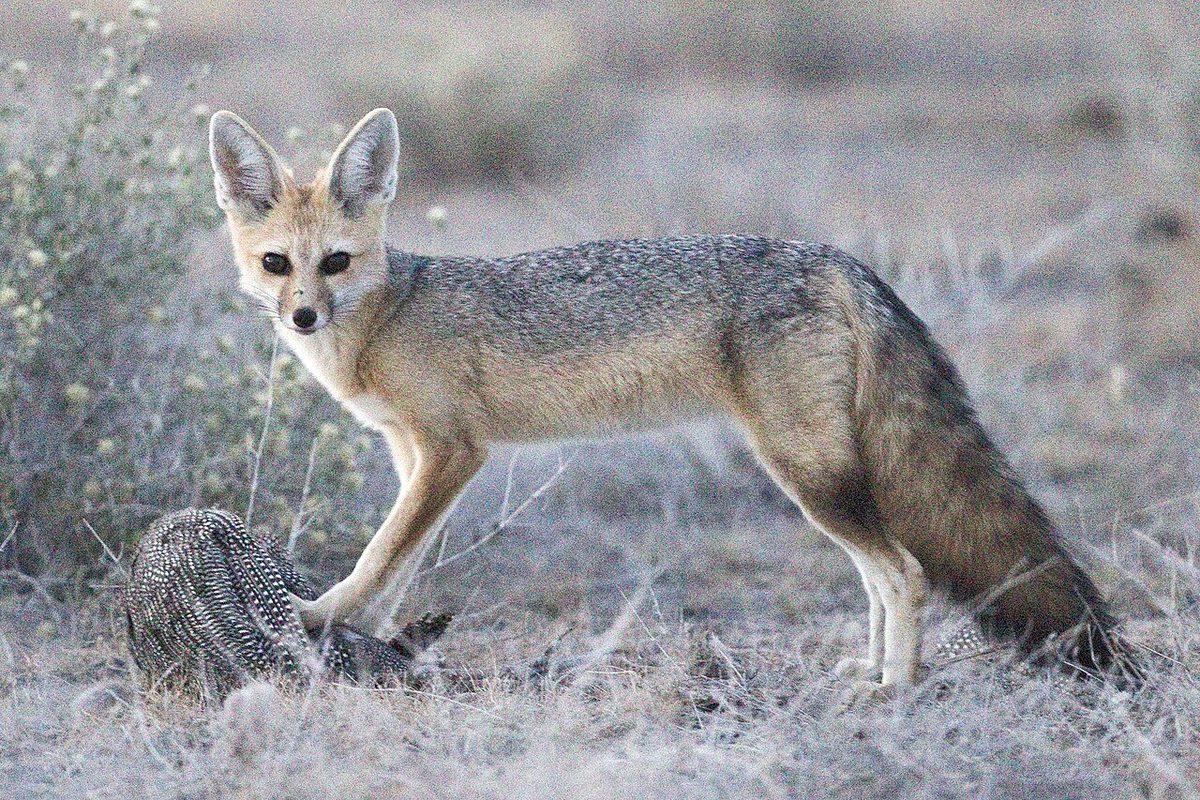
The Cape fox (Vulpes chama) is a small wild fox native to southern Africa. It is the only true fox living in sub-Saharan Africa. Because it split off early from the other members of its genus, it keeps some primitive features of the group.
Range and habitat
The Cape fox lives mainly in dry and semi-dry country, though in places such as the fynbos of South Africa’s Western Cape it reaches wetter areas with denser vegetation. It is widespread in the central and western parts of southern Africa, north to southwestern Angola, and is found across Zimbabwe, Botswana and most of South Africa. It also lives in the mountains of Lesotho.
Appearance
This is a lightly built fox. The body is 45–62 cm (17.5–24.5 in) long, with a tail of 30–40 cm (12–15.5 in). It stands 30–35 cm (12–14 in) at the shoulder and weighs 2.5–4.5 kg (5.5–9.9 lb). Males and females look much alike.
The ears are fairly large and pointed, and the muzzle is small and sharp. The coat is silvery gray, lighter on the neck and flanks and pale tawny to buff underneath. The head is dull red, the lower jaw dark brown, and the legs tawnier than the body. The tail is thick and bushy and always ends in a black tip.
The fur is soft, with wavy underfur about 25 mm deep under a dense layer of guard hair. The coat is molted in October and November.
Behavior
Cape foxes are nocturnal and most active just before dawn and just after dusk. They spend the day in burrows, holes or thick cover. They can dig their own burrows but more often take over and alter one left by another animal, such as a springhare.
They are mostly solitary. Mated pairs form, but the male and female usually forage apart, and loose groups gather only now and then to feed. They are generally quiet, communicating with soft calls, whines and chirps, and bark loudly when alarmed. A raised tail signals excitement.
The diet is broad and opportunistic. Small mammals such as rodents and insects come first, along with birds, eggs, small reptiles, carrion, wild fruit, berries, seeds and roots. Cape foxes sometimes take very young lambs, and they store food in holes.
Breeding takes place in July and August. After 51 to 53 days the female gives birth to one to six cubs in a burrow. Both parents look after them, and the male brings food to the female for the first week or two. Cubs are weaned at six to eight weeks, stay near the den until about four months, and become independent at five to eleven months. They are sexually mature at nine months.
Lions, leopards, caracals, black-backed jackals and birds of prey all hunt Cape foxes, and honey badgers may kill the young. Farmers trap and poison them as suspected lamb-killers, many die on roads, and rabies and canine distemper take a toll. About 2,500 are killed each year. Even so, numbers are stable across the range.
Facts on this page were checked against Wikipedia and may have changed since.