Pale Fox

- Origin
- Sahel, Africa
- Type
- Wild canid
- Size
- Small
- Weight
- 2.0–3.6 kg (4.4–7.9 lb)
- Coat
- Thin and short, with a long bushy tail
- Colors
- Pale sandy, whitish below, with a black-tipped reddish-brown tail
- Life span
- Up to 10 years
- Status
- Least Concern (IUCN)
The pale fox (Vulpes pallida) is a small wild fox of the African Sahel, the dry band of country along the southern edge of the Sahara. It is one of the least studied of all canids, partly because its home is remote and partly because its sandy coat makes it hard to see. Five subspecies are recognised.
Range and habitat
The pale fox lives in the semi-arid Sahel from Mauritania and Senegal in the west, through Nigeria, Cameroon and Chad, to the Red Sea. It is also found in Benin, Burkina Faso, Eritrea, Ethiopia, Gambia, Mali, Niger, South Sudan and Sudan, and in the south its range reaches the savanna of northern Guinea. It keeps to sandy or stony dry country, sometimes wandering into savanna, and it shifts north or south as the region’s periodic droughts come and go.
Appearance
This is a small fox with a long body, fairly short legs and a narrow muzzle. The head and body measure 38 to 55 cm (15 to 22 in), the tail 23 to 29 cm (9.1 to 11.4 in), and it weighs 2.0 to 3.6 kg (4.4 to 7.9 lb).
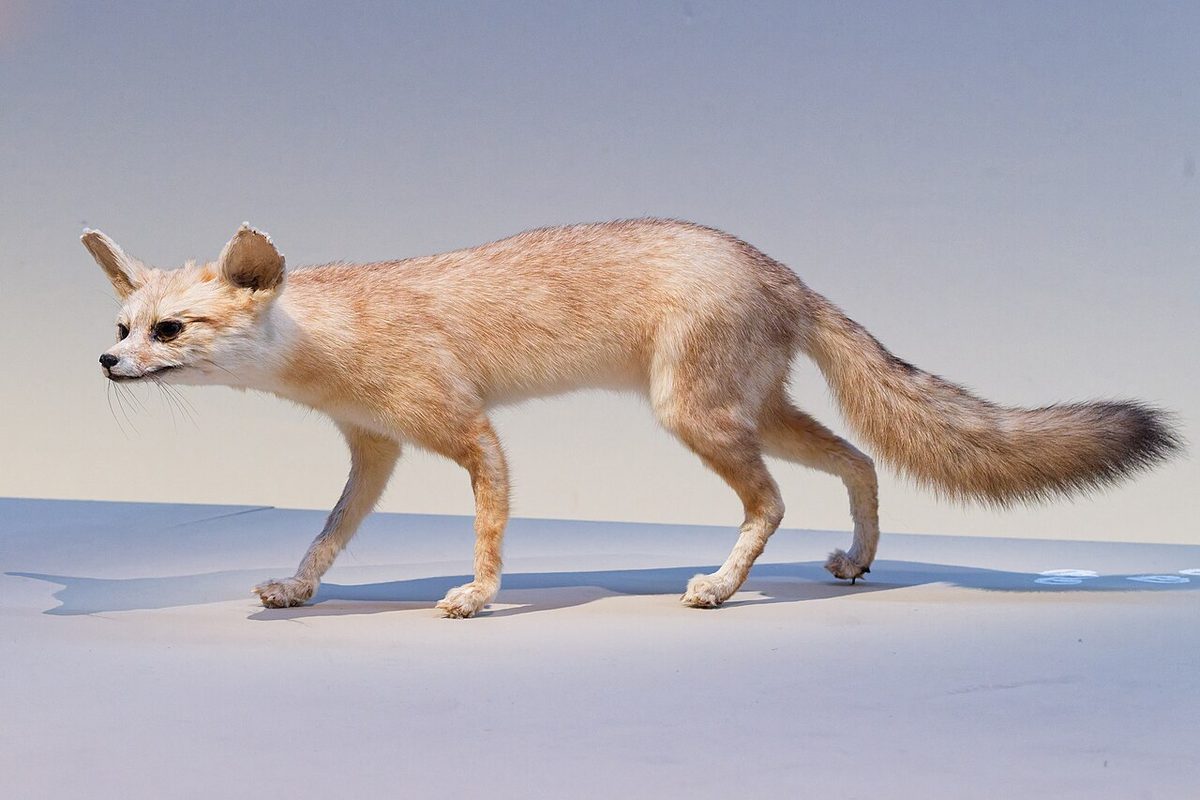
The fur is thin and pale sandy, fading to buff-white underneath. The back is often flecked with black or rufous and has a darker line down the middle. The flanks are paler and the legs rufous. The face is pale, with long whiskers and a dark ring around each eye. The long, bushy tail is reddish brown with a clear black tip and a dark patch over the tail gland.
The ears are large and triangular, as in other desert canids. They shed heat and sharpen the fox’s hearing for prey and for danger.
Behavior
Pale foxes are active at night, when it is cooler. They spend the day in burrows that can run up to 15 meters long and 2 meters deep, and come out at dusk to forage. They are sociable and share burrows, probably as small family groups of parents and young, and they groom and play together. They communicate by voice, by visual displays and by scent marking.
They catch birds, reptiles, insects and small mammals by stealth and agility, and also eat fruit, seeds and carrion. Jackals, birds of prey and other large carnivores prey on them in turn.
Pairs are monogamous and may stay together for several breeding seasons. Breeding usually falls in the cooler months. The female digs a burrow or takes over an existing den, and after a pregnancy of 50 to 60 days she gives birth to three to six pups, which are born blind and deaf. Pale foxes live no more than about 10 years.
Numbers are unknown, but the pale fox seems to be common across its wide range, and the International Union for Conservation of Nature rates it as of least concern. Habitat loss and fragmentation, human encroachment and climate change are growing threats.
Facts on this page were checked against Wikipedia and may have changed since.