Kit Fox
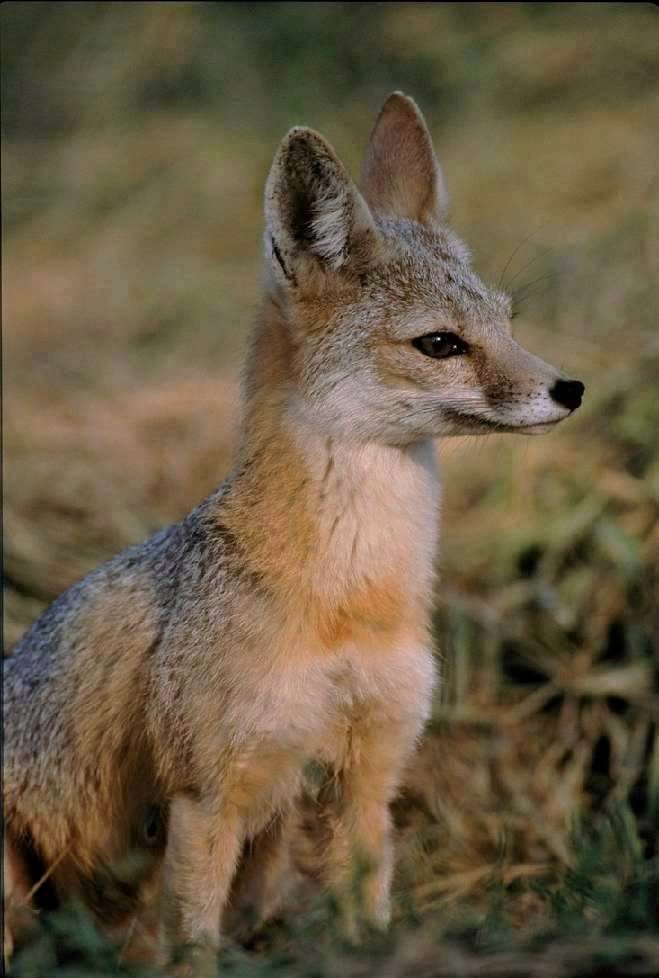

- Origin
- United States
- Type
- Wild canid
- Size
- Small
- Weight
- 1.6–2.7 kg (3.5–6 lb)
- Coat
- Grizzled, with black-tipped or banded guard hairs
- Colors
- Yellow to gray, darker on the back, with a black-tipped tail
- Life span
- About 5.5 years in the wild; 10–12 years in captivity
- Status
- IUCN: Least Concern
The kit fox (Vulpes macrotis) is a small wild fox of the dry country of the southwestern United States and northern and central Mexico. It is the smallest of the four Vulpes foxes found in North America. Some scientists have treated it as the same species as the swift fox, but genetic studies indicate the two are distinct, though they interbreed to a limited extent where their ranges meet.
Range and habitat
The range runs from the arid interior of Oregon in the north to southwestern Colorado in the east, and south through Nevada, Utah, southeastern California, Arizona and New Mexico into western Texas and Mexico. Kit foxes live in desert scrub, chaparral, salt-tolerant shrubland and grassland, at elevations of 400 to 1,900 m (1,300 to 6,200 ft). They seem to prefer loose soil for digging dens.
The species as a whole is not considered threatened. The San Joaquin kit fox of California is the exception: it has been listed as endangered since 1967 and is still declining, mainly through loss of habitat.
Appearance
A kit fox weighs 1.6 to 2.7 kg (3.5 to 6 lb), with males slightly larger than females. The body is 455 to 535 mm (about 18 to 21 in) long, and the tail adds another 260 to 323 mm (about 10 to 13 in). The ears are very large, 71 to 95 mm (2.8 to 3.7 in), and both shed heat and give the fox sharp hearing.
Coat color varies from place to place. It runs from yellow to gray, usually darker on the back and paler on the belly, with dark patches beside the nose. Black-tipped and banded guard hairs give the coat a grizzled look, and the shoulders and flanks are buff to orange. The bushy gray tail ends in a black tip. Stiff tufts of hair on the soles of the feet give grip on sand and protect against extreme temperatures.
Behavior
Kit foxes are active mainly at night, and sometimes at dawn and dusk. They spend the day in underground dens, which they also use to escape predators, save moisture and raise young. They generally hunt alone but live in pairs or small family groups and are not strongly territorial.
They are opportunistic feeders. Rodents, rabbits, hares and insects are common prey, and in the California deserts the main one is Merriam’s kangaroo rat. They also eat birds, reptiles, carrion and occasionally fruit, and they cache food. Their food supplies all the water they need, so they rarely have to drink.
Pairs usually stay together all year and mate between December and February. After a pregnancy of about 49 to 56 days, four or five pups are born in February or March. They first leave the den at about four weeks, are weaned at about eight weeks and are independent at five to six months. Both parents care for them. Wild kit foxes live about 5.5 years on average, and captive ones 10 to 12 years.
Facts on this page were checked against Wikipedia and may have changed since.