Raccoon Dog
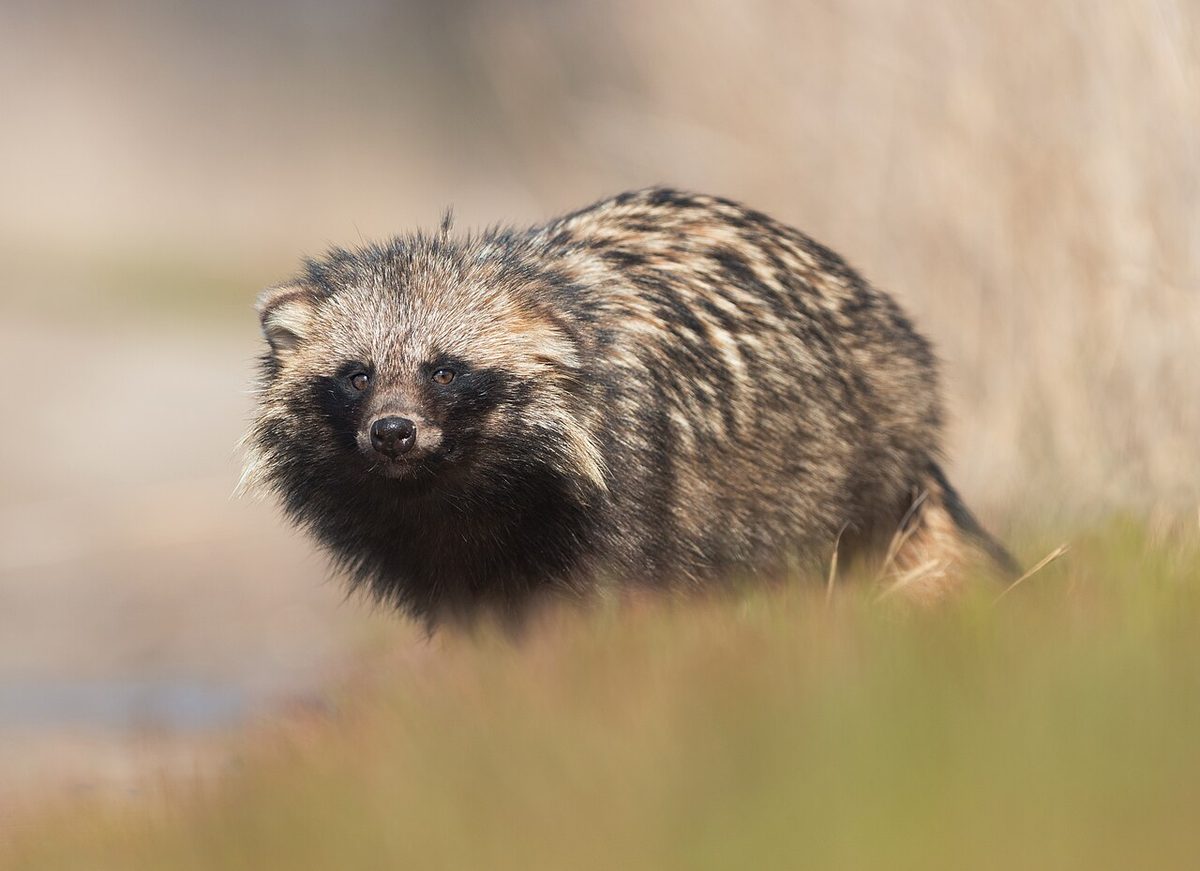

- Origin
- East Asia
- Type
- Wild canid
- Size
- Small
- Weight
- 3–10 kg (7–22 lb), varying with the season
- Coat
- Long, thick winter fur with dense underfur
- Colors
- Earth brown to brownish gray with black guard hairs and a dark facial mask
- Status
- Least Concern (IUCN)
The raccoon dog (Nyctereutes procyonoides) is a wild canid native to East Asia. It is heavy-set and fox-like, and is named for the raccoon-like markings on its face. It is not related to the raccoon. Its closest relatives are the true foxes. The similar Japanese raccoon dog, or tanuki, is now thought to be a separate species, and is the only other living member of the genus.
Range and habitat
The raccoon dog is widespread in its native East Asia. It also lives across much of Europe, where it was brought for its fur. Between 1928 and 1958 some 10,000 animals were released in the Soviet Union.
The animal is now abundant in Finland, Estonia, Latvia and Lithuania, and has been reported from Scandinavia to France and the Balkans. Since 2019 it has been on the European Union’s list of invasive alien species, which means it may not be imported, bred, transported, sold or released.
Appearance
The raccoon dog has a long body and short legs. It measures 45 to 71 cm (18 to 28 in) in length, with a short tail of 12 to 18 cm (4.7 to 7.1 in). The ears are short and barely show above the fur. Weight changes with the season. Animals weigh about 3 kg (6.6 lb) in March. By late summer males average 6.5 to 7 kg (14 to 15 lb), and some reach 9 to 10 kg (20 to 22 lb).
The winter fur is long and thick, with dense underfur and coarse guard hairs, and protects the animal down to about −25 °C (−13 °F). It is a dirty earth brown or brownish gray with black guard hairs. A dark stripe runs along the back and widens over the shoulders into a cross. The summer coat is brighter, a reddish straw color. A rare white form occurs in China.
Behavior
Raccoon dogs are unusual among canids in two ways. They are the only ones known to hibernate, and they regularly climb trees, a habit they share only with the North American gray fox. Before winter they put on a great deal of fat, and animals that fail to do so usually do not survive. In milder regions they sleep only through severe snowstorms.
They are omnivores. They eat insects, rodents, frogs and toads, birds and eggs, fish, reptiles, mollusks, carrion and human garbage, along with fruit, nuts, berries, grain and vegetables.
Raccoon dogs are monogamous, and pairs usually form in autumn. Mating runs from early February to late April. After 61 to 70 days the female gives birth, in April or May, to a litter that is usually of six to eight pups. The male takes an active part in rearing them. Animals of six or seven years have been found in the wild, and captives have lived to 11.
Raccoon dogs and people
Raccoon dogs can harm game birds, especially on floodplains and estuary shores, where in spring they eat mostly eggs and chicks.
They can carry rabies, canine distemper and many parasites.
Facts on this page were checked against Wikipedia and may have changed since.