Yorkshire Terrier

- Origin
- England
- Type
- Toy and companion
- Size
- Toy
- Weight
- Up to 3.2 kg (7 lb)
- Coat
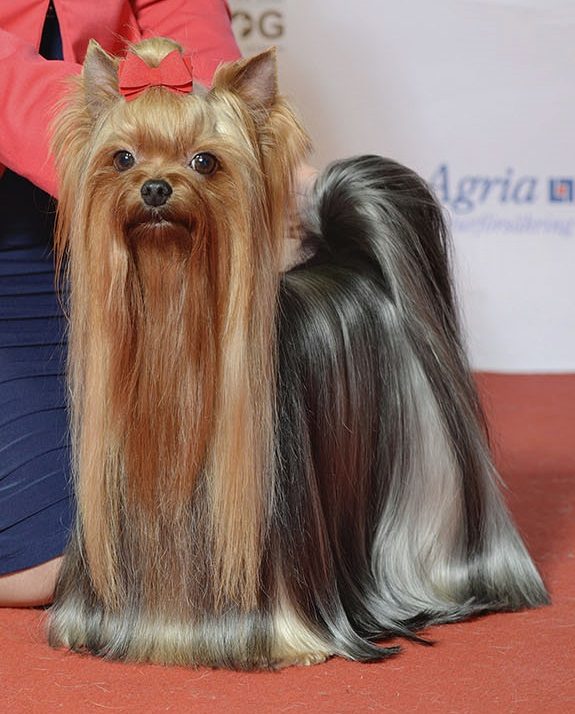
- Long, fine, straight and silky
- Colors
- Dark steel gray on the body, tan on the head, chest and legs
- Life span
- About 13 years
- Status
- Recognised by the FCI, AKC and The Kennel Club
The Yorkshire Terrier, or Yorkie, is a British toy dog of terrier type. Weighing no more than 3.2 kg (7 lb), it is among the smallest of all dog breeds. It was developed in the nineteenth century in the English county of Yorkshire, and today it is usually kept as a playful, energetic companion.
History
In the mid-nineteenth century, workers from Scotland came to Yorkshire looking for work and brought several kinds of terrier with them. The new breed was created mostly by workers in the cotton and woolen mills of Yorkshire and Lancashire. Black-and-Tan Terriers were bred with Paisley and Clydesdale Terriers to make a small ratting dog, and some authorities believed the Maltese was used as well. Few details were written down.
At first the dogs were shown as Scotch Terriers. The name Yorkshire Terrier was given because the dogs had been so much improved in that county. In the late 1860s a show dog called Huddersfield Ben, owned by Mary Ann Foster, was seen at shows across Great Britain and set the type for the breed. He is still called the father of the breed.
The Yorkshire Terrier reached North America in 1872, and the American Kennel Club registered its first in 1885. The breed has since given rise to others, including the Silky Terrier and the Biewer Terrier.
Appearance
The coat is the breed’s main feature. It is glossy, fine, straight and silky, and is traditionally grown very long and parted down the middle of the back. From the neck to the base of the tail it is dark steel gray. The head, chest and legs are a rich tan. Neither The Kennel Club nor the FCI accepts any other color, though particolored, golden and chocolate dogs do occur. Puppies are darker, and the coat may take three years or more to reach its final color.
Yorkies shed less than many breeds, and the coat is often described as hypoallergenic, but allergists do not accept that any whole breed is safe for allergic people.
Temperament
The Kennel Club describes the ideal Yorkshire Terrier as carrying itself very upright, with an important air.
Care and health
A long coat is very demanding and can knot if it is not brushed every day. Many owners trim it short to make care easier.
Studies in the United Kingdom have put life expectancy between 12.5 and 13.3 years, above the average for dogs.
Conditions often seen in the breed include bronchitis, lymphangiectasia, portosystemic shunt, cataracts and keratitis sicca. Others are distichiasis, hydrocephalus, hypoplasia of dens, Legg–Calvé–Perthes syndrome, luxating patella, retinal dysplasia, bladder stones, tracheal collapse, color dilution alopecia and progressive rod-cone degeneration. The breed is highly prone to periodontal disease. Very small puppies can suffer from low blood sugar, and many Yorkies have a delicate digestion.
Because of its size, a Yorkie tolerates anesthesia poorly and is easily hurt by falls or by larger dogs.
Facts on this page were checked against Wikipedia and may have changed since.