Chihuahua

- Origin
- Mexico
- Type
- Toy and companion
- Size
- Toy
- Height
- 15–23 cm (6–9 in)
- Weight
- 1–3 kg (2.2–6.6 lb)
- Coat
- Short and smooth, or long
- Colors
- All colors except merle
- Status
- Recognised by the FCI, AKC and The Kennel Club
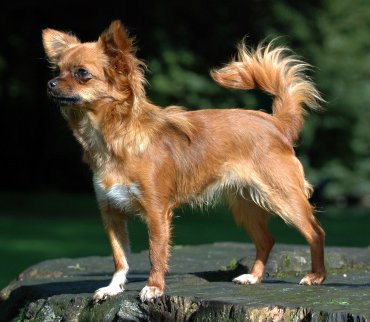
The Chihuahua, or Chihuahueño, is a Mexican toy dog and the smallest recognized breed in the world. It is kept mainly as a companion. It has a compact body, a rounded skull and large upright ears, and it comes in short-coated and long-coated varieties.
History
Genetic studies suggest that the first dogs in North America arrived from Siberia about 10,000 years ago and then lived apart from other dogs for some 9,000 years, until Europeans arrived. That original ancestry has almost vanished. A 2020 study of ancient dog genomes found that a little of it survives in two Mexican breeds, making up about 4 percent of the Chihuahua’s ancestry. Most modern breeds are largely European in origin.
Colonial records from the early nineteenth century mention small, nearly hairless dogs, and one account says the sixteenth-century conquistadores found them plentiful in the region later called Chihuahua. In a letter of 1520, Hernán Cortés wrote that the Aztecs raised and sold small dogs for food.
The American Kennel Club registered its first Chihuahua, a dog called Midget owned by H. Raynor of Texas, in 1904.
Appearance
Breed standards ask for an apple-shaped skull: high and strongly rounded, with large round eyes, big upright ears, and a muzzle that meets the skull at close to a right angle. Chihuahuas have a soft spot on the top of the head called the molera, like the fontanel of a human baby. An older type known as the deer head, with a flatter skull, wider-set eyes, bigger ears and longer legs, can still be registered but counts as a fault in the show ring.
Standards usually set a weight and not a height. Most Chihuahuas stand 15–23 cm (6–9 in), though some grow taller. The international standard asks for 1.5–2.5 kg (3.3–5.5 lb) and disqualifies dogs under 1 kg or over 3 kg. The American standard allows up to 2.7 kg (5.9 lb), and the British standard prefers 1.8–2.7 kg (4–6 lb). Pet Chihuahuas are often heavier. Size is not reliably passed on, and puppies from one litter can end up very different.
Almost any color or pattern is seen, solid, marked or splashed. The international standard excludes merle.
Temperament
Like many small dogs, the Chihuahua may show more aggression than average toward people and other dogs. The American Kennel Club does not recommend the breed for families with young children. Chihuahuas tend to get along fairly well with other dogs, depending on the breed.
Care and health
Chihuahuas have some genetic predisposition to several neurological conditions, among them atlantoaxial instability, ceroid lipofuscinosis, congenital deafness, congenital hydrocephalus, muscular dystrophy, necrotizing meningoencephalitis and neuroaxonal dystrophy. They are mildly predisposed to congenital heart disease, and the tendency to medial patellar luxation is thought to be significant. Puppies are vulnerable to low blood sugar, often after getting cold.
Such small dogs often have trouble giving birth. A study in the United Kingdom found difficult births more than ten times as common in Chihuahuas as in dogs overall.
Studies of life expectancy vary widely, from about 8 years to 11.8 years.
Facts on this page were checked against Wikipedia and may have changed since.