Beagle

- Origin
- England
- Type
- Scenthound
- Size
- Small
- Height
- 33–41 cm (13–16 in)
- Weight
- 8–16 kg (18–35 lb)
- Coat
- Short to medium-length, smooth and hard
- Colors
- Tricolor, or white with tan, lemon, red, liver or black
- Life span
- About 12 years
- Status
- Recognised by the FCI, AKC and The Kennel Club
The Beagle is a small British scenthound that looks much like a foxhound in miniature. It was bred mainly to hunt hare and rabbit on foot, a sport known as beagling. Its nose has also made it a detection dog at borders, and it is commonly kept as a companion.
History
The Beagle’s origin is uncertain. From the Middle Ages the word was used loosely for small hounds of several kinds. By the 18th century two hounds were used on hare and rabbit: the tall, slow Southern Hound, with its excellent nose, and the smaller, faster North Country Beagle.
The modern breed is traced to a pack that the Reverend Phillip Honeywood set up in Essex in the 1830s, thought to carry the blood of both those hounds and perhaps the Harrier. The Beagle Club was formed in 1890 and drew up the first standard.
Beagles were in the United States by the 1840s. The first American standard was written in 1887. The breed has long been more popular in North America than at home. It was the American Kennel Club’s most registered breed from 1953 to 1959.
Appearance
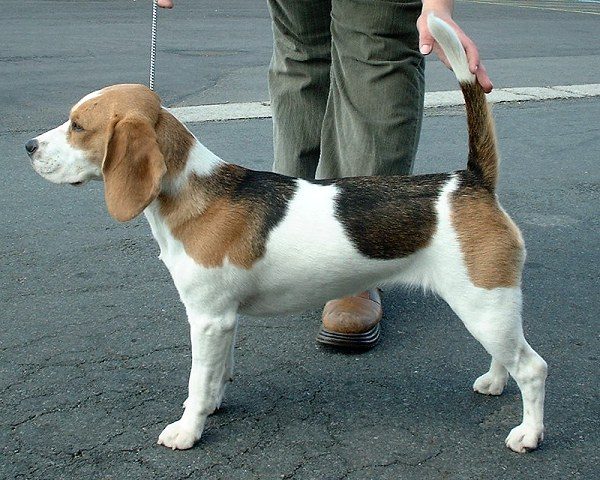
The Beagle stands 33 to 41 cm (13 to 16 in) at the withers and weighs 18 to 35 pounds (8 to 16 kg). Compared with a foxhound, the head is broader, the muzzle shorter and the legs shorter for the body.
The skull is slightly domed, the muzzle square and the nose black or sometimes liver. The eyes are large and hazel or brown, with a soft, pleading look, and the long, soft ears are set low. The tail is carried upright when the dog is busy and has a white tip, bred in so that the hound could be seen with its head down on a scent.
Tricolor, white with black and brown, is the most common color. Two-color dogs are white with tan, lemon, red, liver or black, and some dogs are ticked or mottled.
Temperament
The Beagle is even-tempered and gentle, and several standards call it merry. It likes company, is quickly won over by strangers and is very good with children. That makes it a poor guard, though it will bark or howl at anything unfamiliar. It generally gets along with cats and other dogs.
Beagles are pack animals and are prone to separation anxiety, which can make them destructive when left alone. Their sense of smell is among the best of any dog.
Care and health
Beagles have stamina but are not demanding about exercise. Regular activity helps prevent the weight gain the breed is prone to, since a Beagle will eat whenever food is on offer. The long ears trap moist air, which can lead to ear infections.
A 2024 British study found a life expectancy of 12.5 years. Beagles may be prone to epilepsy, hypothyroidism, several forms of dwarfism and disk disease, while hip dysplasia is rarely a problem. Eye conditions include glaucoma, corneal dystrophy, cherry eye and retinal atrophy.
Facts on this page were checked against Wikipedia and may have changed since.