Chinese Crested

- Type
- Toy and companion
- Size
- Toy
- Height
- 27–33 cm (11–13 in)
- Weight
- 4.5–5.9 kg (10–13 lb)
- Coat
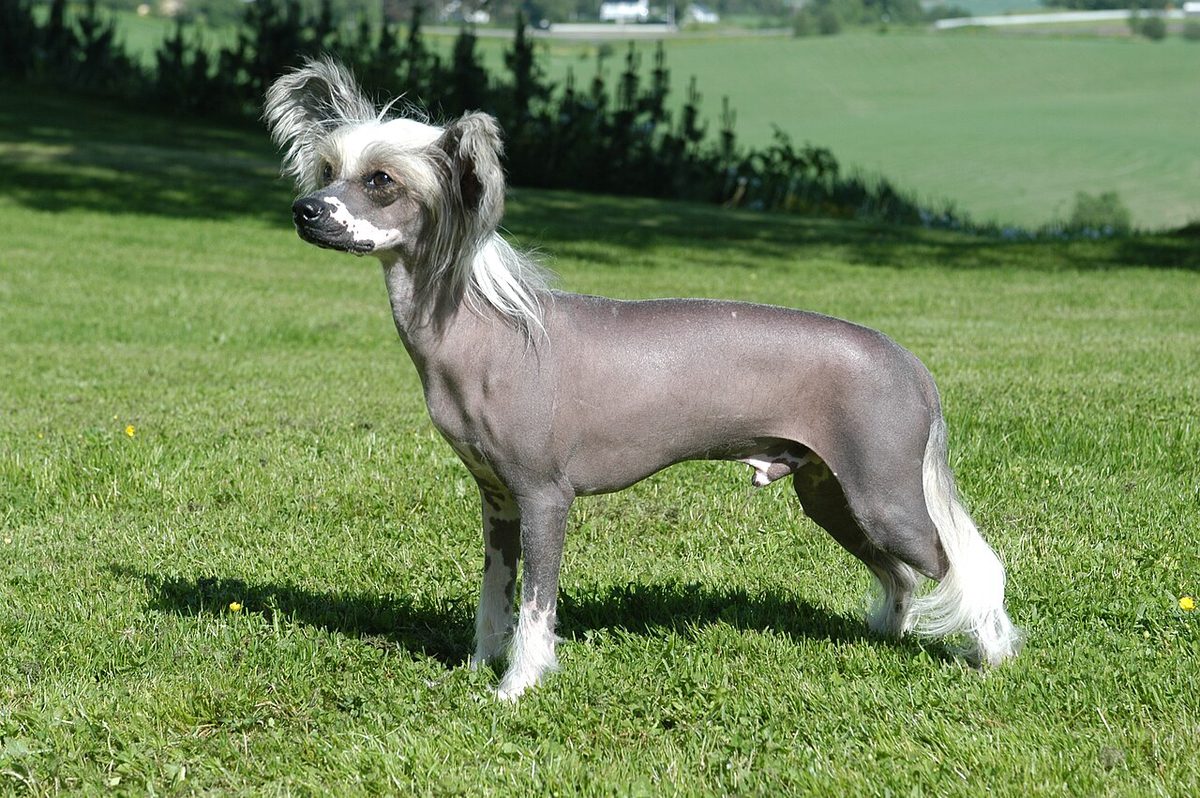
- Hairless with a crest, socks and plume, or a long, soft double coat (powderpuff)
- Colors
- Any color
- Life span
- About 13.4 years
- Status
- Recognised by the FCI and AKC
The Chinese Crested is a small hairless breed of dog. It comes in two varieties, which can be born in the same litter: the hairless, and the powderpuff, which has a full coat.
History
Despite the name, the modern Chinese Crested is unlikely to have come from China. It shares its hairless mutation with the Xoloitzcuintli, which suggests a common origin, and the breed is thought to have begun in Africa or, more probably, Mexico. Spanish explorers came across such dogs in Mexico and elsewhere in Central and South America as early as the 1500s. British, French and Portuguese explorers found them in parts of Africa and Asia during the 1700s and 1800s.
In the 1950s Debora Wood set up the Crest Haven kennel and began breeding the dogs deliberately and recording their lines. The burlesque dancer Gypsy Rose Lee bred them too, and after her death her dogs joined Crest Haven. Every Chinese Crested alive today goes back to these two lines.
The Fédération Cynologique Internationale recognized the breed in 1987 and the American Kennel Club in 1991.
Appearance
The Chinese Crested stands 27 to 33 cm (11 to 13 in) tall and weighs 4.5 to 5.9 kg (10 to 13 lb) on average. It is fine-boned, with almond-shaped eyes and large, upright ears. No color is laid down for the breed.
The hairless has soft skin, ranging from pale flesh to black, with long flowing hair on the head (the crest), tufts on the paws (socks) and a plume on the tail. The amount of body hair varies widely. Some dogs have almost none; others, called hairy hairless, grow a nearly full coat if left untrimmed. Even these have a single coat with bare patches, while the powderpuff has a thick double coat that is long, straight and silky.
Hairlessness is an incompletely dominant trait. Embryos that inherit two copies of the gene do not develop, so every hairless dog carries one copy, and powderpuffs carry none.
Temperament
Cresteds are intelligent and playful, and do well in obedience sports. They can be sensitive and respond best to gentle, consistent training. They are not a high-energy breed, though they enjoy daily exercise outdoors.
Care and health
The powderpuff’s coat needs frequent brushing and a weekly bath to prevent mats. It sheds little or not at all. The hairless variety’s skin is cared for much like human skin and can suffer from acne, dryness and sunburn, especially in pale dogs.
A 2024 study in the United Kingdom found a life expectancy of 13.4 years. Hairless dogs are prone to missing, crowded or decaying teeth; powderpuffs rarely have dental defects. The breed has a higher rate of primary lens luxation than most, and can also develop progressive retinal atrophy and dry eye. Other conditions noted are patellar luxation and canine multiple system degeneration, a progressive movement disorder that starts at 10 to 14 weeks of age.
Facts on this page were checked against Wikipedia and may have changed since.