French Bulldog
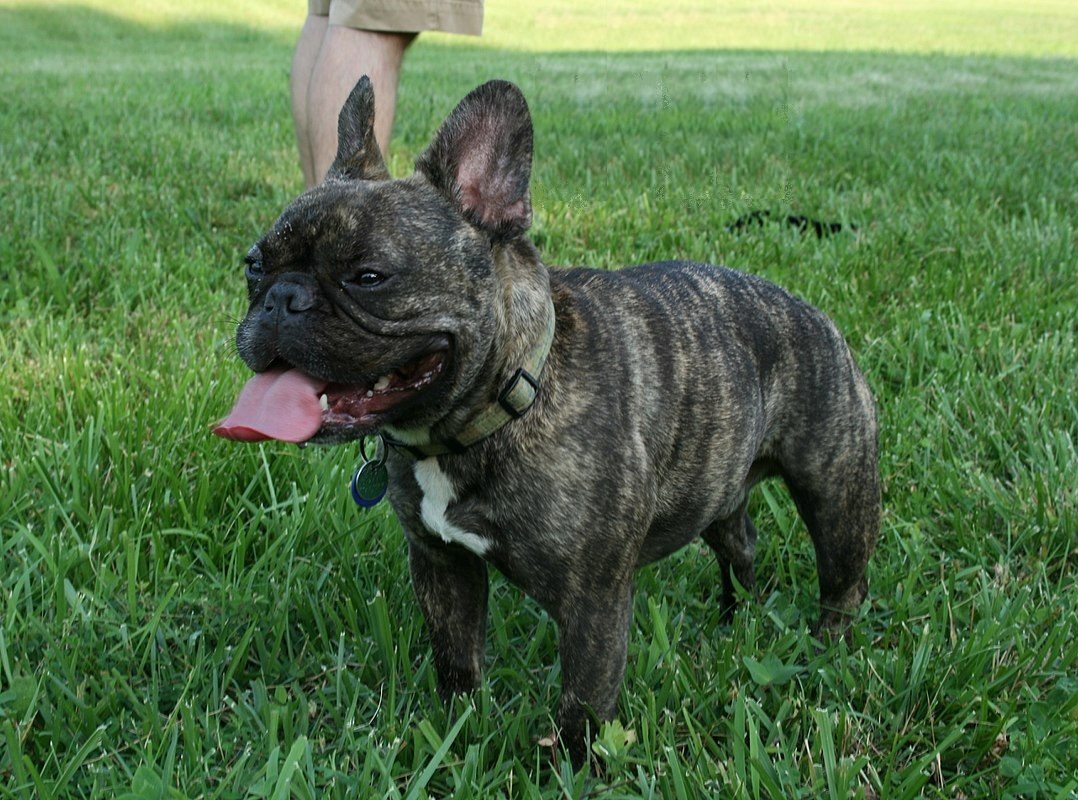

- Origin
- France
- Type
- Toy and companion
- Size
- Small
- Height
- 24–35 cm (9–14 in)
- Weight
- 8–14 kg (18–31 lb)
- Coat
- Short, fine and smooth
- Colors
- Brindle, fawn, cream, or white with brindle patches (pied)
- Life span
- About 10 years
- Status
- Recognised by the FCI, AKC and The Kennel Club
The French Bulldog is a French companion dog that appeared in Paris in the middle of the nineteenth century, apparently from crosses between Toy Bulldogs imported from England and the local ratting dogs. It is now one of the most registered breeds in Australia, the United Kingdom and the United States. Its flat face and wrinkled skin, the features it was bred for, also leave it open to a number of health problems.
History
After bull-baiting was banned in the United Kingdom in 1835, bulldogs were bred for other purposes, and by mid-century there were miniature ones of about 7–11 kg (15–24 lb). Around the same time, lace workers from Nottingham who had lost their work to the Industrial Revolution settled in Normandy and took their Toy Bulldogs with them. The little dogs caught on in France, and English breeders began exporting bulldogs they thought too small or faulty, such as those with upright ears. By 1860 few Toy Bulldogs were left in England.
In France the type came to be seen as a breed and was named the Bouledogue Français. It was fashionable with society ladies, Parisian prostitutes, artists, writers and designers alike. No records were kept of its development, but terrier blood was added along the way and helped produce the long, straight ears.
Americans began a breeding program in 1885, and the dogs were first shown at Westminster in 1896. When a judge the next year gave prizes only to dogs with folded “rose” ears, the owners formed the French Bull Dog Club of America and wrote a standard preferring the erect bat ear. The American Kennel Club recognised the breed soon after, and by 1906 it was the fifth most popular in the country.
Appearance
The French Bulldog is a muscular little dog with a soft, loose skin that forms wrinkles. The head is large and square with a flat face and ears like a bat’s. The American standard sets a top weight of 13 kg (28 lb) and asks for very dark eyes; blue eyes are not accepted.
The coat is short and fine. Accepted colors are brindle, fawn of any shade, cream, and white with brindle patches, known as pied. Brindle is the most common, then fawn. The breed clubs recognise no other colors or patterns.
Care and health
A British study of 43 common conditions found French Bulldogs significantly more likely than other dogs to have 20 of them. Narrowed nostrils were 42 times as common and brachycephalic obstructive airway syndrome 30 times as common. Ear discharge, skin fold dermatitis and difficult births were also far more frequent.
The short muzzle distorts the upper airway and obstructs breathing. It also makes anesthesia riskier and leaves the dogs prone to overheating, because they cannot cool themselves well by panting. Several airlines refuse to carry them after deaths in flight.
More than 80% of litters are delivered by Caesarean section. The breed is also prone to malformed vertebrae, slipped kneecaps, disk herniation, demodicosis, skin allergies and hereditary cataracts.
Estimates of life expectancy vary widely. A 2024 British study found 9.8 years and a Japanese study 10.2 years. An earlier British study gave 4.53 years, a figure its authors said may have been skewed by the fast-growing, very young population.
Facts on this page were checked against Wikipedia and may have changed since.