Staffordshire Bull Terrier

- Origin
- England
- Type
- Terrier
- Size
- Medium
- Height
- 36–41 cm (14–16 in)
- Weight
- 11–17 kg (24–37 lb)
- Coat
- Short, smooth and close
- Colors
- White, black, blue, fawn, red or brindle, with or without white
- Life span
- 11–12 years
- Status
- Recognised by the FCI, AKC and The Kennel Club
The Staffordshire Bull Terrier, also called the Stafford or Staffy, is a small to medium-sized terrier from England. It began in Staffordshire and the northern parts of Birmingham, and it descends from the 19th-century crosses of bulldogs and terriers known as bull and terriers. First bred to fight, it is now a family pet and companion.
History
Bull-baiting and bear-baiting were outlawed in Britain by the Cruelty to Animals Act of 1835. Dog fighting was easier to hide and carried on, and breeders moved away from the heavy bulldog, adding terrier blood for agility and gameness. The resulting bull and terriers went by many names and were a mixed group of dogs, not a true breed.
In the mid-19th century James Hinks used outcrosses, including Dalmatians and Collies, to create the Bull Terrier as a show dog. Those who preferred the original type stayed with it, and their dogs became the Staffordshire Bull Terrier, named for the county where it was most popular. Bull and terriers taken to the United States became the ancestors of the American Staffordshire Terrier and the American Pit Bull Terrier.
Organized dog fighting in Britain largely ended after the Protection of Animals Act of 1911, but the fighting past made kennel clubs slow to accept the breed. Joseph Dunn, a judge and breeder, led the campaign. The Kennel Club approved the name in 1935, and the Staffordshire Bull Terrier Club was formed that June at a pub in Cradley Heath, where a standard was agreed the same day. The Canadian Kennel Club followed in 1952, the FCI in 1954 and the American Kennel Club in 1974.
Appearance
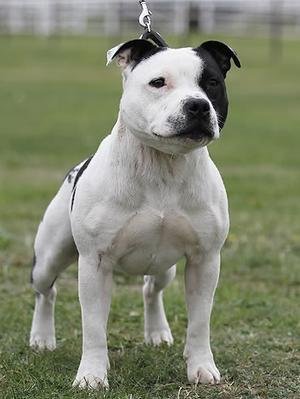
The Stafford is muscular and well-boned, with strong shoulders, a wide chest and wide-set legs. It is about as long from withers to tail as it is tall. The head is broad, and the ears fold over at the tip. Dogs stand 36–41 cm (14–16 in) at the withers. Males weigh about 13–17 kg (29–37 lb) and females about 2 kg less.
The coat is short, stiff and close. It may be white, or black, blue, fawn, red or any brindle, each with or without white.
Temperament
The Kennel Club calls the breed bold, fearless and totally reliable, and its standard notes a particular affinity with children; it is among the breeds the club recommends for families. The Stafford also has a reputation for pugnacity and is known not to back down when another dog challenges it. It is agile and quite active.
Staffords are often confused with pit bull types, with which they share ancestors. A proposal in 2018 to add the breed to the UK’s Dangerous Dogs Act was rejected by Parliament.
Care and health
UK studies have found a life expectancy of 11.3 to 12 years. The breed is predisposed to juvenile demodicosis and is one of those most often affected by hereditary cataracts. Neurological disorders identified in Staffords include cerebellar abiotrophy, Chiari-like malformation, myotonia congenita and L-2-hydroxyglutaric aciduria.
Facts on this page were checked against Wikipedia and may have changed since.