Boston Terrier

- Origin
- United States
- Type
- Toy and companion
- Size
- Small
- Height
- 23–38 cm (9–15 in)
- Weight
- 3–11 kg (6–25 lb)
- Coat
- Short, smooth and slick
- Colors
- Black, brindle or seal, each with white markings
- Life span
- About 12 years
- Status
- Recognised by the FCI and AKC
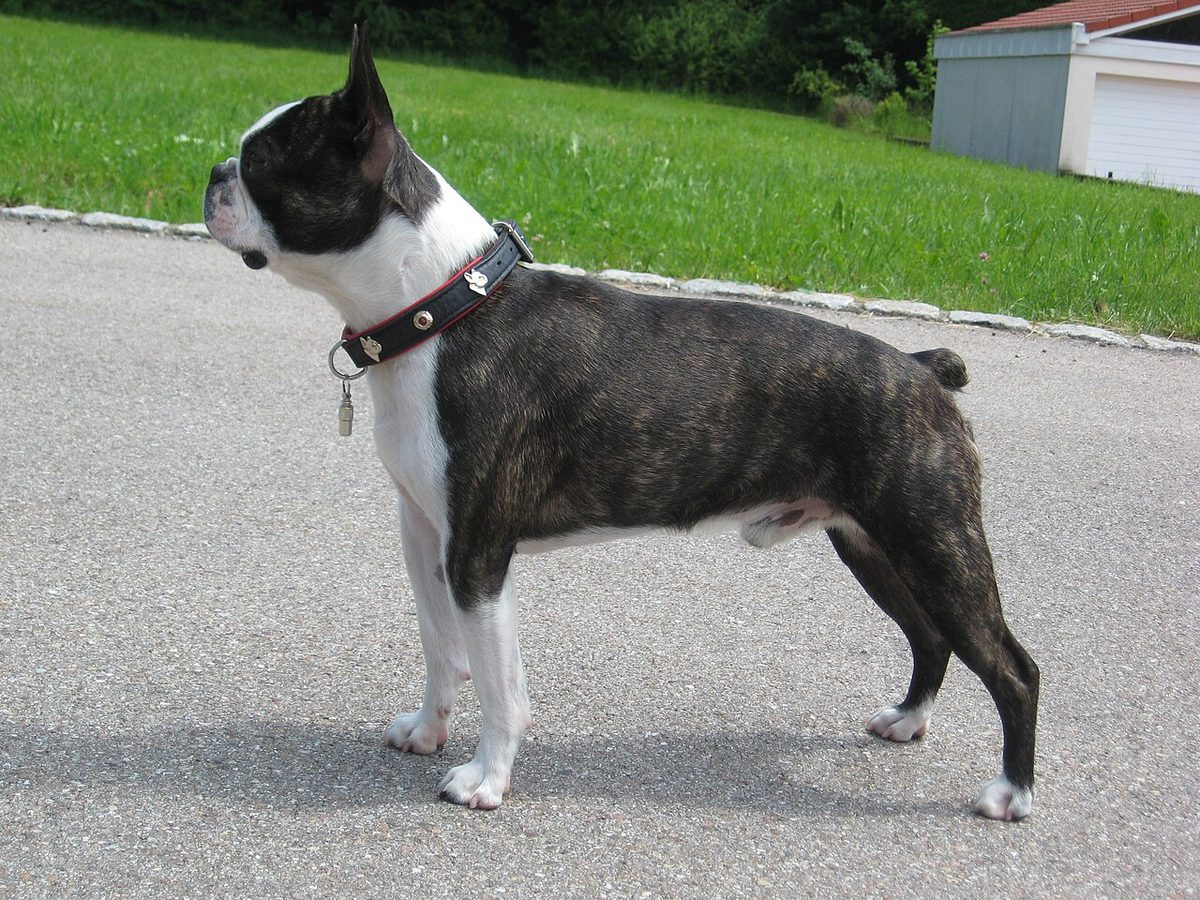
The Boston Terrier is a small, compact dog with a short muzzle, a short tail and upright ears. It is one of the few breeds that began in the United States, where it was bred down from fighting dogs of the bull-and-terrier type into a companion. Its neat white markings and pleasant manners earned it the nickname “the American Gentleman”.
History
The breed goes back to about 1870, when Robert C. Hooper of Boston bought a dog named Judge from William O’Brien. Judge, a bull-and-terrier type of about 15 kg (32 lb), was mated to Gyp, a white bulldog-type female of about 9 kg (20 lb) owned by Edward Burnett of Southboro, Massachusetts. She was stocky and strong and had the blocky head still seen in the breed. The American Kennel Club regards Hooper’s Judge as the ancestor of nearly all true Boston Terriers. The early dogs, known as Old Boston Bulldogs, weighed up to 20 kg (44 lb), and later breeders made the type smaller and more refined.
The Boston Terrier Club was formed in 1891 and joined the American Kennel Club in 1893, when the breed was accepted as a non-sporting dog. Color and markings mattered little at first, but by the 20th century they had been written into the standard as an essential feature. A Boston Terrier named Rhett has been Boston University’s mascot since 1922, and the breed has been the state dog of Massachusetts since 1979. In 2024 it was the 23rd most registered breed with the AKC.
Appearance
The Boston Terrier is compact and well proportioned, with a square-looking head, erect ears, a slightly arched neck and a broad chest. The muzzle is short and generally free of wrinkles, and the bite is even or slightly undershot. The eyes are large, round and set wide apart. Under the breed standards the dog should weigh no more than 11 kg (25 lb), and the AKC divides it into three weight classes: under 15 lb, 15 to under 20 lb, and 20 to 25 lb.
The tail is naturally short, usually no more than 5 cm (2 in), and may be straight, curled or corkscrewed.
The coat is short and smooth. It is white in combination with black, brindle or seal, a color that looks black with a red cast in the light. Solid colors are not accepted. The required markings are a white chest, a white band around the muzzle and a white band between the eyes; a white collar and white on the legs are also desired, and symmetrical markings are preferred in the show ring.
Temperament
Boston Terriers are generally eager to please and easy to train. They are usually quiet, barking only when there is reason to, which suits them to apartment life. They enjoy company and, when properly socialized, get along well with children, older people, other dogs and other pets. The breed has lost most of its fighting ancestors’ aggression, though some males will still challenge another dog they feel is invading their territory.
Care and health
A 2024 study in the United Kingdom found a life expectancy of 11.8 years, a little below the 12.7-year average for purebred dogs.
The Boston Terrier is a brachycephalic breed: its shortened muzzle deforms the upper airway and can obstruct breathing. The effects include noisy breathing, brachycephalic airway obstructive syndrome, skin fold dermatitis and protruding eyes, along with a higher risk under anesthesia and of overheating, since the dog cannot cool itself well by panting.
Most litters are delivered by caesarean section, more than 80% in a UK Kennel Club survey. The breed is one of those most often affected by hereditary cataracts, and is predisposed to several skin conditions, among them atopic dermatitis, demodicosis, mast cell tumors and pattern alopecia. A curved back, called roaching, may come from patella problems in the hind legs. Hip dysplasia is uncommon: a North American study found it in 0.36% of Boston Terriers, against 3.52% of dogs overall.
Facts on this page were checked against Wikipedia and may have changed since.