Wire Fox Terrier
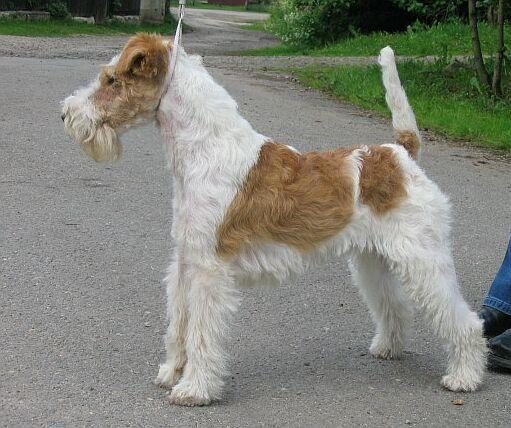

- Origin
- England
- Type
- Terrier
- Size
- Small
- Height
- Up to 39 cm (15.5 in)
- Weight
- 6.8–8.6 kg (15–19 lb)
- Coat
- Rough and broken
- Colors
- Mostly white with brown and black markings
- Life span
- About 13.5 years
- Status
- Recognised by the FCI and The Kennel Club
The Wire Fox Terrier is a terrier from England, developed by fox hunting enthusiasts. It looks much like the Smooth Fox Terrier, but the two are believed to have been developed separately.
History
The breed is thought to descend from a rough-coated, black and tan working terrier, now extinct, that was found in Wales, Derbyshire and Durham. It is said to have been bred to follow foxes into their burrows. Its short, strong tail, usually docked, served the hunter as a handle for pulling the dog back out.
Queen Victoria is said to have owned one, and her son King Edward VII had a Wire Fox Terrier named Caesar. Even so, the breed was not a popular family pet until the 1930s, when the Thin Man films appeared with a Wire Fox Terrier, Asta, among the cast. Its popularity soared. Snowy, Tintin’s companion in the comic strip, is a Wire Fox Terrier too.
The breed fell out of fashion again late in the 20th century, most likely because hunting terriers with strong prey instincts are hard to keep in cities.
In the show ring it has an unmatched record. As of 2019 it had taken Best in Show at the Westminster Kennel Club show 15 times, more than any other breed. One of the winners, Matford Vic, won twice, in 1915 and 1916.
Appearance
The Wire Fox Terrier is a sturdy, balanced dog that should stand no more than 39 cm (15.5 in) at the withers. Males weigh 7.7 to 8.6 kg (17 to 19 lb) and females 6.8 to 7.7 kg (15 to 17 lb).
The rough, broken coat is the breed’s hallmark. It is mainly white, with brown markings on the face and ears and usually a black saddle or a large patch of color. There may be other black or brown markings on the body.
Temperament
Energy and intelligence are the breed’s most distinctive traits. A Wire Fox Terrier is alert, quick and enthusiastic, and with proper care and exercise it is friendly and playful. It was bred to think for itself, and it bores easily, so it needs stimulation, exercise and a great deal of attention.
Its hunting background shows in a readiness to run off, chase things and go after other animals, behavior that is normal for the breed but leads some owners to give their dogs up. It needs firm control and plenty to do.
Care and health
Show dogs are stripped by hand, which keeps the coat’s colors and gloss. Many pets are clipped by a groomer each month, which is simpler and cheaper but dulls the colors and leaves the coat soft, curly and harder to keep clean.
A 2024 study in the United Kingdom found a life expectancy of 13.5 years for the breed, compared with 12.7 for purebred dogs overall.
Facts on this page were checked against Wikipedia and may have changed since.