Cavalier King Charles Spaniel
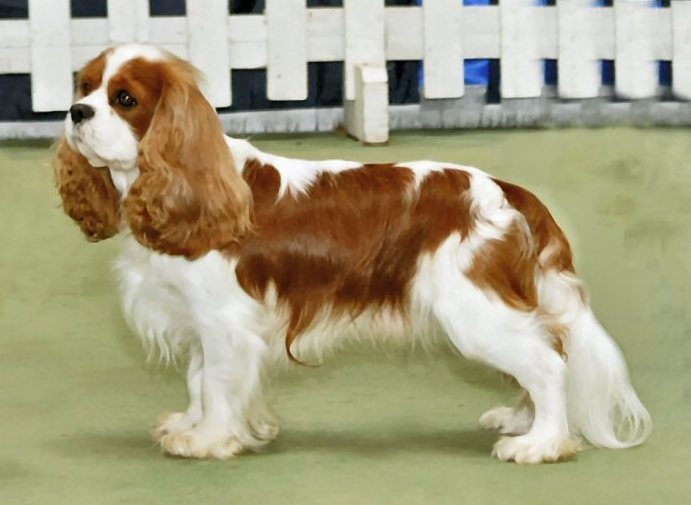

- Origin
- England
- Type
- Toy and companion
- Size
- Small
- Weight
- 5.4–8 kg (12–18 lb)
- Coat
- Silky, moderately long, with feathering
- Colors
- Blenheim (chestnut and white), tricolor, black and tan, or ruby
- Life span
- 8–12 years
- Status
- Recognised by the FCI, AKC and The Kennel Club
The Cavalier King Charles Spaniel is a British toy spaniel with a silky coat in four recognised colors. It was historically a lap dog, and it is small for a spaniel. Until the 1920s it shared its history with the smaller, flatter-faced King Charles Spaniel; the Cavalier came out of an effort to bring back the older look of the toy spaniels of Charles II’s time, when the king’s supporters were known as Cavaliers.
History
During the 19th century toy spaniels were crossed with flat-nosed breeds and changed greatly. In 1926 an American, Roswell Eldridge, offered show prizes for Blenheim spaniels of the old type, with a long face and a flat skull. Breeders of the day were appalled, but a few took up the idea. The first Cavalier club was formed in 1928.
World War II nearly ended the project, as most breeding stock was lost to wartime hardship; one kennel fell from 60 dogs to three. The Kennel Club recognised the Cavalier as a breed of its own on December 5, 1944. The first recorded Cavalier reached the United States in 1956, and the American Kennel Club recognised the breed in 1995.
Appearance
Adult Cavaliers weigh on average 5.9 to 8.2 kg (13 to 18 lb). The coat is silky and of moderate length, free of curl though a slight wave is allowed, with long feathering on the ears, legs, feet and tail. Compared with the King Charles Spaniel, the Cavalier is larger, with a flat skull where the other’s is domed, higher-set ears and a longer muzzle.
Blenheim is rich chestnut on pearly white, sometimes with a chestnut spot in the center of the forehead. Tricolor is black and white with tan markings. Black and tan dogs are black with tan highlights, and ruby dogs are chestnut all over.
Temperament
The Cavalier is playful, patient and eager to please. Most get along well with children and with other dogs, large or small, and the breed adapts readily to city or country life. It tends to treat every stranger as a friend, so it is a poor guard dog. It will chase most things that move, including cars, and its hunting instinct can put birds and small animals at risk.
Care and health
The coat needs brushing every week but no trimming.
The breed has serious inherited health problems, linked to the small number of dogs it descends from. Mitral valve disease, a heart condition, affects nearly all Cavaliers in time, may be present in more than half by the age of five, and is the leading cause of death. Syringomyelia, in which a skull malformation leads to fluid pockets in the spinal cord, is widespread; it can cause severe pain, although most dogs with these pockets show no symptoms. Other conditions noted include episodic falling, hip dysplasia, luxating patella, dry eye, cataracts, glue ear and deafness.
Lifespan is usually between eight and twelve years.
Facts on this page were checked against Wikipedia and may have changed since.