West Siberian Laika

- Origin
- Russia
- Type
- Spitz
- Size
- Medium
- Height
- 51–61 cm (20–24 in)
- Coat
- Double coat of harsh, straight guard hair over a thick, soft undercoat
- Colors
- Wolf gray, pale red or white, sometimes with white patches
- Status
- Recognised by the FCI
The West Siberian Laika is a spitz-type hunting dog from Russia. It comes from the hunting dogs of the Mansi and Khanty peoples of the Urals and West Siberia. Laika comes from the Russian word for barking, and the name fits the way it hunts: the dog finds an animal, stays with it and barks to show the hunter where it is.
History
Laikas are an old kind of dog that stayed with hunters in remote northern parts of Russia long after other regions had turned to more specialised breeds. In the late 19th century Russian experts counted dozens of local varieties, each tied to a particular indigenous people, none of them pedigreed. There were no standards or registrations for the West Siberian Laika until 1930. World War II interrupted the work, and systematic breeding resumed in 1946, which is when the breed took its modern shape. Before that, hunters knew only the Mansi Laika and the Khanty Laika, and the older name was still common in the Urals around 1960. It is one of four Russian laika breeds established as purebreds, and it has become the most numerous, well beyond its home range.
Appearance
Males stand 56–61 cm (22–24 in) at the shoulder and females 51–58 cm (20–23 in). The body is slightly longer than tall and well muscled.
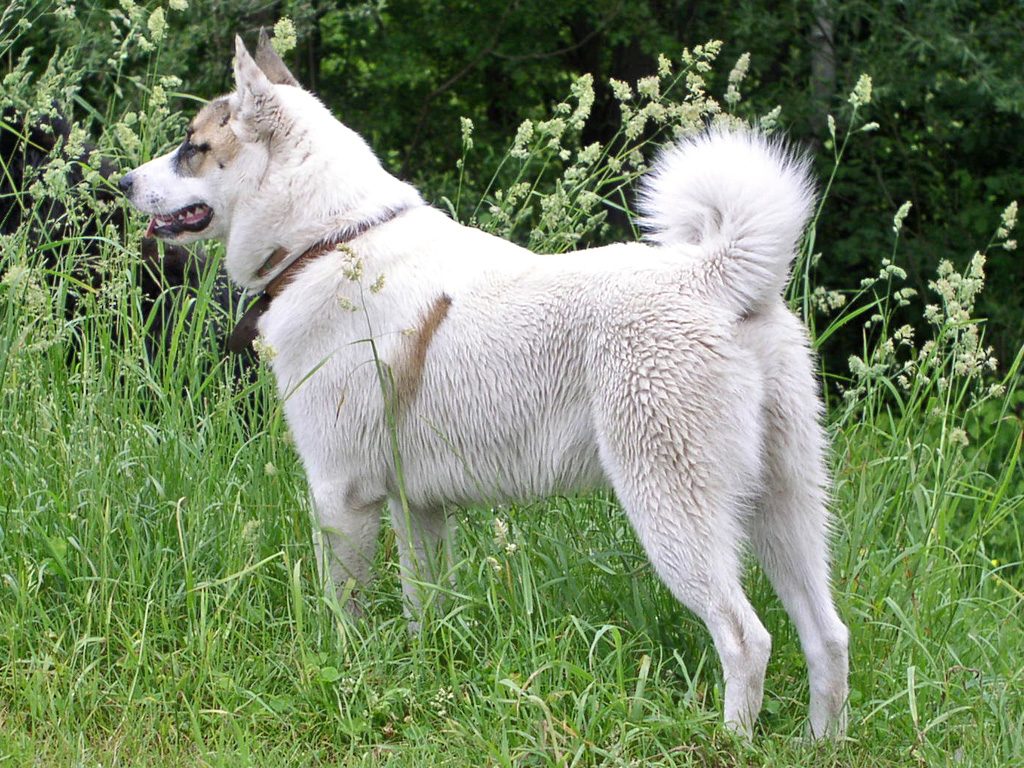
The head is a wedge, flat on top and broad between the ears, with a pointed muzzle and tight lips. The eyes are almond-shaped, deep set, slanted and brown. The ears are always pricked. The tail curls high over the back.
The double coat has harsh, straight guard hairs over a thick, soft undercoat. Longer hair on the neck and shoulders forms a ruff around the face, and the tail is heavily coated too. The usual colors are wolf gray, pale red and white. The gray runs from almost white to nearly black and may be mixed with red, and any color may come with white patches.
Temperament
The West Siberian Laika is affectionate and devoted to its owner, and protective of family and property. Most bark at strangers and stay aloof with them. Many are slow to accept a new owner. The breed is very territorial and may be aggressive toward strange dogs of the same sex. It learns to leave farm animals alone, and accepts the household cat, but treats stray cats as game.
It is an intelligent, expressive dog that watches its owner closely. Hunting comes before everything else. Treeing squirrels comes naturally, and dogs of this kind have been used in the United States, Canada and Japan to reduce conflicts between people and bears.
Care and health
This is a poor kennel dog. Left alone in a pen or small yard, it may bark for no clear reason, dig under or climb fences, or bite at the wire and damage its teeth. Laikas that are well exercised, hunted and kept in company with people and other animals are content and obedient. Between hunting seasons they need regular long walks to stay fit.
Facts on this page were checked against Wikipedia and may have changed since.