Norrbottenspets
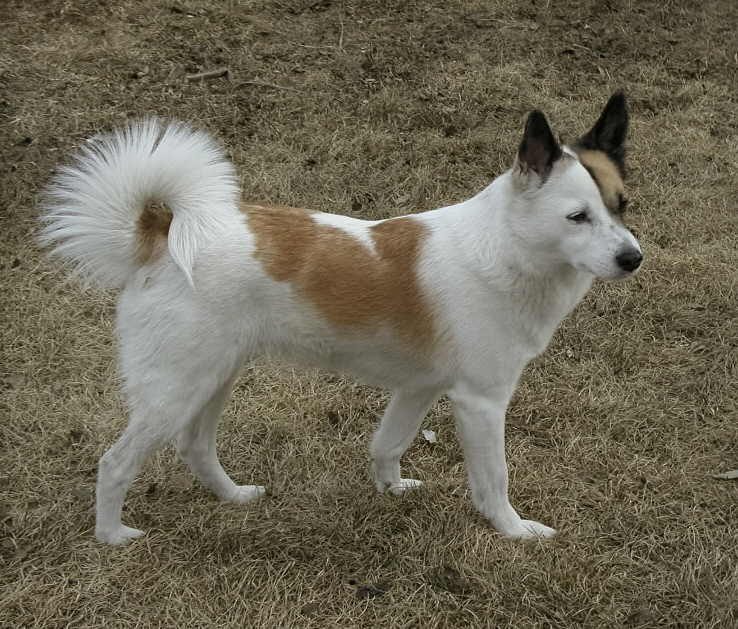

- Origin
- Sweden
- Type
- Spitz
- Size
- Medium
- Height
- 40–47 cm (16–19 in)
- Weight
- 11–15 kg (24–33 lb)
- Coat
- Short, hard, straight outer coat over a fine, dense undercoat
- Colors
- White with yellow or red patches
- Status
- Recognised by the FCI
The Norrbottenspets is a small to medium-sized spitz from Sweden, traditionally kept as a hunting dog and general farm dog in the north of the country. It is named after the region of Norrbotten in the northeast; spets is the Swedish spelling of spitz.
History
The breed’s origins are unknown, though both Arctic and German spitz blood are thought likely to be in its ancestry. It is the Swedish counterpart of the closely related Finnish Spitz and the Russian Karelo-Finnish Laika. These dogs became separate breeds only when kennel clubs on each side of the national borders recognized their own.
The Norrbottenspets was almost lost in the 20th century. In 1948 the Swedish Kennel Club declared it extinct, and it was not until the 1960s that enough dogs were found for the breed to be declared alive again. It has never had the international attention of the Finnish Spitz and is seldom seen outside Scandinavia, but with renewed interest in national breeds it is now fairly popular in Sweden.
Appearance
This is a compact, robust dog with typical spitz features, slightly smaller than the Finnish Spitz. Under the standard, males stand 43 to 47 cm and females 40 to 44 cm; weight is usually 11 to 15 kg. The head is wedge-shaped with erect ears. The body is strong, as long as it is tall, with a deep chest, and the long tail is carried high and curled over the back.
A thick double coat protects the dog in Arctic winters: the outer coat is hard, short and straight, and the undercoat fine and dense. The standard asks for white with yellow or red patches, though other colors are seen.
Temperament
The Norrbottenspets is described as highly intelligent, energetic and curious. It is generally even-tempered but is said to have little patience with children who bother it.
Most are now kept as pets. As a hunting dog it is tireless and determined, with a keen nose, and is used on gamebirds, deer including elk, and occasionally bear. Many have been trained for search and rescue.
Care and health
The breed needs a great deal of exercise and can become destructive without it. A Swedish study of more than 200,000 insured dogs in 1995 and 1996 found that the Norrbottenspets had the lowest rate of illness of all dogs, purebred or mixed.
Facts on this page were checked against Wikipedia and may have changed since.