Norwegian Buhund
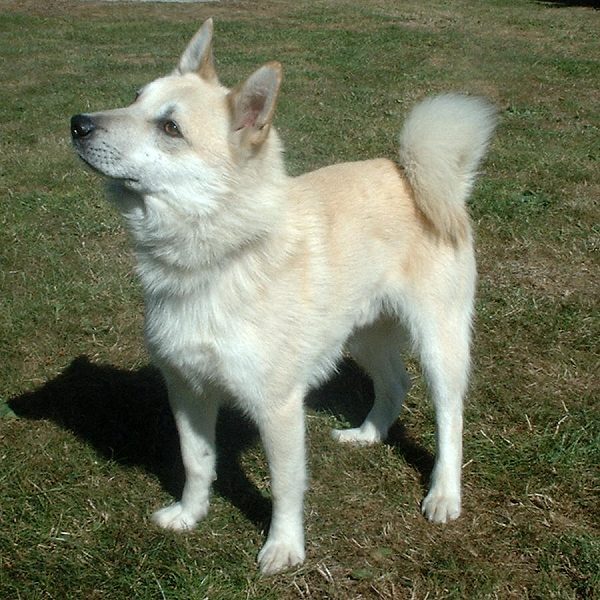

- Origin
- Norway
- Type
- Spitz
- Size
- Medium
- Height
- 43–46 cm (17–18 in)
- Weight
- 12–18 kg (26–40 lb)
- Coat
- Short to medium length
- Colors
- Wheaten, from pale cream to bright orange, or black
- Status
- Recognised by the FCI and The Kennel Club
The Norwegian Buhund is a spitz-type dog from Norway, used as a watchdog and as an all-purpose farm and herding dog. It is closely related to the Icelandic Sheepdog and the Jämthund.
History
The Buhund belongs to the large family of spitz dogs, which guarded farms and herded cattle and sheep. Its name joins the Norwegian words bu, meaning a homestead or the mountain hut where a shepherd lived with his animals in summer (it can also mean livestock), and hund, dog. The modern Buhund was bred on the rainy western coast of Norway.
Appearance
The Buhund is a little under medium size and square in outline, with a level back and a deep chest. The head is wedge-shaped, with pricked ears and a black nose. The tail is set high and curls tightly over the middle of the back. Males stand 43 to 46 cm (17 to 18.5 in) and weigh 14 to 18 kg (31 to 40 lb); females stand up to 44 cm (17.5 in) and weigh 12 to 16 kg (26 to 35 lb).
There are two main colors. Wheaten covers any shade from pale cream to bright orange, with or without dark-tipped hairs, and a black mask is acceptable. Black dogs should show little bronzing. In both, white should be kept to a minimum: a narrow ring around the neck, a narrow blaze, a small chest patch, white feet and a white tail tip are allowed. Gray dogs colored like the Norwegian Elkhound sometimes appear, and the Kennel Club standard in the United Kingdom also lists wolf sable.
Temperament
This is a cheerful, busy dog that does not tire easily. Buhunds are affectionate, fond of children, and bond closely with their owners, which makes them natural watchdogs. They can be aloof or wary with strangers and may bark at every new sound or movement. They are brave and communicative but rarely snap or bite unless provoked.
They are highly intelligent, headstrong and keen to learn. A Buhund that is ignored, bored or kept still too often turns restless and destructive, so the breed suits owners who have time for daily exercise and training. Its energy and eagerness make it a very good agility dog and a willing partner for running, hiking or cycling.
Care and health
The coat does not tangle or mat. Weekly brushing is enough for most of the year, with extra brushing when the dog sheds heavily, twice a year. The breed is prone to inherited eye problems and hip dysplasia.
Facts on this page were checked against Wikipedia and may have changed since.