Bolonka

- Origin
- Russia
- Type
- Toy and companion
- Size
- Toy
- Height
- 18–27 cm (7–11 in)
- Weight
- 2–5 kg (4–11 lb)
- Coat
- Long, soft, wavy to curly
- Colors
- Black, brown, gray, red or wolf-gray; the Franzuskaya variety is white
- Status
- Recognised by the AKC and the Nordic Kennel Union; not recognised by the FCI
The Bolonka, in full the Russian Tsvetnaya Bolonka or “Russian colored lapdog”, is a rare toy dog of the Bichon type. It was developed in Moscow and Saint Petersburg as a small companion suited to apartment life. Germany knows it as the Bolonka Zwetna. There is also a white variety, the Franzuskaya (“French”) Bolonka. The plural is Bolonki.
History
Small Bichon-like dogs reached Russia through its ties with France. Louis XIV is said to have sent lapdogs as gifts to the Russian nobility in the early 18th century, and more arrived with Napoleon’s army; they were called French Bolonki. Little white dogs of this kind were favorites of fashionable ladies in both countries.
Russia had little tradition of toy breeds. Its climate and economy called for working dogs, and small dogs were thought unnecessary, all the more so under the Soviet regime. Since dogs could not be imported, enthusiasts in Moscow and Leningrad bred from what they had, drawing on the ancestors of the Bichon Frise, Toy Poodle, Shih Tzu, Pekingese and Bolognese. The colored dogs have carried the name Russian Tsvetnaya Bolonka since 1966, and interest in them revived after the fall of the Iron Curtain.
The white dogs began to be treated as a native Russian breed in the 1950s. In 1978 a breeding pair was sent from the Soviet Union to East Germany as a diplomatic gift, and from these and a few others the Franzuskaya Bolonka was developed in Germany in the 1980s. The German kennel club recognised it as a variation of the Bolognese.
The Nordic Kennel Union accepted the Russian Tsvetnaya Bolonka in January 2013, which opened shows in Denmark, Norway, Sweden and Finland to the breed. The American Kennel Club added it to its Foundation Stock Service in 2015, assigned it to the Toy Group, and gave it full recognition in 2026. The FCI does not recognise it.
Appearance
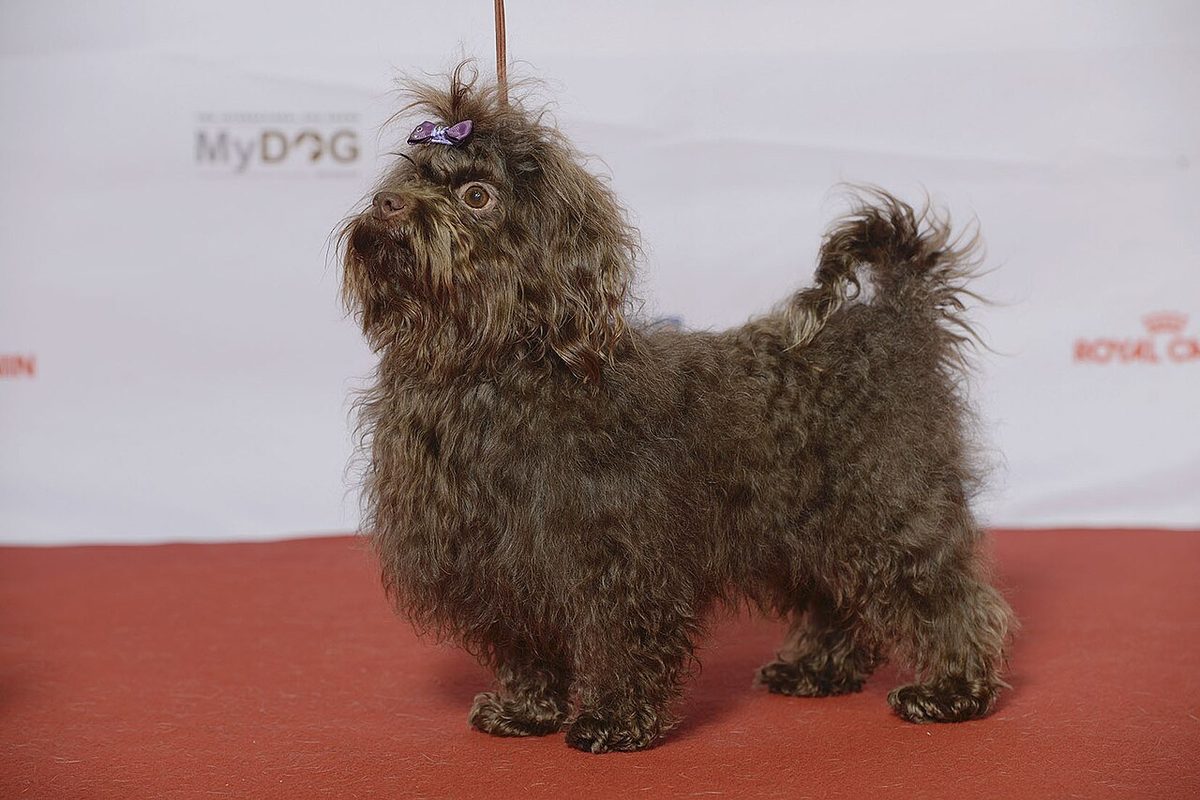
Bolonki stand 18 to 27 cm (7 to 11 in) at the withers and weigh 2 to 5 kg (4 to 11 lb), males being the larger. The body is square in outline and moderately boned, never fine. The long coat is soft and falls in big waves or curls. Colored dogs are black, brown, gray, red or wolf-gray. Males have a distinct beard and moustache, and the tail is carried so that its tip touches the back.
Temperament
The Bolonka was bred purely as a companion and is described as even-tempered, intelligent, sociable and affectionate, never shy or aggressive. It tends to treat strangers as possible playmates, so early socialization helps it learn to greet people politely. It does not enjoy rough games. It will defend its home and its people enough to make a fair watchdog, but it is not a guard dog.
Care and health
Like other Bichon types, the Bolonka does not shed, and it is considered suitable for people with allergies, though how well a given person tolerates a given dog varies. Daily brushing keeps the coat from matting; severe matting can lead to a hematoma. The coat also needs regular trimming and bathing.
Facts on this page were checked against Wikipedia and may have changed since.