Black Russian Terrier
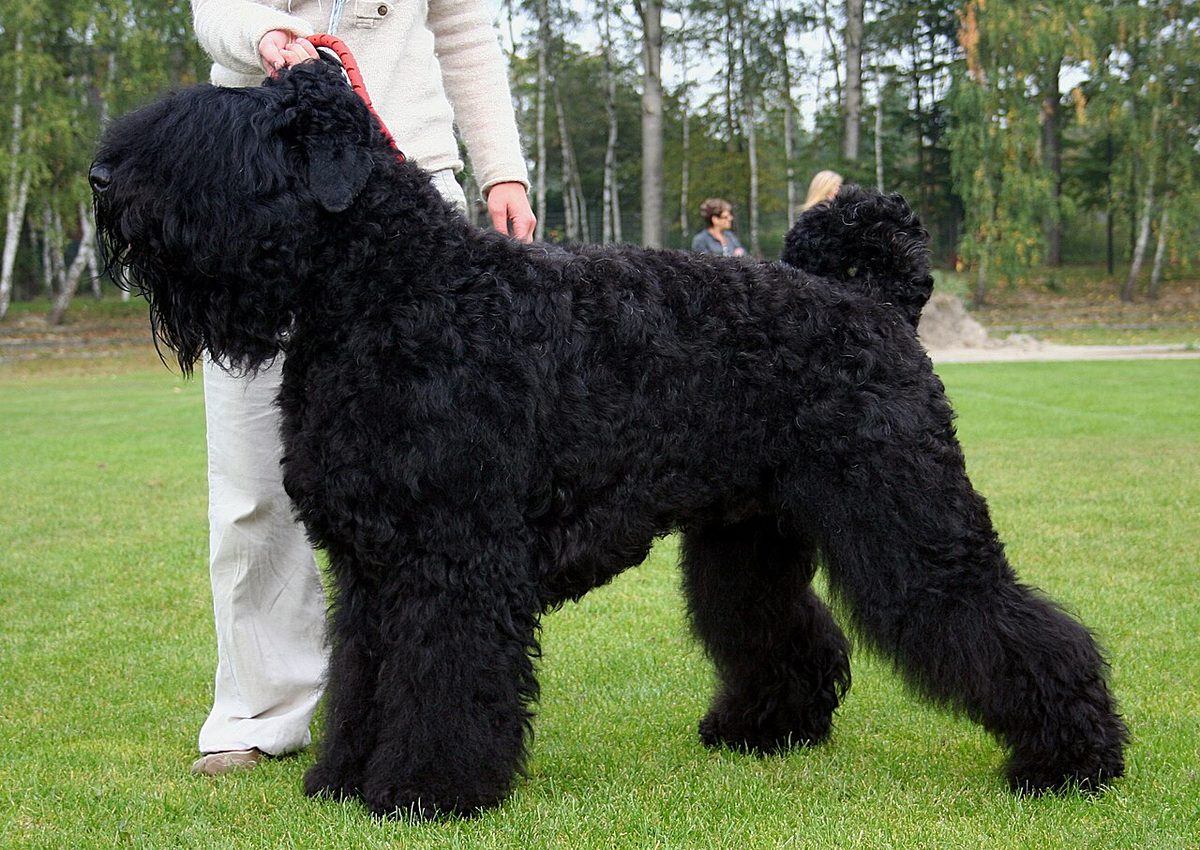

- Origin
- Russia
- Type
- Working
- Size
- Giant
- Height
- 68–76 cm (27–30 in)
- Weight
- 45–60 kg (99–130 lb)
- Coat
- Hard, dense double coat, slightly waved
- Colors
- Black, sometimes with scattered gray hairs
- Life span
- About 11 years
- Status
- Recognised by the FCI, AKC and The Kennel Club
The Black Russian Terrier is a large working dog developed in the Soviet Union for military use. Despite the name it is not a true terrier. Around seventeen breeds are believed to have gone into it, among them the Giant Schnauzer, Airedale Terrier, Rottweiler, Newfoundland, Caucasian Shepherd Dog and South Russian Shepherd Dog. Today it works as a guard and service dog, competes in dog sports and is kept as a companion.
History
The breed was created at the state-owned Red Star (Krasnaya Zvezda) Kennel in Moscow in the late 1940s and early 1950s. Much of the breeding stock came from countries where the Red Army had been active during the Second World War, East Germany in particular. Dogs were chosen for working ability, not looks, and the early ones resembled the modern breed only in build and coat type.
The first working dogs were shown at an exhibition in Moscow in 1955. Until 1957 only Red Star bred them; that year some puppies were sold to civilian breeders, who began to breed for appearance while keeping working ability. The first standard was published in 1958. The breed spread through the Soviet Union, then to Finland, the rest of Europe, and on to the United States, Canada and Australia. The FCI recognized it in the 1980s, and a second Russian standard followed in 1996, the year the breed arrived in the United Kingdom. The AKC recognized it in July 2004.
Appearance
Under the FCI standard males stand 72 to 76 cm at the withers and females 68 to 72 cm; males weigh 50 to 60 kg and females 45 to 50 kg. The body is slightly longer than tall. The double coat has a coarse outer layer over a softer undercoat. It is hard and dense, never soft or silky, and is trimmed to between 5 and 15 cm. It forms a beard and eyebrows on the face and a slight mane around the neck and withers, more marked in males. The color is black, or black with a few scattered gray hairs.
Temperament
Bred to work, the Black Russian Terrier needs a job to be content. It responds well to firm, consistent training started early and does well in obedience, agility and Schutzhund. It tends to bond closely with one person and does not do well when left in boarding kennels. Adults are much calmer than young dogs and are happiest lying near their owner.
Care and health
The coat sheds little but needs grooming several times a week. Puppies grow very fast, about a kilogram a week, and should not be pushed to exercise.
A 2024 British study found a life expectancy of 10.9 years. Hereditary conditions of major concern are hip dysplasia, elbow dysplasia, hyperuricosuria, and juvenile laryngeal paralysis and polyneuropathy. Lesser concerns include hypertrophic osteodystrophy and panosteitis in fast-growing puppies, heart disease such as aortic stenosis, eye problems such as entropion and ectropion, allergies, hot spots, and fungal infections of the ears and beard.
Facts on this page were checked against Wikipedia and may have changed since.