Samoyed
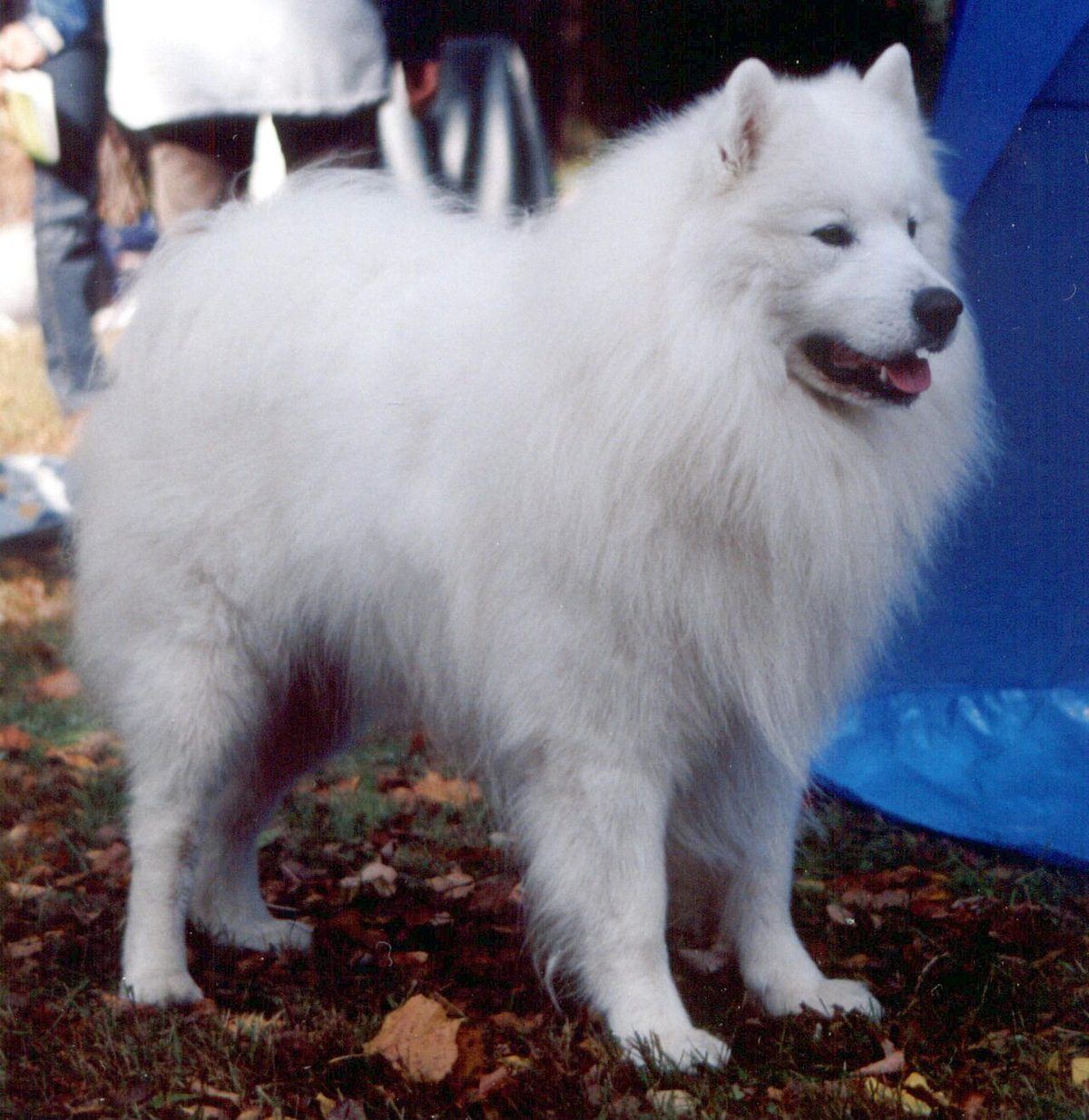

- Origin
- Russia
- Type
- Spitz
- Size
- Medium
- Height
- 46–60 cm (18–23.5 in)
- Weight
- 16–30 kg (35–66 lb)
- Coat
- Dense double coat with long, straight guard hairs
- Colors
- White, cream, or white and biscuit
- Life span
- 12–13 years
- Status
- Recognised by the FCI, AKC and The Kennel Club
The Samoyed is a spitz-type dog with a thick, white double coat, named after the Samoyedic peoples of Arctic Russia. It herded reindeer, hunted, guarded and pulled sleds, and later went with explorers to both polar regions.
History
The Samoyed descends from the Nenets Herding Laika, a reindeer-herding spitz used across the Arctic, especially by the Nenets, who were once called Samoyeds. DNA evidence shows it is a basal breed, older than the modern breeds created in the nineteenth century. Dogs collected from the Nenets on the Yamal Peninsula about a century ago proved to be related both to specimens 850 and 2,000 years old from the same region and to today’s Samoyed, so the ancient Arctic lineage lives on in the breed.
The British zoologist Ernest Kilburn-Scott is widely regarded as the breed’s founder. In 1889 he came back to England with a puppy bought at a Samoyed camp near Arkhangelsk. Early imports were of many colors, but the true Siberian dogs were believed to be mostly white. The first official standard was drawn up in England in 1909.
Polar expeditions made heavy use of these dogs. Thirty-three were bought from the Nenets for Nansen’s Fram expedition of 1893–1896; he noted that they were strong, tough sled pullers and good at hunting polar bears. Carsten Borchgrevink took 90 on the Southern Cross Expedition of 1898–1900, the first dogs used in Antarctic exploration, and Ernest Shackleton later bought nine of the survivors. Robert Falcon Scott took twenty on his 1902 journey.
Appearance
The American Kennel Club standard asks for males of 53 to 60 cm and 20 to 29 kg and females of 48 to 53 cm and 16 to 23 kg. The Kennel Club in Britain gives 51 to 56 cm for males and 46 to 51 cm for females.
The outer coat has long, coarse, straight guard hairs that look white with a hint of silver and keep the soft, dense undercoat fairly clean. Most Samoyeds are white, often with a light brown “biscuit” tint, usually on the ears. Males carry a larger ruff. The ears are thick, furry, triangular and upright. The tail lies curled over the back and to one side, touching the back, and drops when the dog is relaxed.
Temperament
Samoyeds are friendly and good-natured, and aggression is rare, so they make poor guard dogs. They do bark, which makes them alert watchdogs. Their happy expression is known as the “Sammie smile”. They are good companions for children and other dogs and stay playful into old age. A bored Samoyed may dig or become destructive.
Care and health
The undercoat sheds heavily once or twice a year, and fine hairs come away all year round, so frequent grooming is needed. The breed is sometimes called hypoallergenic, but it sheds a fair amount.
A 2024 British study found a life expectancy of 13.1 years. Samoyed hereditary glomerulopathy is an inherited kidney disease that is most severe in males, who usually die at 8 to 15 months; a genetic test exists. Other conditions described in the breed are diabetes mellitus, progressive retinal atrophy, short-limbed dwarfism with eye defects, pulmonary stenosis, hip dysplasia and sebaceous adenitis.
Facts on this page were checked against Wikipedia and may have changed since.